
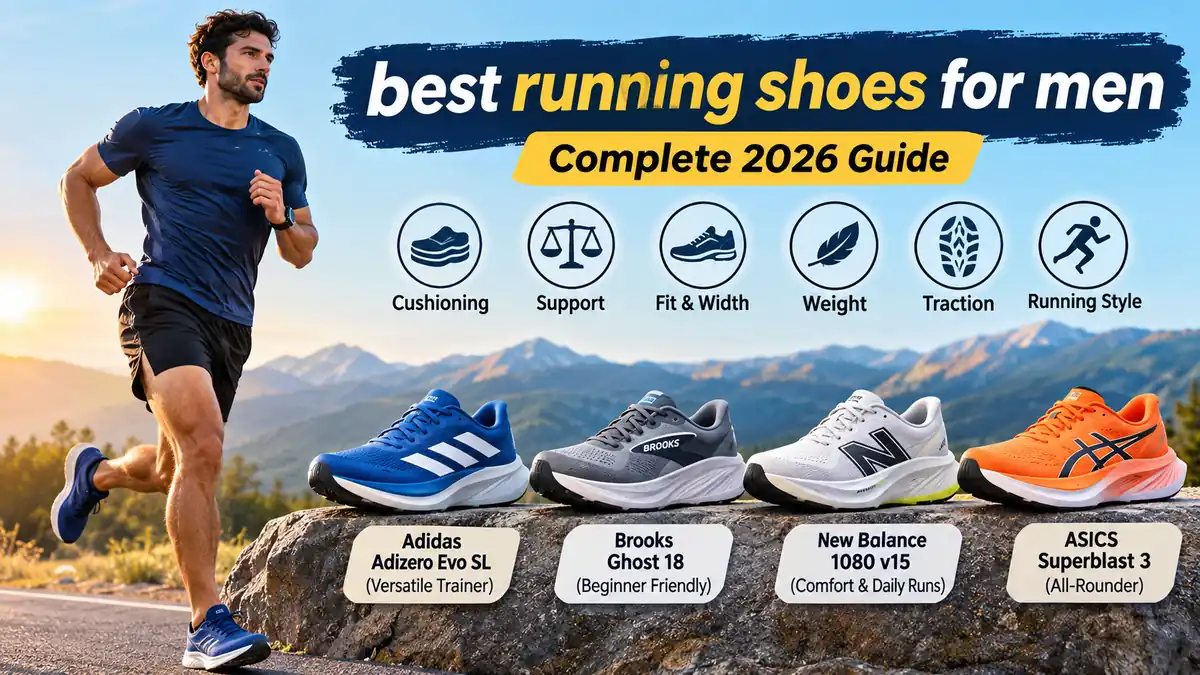
A great running shoe should make your miles feel comfortable, controlled, and enjoyable. Yet with hundreds of models offering different cushioning systems, stability features, and performance technologies, finding the right pair can be surprisingly difficult.
The best running shoes for men depend on foot shape, running distance, training pace, terrain, and personal comfort. A well-fitting daily trainer is often the most practical choice, while stability shoes, lightweight tempo trainers, and specialized racing shoes serve different needs. No single model works perfectly for every runner.
Recent 2026 reviews from Runner’s World, RunRepeat, and RTINGS highlight models such as the Adidas Adizero Evo SL, Brooks Ghost 18, New Balance 1080 v15, and ASICS Superblast 3. Their different recommendations reinforce a simple principle: the best shoe is the one that fits your feet and supports the running you actually do. Runner’s World+2
What Are the best running shoes for men in 2026?
The strongest running shoes combine secure fit, appropriate cushioning, predictable ground contact, and durability. However, different designs excel at different activities.
A beginner running three times a week may prefer a comfortable, forgiving trainer. Someone preparing for a marathon might prioritize cushioning that remains comfortable over long distances. A runner chasing faster 5K times may prefer a lighter, more responsive shoe.
Best running shoes by category
The following comparison brings together models recognized in recent independent running-shoe reviews.
| Category | Running shoe | Main strength |
|---|---|---|
| Versatile training | Adidas Adizero Evo SL | Lightweight, responsive ride |
| Beginner running | Brooks Ghost 18 | Predictable everyday comfort |
| Daily training | New Balance 1080 v15 | Soft cushioning |
| Premium all-rounder | ASICS Superblast 3 | Versatility across training paces |
| Stability | ASICS Gel-Kayano 33 | Supportive platform |
| Tempo running | Saucony Endorphin Speed 5 | Faster training sessions |
| Marathon racing | Adidas Adizero Adios Pro 4 | Race-focused performance |
| Trail running | Altra Experience Wild 3 | Off-road traction |
| Wide feet | HOKA Clifton 11 | Roomier fit options |
| Run-walk workouts | On Cloudmonster 3 | Cushioned rolling ride |
These are category-based recommendations drawn from published testing, not a claim that every model was personally tested for this article. Fit and individual preference can change the ranking substantially. Running Shoe Reviews+2
Best Running Shoes for Different Training Needs
1. Adidas Adizero Evo SL — Best versatile lightweight trainer
The Adidas Adizero Evo SL has become a prominent choice for runners who want a responsive shoe without restricting it to race day.
Its energetic underfoot feel makes it useful for steady training, faster efforts, and some longer runs.
Key advantages:
- Lightweight construction
- Responsive cushioning
- Suitable for several training paces
- More versatile than a highly specialized racing shoe
Potential limitations: Runners who prefer a firmer, more planted platform may find a traditional daily trainer more reassuring.
Runner’s World and RunRepeat both selected the Evo SL as an overall standout in their 2026 evaluations. Runner’s World+1
2. Brooks Ghost 18 — Best for beginners
The Brooks Ghost 18 is designed around reliable daily running rather than aggressive speed.
For beginners, consistency and comfort are generally more valuable than advanced racing technology. A shoe that feels stable and predictable can make regular training easier to maintain.
The Ghost 18 is particularly relevant for runners who prefer a conventional training experience.
Key advantages:
- Comfortable for everyday road running
- Predictable cushioning
- Available in multiple widths
- Practical for short and moderate distances
Potential limitations: Its less aggressive ride may feel comparatively ordinary during fast workouts.
Runner’s World identifies it as a beginner-friendly option, while RTINGS describes it as a relatively stable alternative to softer shoes. Running Shoe Reviews+1
3. New Balance 1080 v15 — Best for comfortable daily mileage
The New Balance 1080 v15 emphasizes cushioning and comfort for runners accumulating regular mileage.
A comfortable daily trainer should handle easy runs, recovery sessions, and moderate-distance workouts without requiring the runner to adjust their natural stride.
This model is especially relevant for people who enjoy a softer underfoot sensation.
Key advantages:
- Plush cushioning
- Comfortable for easy-paced running
- Suitable for regular training
- A useful option to try for wider feet
Potential limitations: Runners who prefer direct ground feedback may find a softer shoe less engaging.
RunRepeat selected the 1080 v15 as its leading daily trainer, and OutdoorGearLab recognized its plush cushioning. RunRepeat+1
4. ASICS Superblast 3 — Best premium all-rounder
The ASICS Superblast 3 is a versatile premium trainer designed to accommodate a range of running speeds.
Its appeal lies in combining substantial cushioning with an energetic feel, potentially reducing the need for separate shoes for every training session.
It is particularly interesting for experienced runners who alternate between easy mileage, longer runs, and faster workouts.
Key advantages:
- Versatile performance
- Protective cushioning
- Suitable for varied training sessions
- Responsive ride
Potential limitations: Premium pricing and a substantial platform may not suit every runner.
RTINGS named it its top men’s running-shoe pick in its October 2026 update, while RunRepeat also rated it highly among neutral daily trainers. RTINGS.com+1
5. ASICS Gel-Kayano 33 — Best stability running shoe
The ASICS Gel-Kayano 33 is a supportive running shoe for people who prefer additional guidance underfoot.
Stability footwear typically uses platform geometry, supportive sidewalls, or other design features to influence how the foot moves through a stride.
The Gel-Kayano series has long focused on cushioned stability for regular road training.
Key advantages:
- Support-oriented construction
- Cushioned ride
- Suitable for easy and longer runs
- Useful for runners who prefer more structured support
Potential limitations: Additional support can feel unnecessary or restrictive to some neutral runners.
RunRepeat includes the Gel-Kayano 33 among its leading stability choices for men. RunRepeat+1
Importantly, overpronation alone does not mean a runner needs corrective footwear. Comfort, movement, and individual symptoms matter more than a single gait label.
6. Saucony Endorphin Speed 5 — Best for tempo runs
The Saucony Endorphin Speed 5 targets runners who want to practice faster running without relying exclusively on race-day footwear.
Tempo sessions, intervals, and progression runs can benefit from shoes that feel responsive and transition smoothly through each step.
Key advantages:
- Responsive underfoot feel
- Designed for faster workouts
- Useful for tempo training
- Can complement a traditional daily trainer
Potential limitations: A speed-oriented shoe may feel less relaxed than a conventional trainer during slow recovery runs.
RunRepeat identifies the Endorphin Speed 5 as a leading tempo-running option. RunRepeat
7. Adidas Adizero Adios Pro 4 — Best for marathon racing
The Adidas Adizero Adios Pro 4 belongs to the specialized racing category.
Modern marathon racing shoes often combine high-rebound foams, aggressive rocker geometry, and stiffening elements to improve running economy for some athletes.
They are designed for sustained faster efforts rather than everyday versatility.
Key advantages:
- Race-oriented construction
- Responsive cushioning
- Designed for competitive distance running
- Suited to runners seeking performance at faster paces
Potential limitations: Racing shoes can be expensive, less versatile, and less durable than conventional training footwear.
Runner’s World selected this model for marathon racing in its men’s 2026 guide. Running Shoe Reviews
8. Altra Experience Wild 3 — Best for trail running
The Altra Experience Wild 3 is designed for off-road running, where grip and stability on uneven surfaces matter.
Unlike road shoes, trail footwear generally incorporates more aggressive outsole patterns and construction features suited to dirt, gravel, and irregular terrain.
Key advantages:
- Trail-focused traction
- Suitable for varied off-road surfaces
- Designed for uneven terrain
- More appropriate than smooth road shoes on loose ground
Potential limitations: Trail outsoles can feel less smooth on pavement, and traction varies with mud, wet rock, and surface conditions.
Runner’s World included the Experience Wild 3 as its trail-running recommendation for men. Running Shoe Reviews
How to Choose the best running shoes for men
Understanding the different features of running shoes is more useful than simply choosing a popular model.
A shoe that works brilliantly for one runner may cause discomfort for another because of differences in foot width, training habits, and preferred cushioning.
1. Choose the right cushioning level
Cushioning describes how the midsole compresses and responds when your foot contacts the ground.
Modern running shoes use specialized foams, including EVA-based materials, TPU-based compounds, and PEBA-based performance foams.
The amount and character of cushioning affect how a shoe feels.
| Cushioning type | Characteristics | Common use |
|---|---|---|
| Firm | Stable, direct ground feel | Traditional training |
| Moderate | Balanced comfort and response | Everyday running |
| Soft | Plush underfoot sensation | Easy and recovery runs |
| Maximum | Thick cushioning platform | Long-distance comfort |
| Responsive | Noticeable rebound | Tempo and faster running |
More cushioning does not automatically mean better protection against injuries. Scientific evidence has not established that softer midsoles consistently reduce running injuries. Cochrane
The right cushioning level is one that feels comfortable and stable at your normal running pace.
2. Understand neutral versus stability shoes
Running shoes are often divided into neutral and stability categories.
Neutral running shoes generally allow the foot to move without pronounced corrective guidance. Examples include the Adidas Adizero Evo SL, ASICS Novablast 6, and New Balance 1080 v15.
Stability running shoes incorporate features intended to provide additional guidance. Examples include the ASICS Gel-Kayano 33, Saucony Guide 19, Brooks Adrenaline GTS 25, and Nike Structure 26.
Pronation is the natural inward rolling movement of the foot during running. It helps the lower limb adapt to ground contact.
Although excessive inward motion is sometimes called overpronation, observing pronation does not automatically establish a need for stability shoes.
The American College of Sports Medicine advises against selecting footwear solely from arch height or pronation observations. ACSM
A stability shoe can still be an excellent choice if its support feels comfortable and natural.
3. Consider heel-to-toe drop
Heel-to-toe drop is the height difference between the shoe’s heel and forefoot.
For example, if a shoe has a heel stack height of 36 mm and a forefoot stack height of 28 mm, its drop is 8 mm.
Common categories include:
- Zero drop: Heel and forefoot sit at approximately equal heights.
- Low drop (1–4 mm): Smaller height difference.
- Moderate drop (5–8 mm): Middle-ground geometry.
- Higher drop (9–12 mm): More pronounced heel elevation.
Drop can affect how loading is distributed across the ankle, calf, Achilles tendon, and knee.
However, there is no universally ideal drop for men. A sudden switch from a higher-drop shoe to a zero-drop model may increase calf and Achilles loading, especially when training volume remains unchanged.
Gradual adaptation is sensible when changing footwear geometry significantly.
4. Check shoe weight
Shoe weight influences how much mass a runner moves with every stride.
Lightweight running shoes can feel quicker and easier to accelerate in, especially during faster training.
However, minimizing weight can involve compromises in outsole coverage, cushioning, structure, or durability.
A heavier shoe may feel more protective and stable during relaxed mileage.
For most recreational runners, fit and comfort deserve greater priority than saving a few grams.
5. Evaluate outsole traction
The outsole is the bottom layer that contacts the running surface.
Road running shoes generally use rubber compounds and relatively smooth tread patterns suited to pavement.
Trail running shoes use more pronounced lugs for traction on loose or uneven surfaces.
Wet pavement, smooth stone, gravel, mud, and technical trails create different traction requirements.
A trail shoe with deep lugs is not automatically superior on every surface. Some aggressive tread patterns are uncomfortable or less efficient on roads.
Choose the outsole according to where you run most frequently.
Best Running Shoes for Men by Foot Type
Foot shape is one of the most important factors in running-shoe comfort.
Men’s running shoes are commonly built around a standard width, but individual feet vary considerably.
Running shoes for wide feet
Runners with wide feet often experience pressure around the forefoot or little toe when wearing narrow shoes.
Possible signs of insufficient width include numbness, rubbing, blisters, and visible stretching of the upper material.
Models worth comparing include the HOKA Clifton 11, Brooks Ghost 18 in wide sizing, and New Balance 1080 v15.
Runner’s World specifically highlights the Clifton 11 for wider feet, while other testing publications recognize the width options of Brooks and New Balance models. Running Shoe Reviews+1
A wider shoe should provide more forefoot space without allowing the heel to move excessively.
Running shoes for flat feet
Flat feet describe feet with relatively low arches.
Having flat feet does not automatically mean a person requires motion-control shoes or orthopedic insoles.
Some runners with low arches are comfortable in neutral footwear, while others prefer a more supportive platform.
The Saucony Guide 19, ASICS Gel-Kayano 33, and Brooks Adrenaline GTS 25 are examples of stability models that may be worth trying.
The deciding factor should be comfort and functional fit rather than arch shape alone.
Running shoes for high arches
High arches can be associated with different pressure patterns under the foot, but arch height by itself does not reliably determine the ideal shoe category.
Some runners with high arches prefer flexible, cushioned neutral trainers.
Models such as the ASICS Gel-Nimbus 28, New Balance 1080 v15, and Nike Vomero Plus offer different cushioned experiences.
A comfortable shoe should distribute pressure without creating uncomfortable contact around the arch.
Running shoes for heavier men
Body weight can influence cushioning compression, wear, and preferred stability.
However, heavier runners do not universally require the thickest or firmest running shoes.
A wide platform, comfortable midsole, and secure upper may be more useful than maximum stack height alone.
Models such as the HOKA Bondi 9, Nike Vomero Plus, and New Balance 1080 v15 provide different cushioning options.
RTINGS identifies the Bondi 9 and Vomero Plus as relevant alternatives for heavier runners, while noting differences in stability and responsiveness. RTINGS.com
The most useful test is whether the shoe maintains a comfortable and controlled feel throughout a normal run.
Best Running Shoes for Different Distances
Running distance affects how footwear characteristics become noticeable.
A shoe that feels exciting during a short interval session may become uncomfortable during a two-hour long run.
Best running shoes for 5K
A 5K is short enough that lightweight construction and responsiveness can be appealing, particularly for runners seeking faster times.
For beginners, however, a standard daily trainer is usually sufficient.
Suitable categories include:
- Comfortable daily trainers for first-time 5K runners
- Lightweight trainers for regular speed sessions
- Racing shoes for experienced competitors
The Adidas Adizero Evo SL and Saucony Endorphin Speed 5 are examples of versatile shoes suitable for faster training.
Best running shoes for 10K
The 10K combines endurance with the ability to sustain a moderately challenging pace.
A balanced trainer can be effective for both training and recreational racing.
The ASICS Superblast 3, Adidas Adizero Evo SL, and Saucony Endorphin Speed 5 illustrate different approaches to responsive running footwear.
For runners who prioritize comfort rather than speed, a conventional daily trainer remains appropriate.
Best running shoes for half marathons
Half-marathon training typically involves regular easy mileage, longer weekend runs, and occasional faster sessions.
Comfort over distance becomes increasingly important.
A well-cushioned trainer such as the New Balance 1080 v15 may suit everyday preparation, while a more responsive shoe may be preferred for race day.
The right combination depends on pace, experience, and training frequency.
Best running shoes for marathons
Marathon running places sustained demands on the feet and lower limbs.
Foot swelling, pressure points, and changes in running form can become more noticeable after several hours.
For training, runners often favor cushioned daily trainers or versatile premium models.
For racing, some experienced runners prefer carbon-plated or similarly stiffened performance footwear, such as the Adidas Adizero Adios Pro 4 or Nike Vaporfly 4.
A marathon shoe should be tested during long training runs rather than introduced for the first time on race day.
Carbon-plated shoes can improve running economy for some runners, but they are not necessary to complete a marathon successfully.
How to Find the Correct Running Shoe Size
Even an excellent running shoe becomes a poor choice when the fit is wrong.
Running shoes should feel secure around the heel and midfoot while allowing sufficient space for the toes.
Step-by-step fitting method
- Measure both feet. One foot may be slightly longer or wider than the other.
- Try shoes later in the day. Feet can become slightly larger after prolonged standing and activity.
- Wear your running socks. Sock thickness affects available space.
- Check the toe box. Aim for approximately a thumb’s width of room beyond the longest toe.
- Check heel security. Your heel should not repeatedly slip while running.
- Test movement. Walk, jog, and turn to identify rubbing or pressure.
- Compare widths. If the length feels right but the sides are tight, try a wider version rather than automatically sizing up.
Clinical fitting guidance from Nationwide Children’s Hospital emphasizes toe clearance, heel security, and limiting unwanted movement inside the shoe. Nationwide Children’s Hospital
Should running shoes be a size bigger?
Not necessarily.
Some runners wear a half-size larger than their everyday footwear, but sizing varies between brands and shoe models.
A shoe should not feel excessively loose simply to provide toe space.
Too much length can allow sliding, which may cause blisters and reduce stability on descents.
The correct fit balances toe clearance with secure midfoot and heel support.
What if one foot is bigger?
This is common.
Generally, the larger foot should determine the minimum required shoe size.
If the smaller foot feels loose, appropriate lacing techniques may help improve security.
When the size difference is substantial, professional fitting assistance may be useful.
Running Shoe Technologies Explained
Running-shoe manufacturers use different technologies to influence cushioning, responsiveness, and stability.
Understanding the underlying concepts makes product descriptions easier to evaluate.
EVA, TPU, and PEBA foam
EVA, or ethylene-vinyl acetate, is a widely used cushioning material.
Manufacturers can formulate EVA-based foams with different densities and properties, producing shoes that range from firm to soft.
TPU, or thermoplastic polyurethane, is another family of materials used in performance cushioning systems.
PEBA-based foams are associated with many lightweight, high-rebound performance shoes.
However, foam chemistry alone does not determine whether a shoe performs well. Geometry, formulation, weight, and overall construction also matter.
Carbon plates and nylon plates
Stiffening plates are used in certain running shoes to modify bending behavior and contribute to the shoe’s overall ride.
Carbon-fiber plates are especially common in premium racing footwear.
Nylon plates and other polymer structures are also used in performance-oriented trainers.
A plate does not work independently. Its effectiveness depends on how it interacts with the foam, rocker shape, and runner.
Rocker geometry
Rocker geometry describes a curved sole shape designed to encourage a rolling transition through the stride.
Some runners enjoy a pronounced rocker because it makes forward movement feel smooth.
Others prefer a flatter, more flexible forefoot.
The benefit is individual, and a more aggressive rocker is not automatically better.
Stack height
Stack height measures the amount of material between the foot and the ground at a specified point.
High-stack shoes often provide more space for cushioning foam, but they may also change stability and ground feel.
Low-stack shoes generally offer more direct feedback from the running surface.
Neither category is inherently superior for every runner.
How Long Do Men’s Running Shoes Last?
Most conventional running shoes are commonly assessed for replacement after approximately 300–500 miles (480–800 kilometers).
This is a practical guideline, not an exact expiration point.
REI, Brooks, and ASICS all describe similar mileage ranges while emphasizing that actual durability varies with running habits and shoe construction. REI Expert Advice+2
Estimated replacement frequency
| Weekly distance | Time to reach 300–500 miles |
|---|---|
| 10 miles | 30–50 weeks |
| 15 miles | 20–33 weeks |
| 20 miles | 15–25 weeks |
| 30 miles | 10–17 weeks |
| 40 miles | 8–13 weeks |
These estimates assume consistent weekly mileage and do not account for walking or casual use.
Signs your running shoes need replacing
Watch for changes in how your shoes look and feel.
Common indicators include:
- Outsole rubber worn smooth in important contact areas
- Midsole cushioning feeling noticeably flatter
- New pressure points or recurring blisters
- Torn upper material
- Heel structure losing its shape
- Unusual discomfort during familiar runs
A worn outsole does not always mean the cushioning has completely failed, and an intact outsole does not guarantee that the midsole still performs as intended.
Comparing an older pair with a newer pair of the same model can help reveal differences in cushioning and stability.
How to make running shoes last longer
Regular care can help preserve running shoes.
Remove mud and debris after dirty runs, allow wet shoes to air-dry, and avoid prolonged exposure to direct heat.
If washing is necessary, follow the manufacturer’s care instructions rather than assuming machine washing is safe.
Using a separate pair for everyday walking can also reduce unnecessary wear on dedicated running shoes.
Some runners rotate between two pairs for training. This provides a different underfoot feel and allows one pair to dry while the other is being used.
Common Mistakes When Choosing Running Shoes
Several mistakes can make running shoes less comfortable or less suitable for training.
Choosing shoes based only on appearance
Color and design are understandable preferences, but they do not reveal whether a shoe fits properly.
A visually appealing shoe that creates toe pressure or heel slipping is unlikely to be a good long-term running option.
Assuming expensive shoes are always better
Premium running shoes may contain advanced materials and sophisticated construction.
However, these features do not guarantee better comfort or running performance for every person.
A moderately priced daily trainer that fits well may be more useful than a premium racing shoe.
Buying shoes that are too narrow
Forefoot pressure is a common fitting problem.
Some runners compensate by selecting longer shoes when they actually need additional width.
Trying a wider version can improve comfort without creating excessive toe-box length.
Switching to minimalist shoes too quickly
Minimalist and barefoot-style running shoes generally provide less cushioning and structure than conventional trainers.
Transitioning abruptly can change the loading demands on the feet and lower legs.
A gradual transition, with attention to training volume and discomfort, is more sensible than immediately replacing all regular training footwear.
Assuming shoes can prevent every running injury
Running injuries involve multiple factors, including training progression, recovery, previous injuries, and individual physical capacity.
A 2022 Cochrane review found limited evidence that choosing one running-shoe category over another consistently reduces lower-limb injury risk. A 2026 medical review similarly emphasized the limited evidence connecting footwear features with clinically meaningful injury outcomes. Cochrane+1
Comfortable shoes are valuable, but they cannot replace sensible training and adequate recovery.
How to Build a Practical Running Shoe Rotation
Not every runner needs several pairs of shoes.
For someone running a few times a week, one versatile daily trainer may be enough.
More experienced runners sometimes use different shoes for different workouts.
One-shoe rotation
A versatile daily trainer is the simplest approach.
Models such as the Brooks Ghost 18, New Balance 1080 v15, or Adidas Adizero Evo SL can serve different runners as their primary training shoe.
The most appropriate option depends on whether comfort, stability, or responsiveness is the main priority.
Two-shoe rotation
A two-shoe rotation typically includes:
- Daily trainer: Used for easy runs, recovery sessions, and general mileage.
- Faster trainer: Used for intervals, tempo sessions, and selected races.
For example, a runner might use a comfortable neutral trainer for most weekly mileage and the Saucony Endorphin Speed 5 for faster workouts.
Three-shoe rotation
An experienced runner may use a daily trainer, a speed-focused trainer, and a dedicated racing shoe.
This approach can provide more specialized footwear for different training demands.
However, it is a preference rather than a requirement. Many runners train and race successfully using one comfortable pair.
Are Running Shoes Different From Walking Shoes?
Running and walking involve different movement patterns and loading demands.
Running includes a flight phase, during which neither foot contacts the ground. Walking generally involves continuous contact with the ground through alternating support phases.
Running shoes are designed around the repetitive impacts and transitions associated with running.
Walking shoes may emphasize stability, flexibility, and comfort at lower speeds.
Many running shoes work well for walking, particularly cushioned daily trainers.
However, specialized racing shoes may feel awkward or unnecessarily unstable during casual walking.
Someone who alternates between jogging and walking can often use one comfortable running shoe for both activities.
Are Trail Running Shoes Suitable for Roads?
Trail shoes can be used on roads, but their suitability depends on the outsole and overall construction.
Shoes with shallow, closely spaced lugs may transition reasonably well between pavement and compact dirt paths.
Aggressive trail shoes with deep lugs may feel less smooth on asphalt.
Road shoes can handle occasional dry, well-maintained trails, but they may lack traction on mud, loose gravel, and technical terrain.
For runners who regularly alternate between road and trail, a road-to-trail hybrid may provide a useful compromise.
The main priority is predictable traction on the surfaces encountered most often.
Final Thoughts on the best running shoes for men
Finding the best running shoes for men in 2026 begins with understanding how and where you run.
The Adidas Adizero Evo SL stands out for versatile, responsive training, while the Brooks Ghost 18 offers a more traditional daily-running experience. The New Balance 1080 v15 emphasizes comfort, the ASICS Gel-Kayano 33 provides structured stability, and the Saucony Endorphin Speed 5 targets faster workouts.
These models demonstrate how different running shoes address different needs rather than competing to be a universal winner.
Start by identifying your usual running distance, preferred cushioning, foot width, and primary terrain. Then compare a few suitable models and evaluate how they actually feel while running.
A comfortable fit, appropriate support, and a predictable ride matter more than brand popularity or the latest footwear technology.