
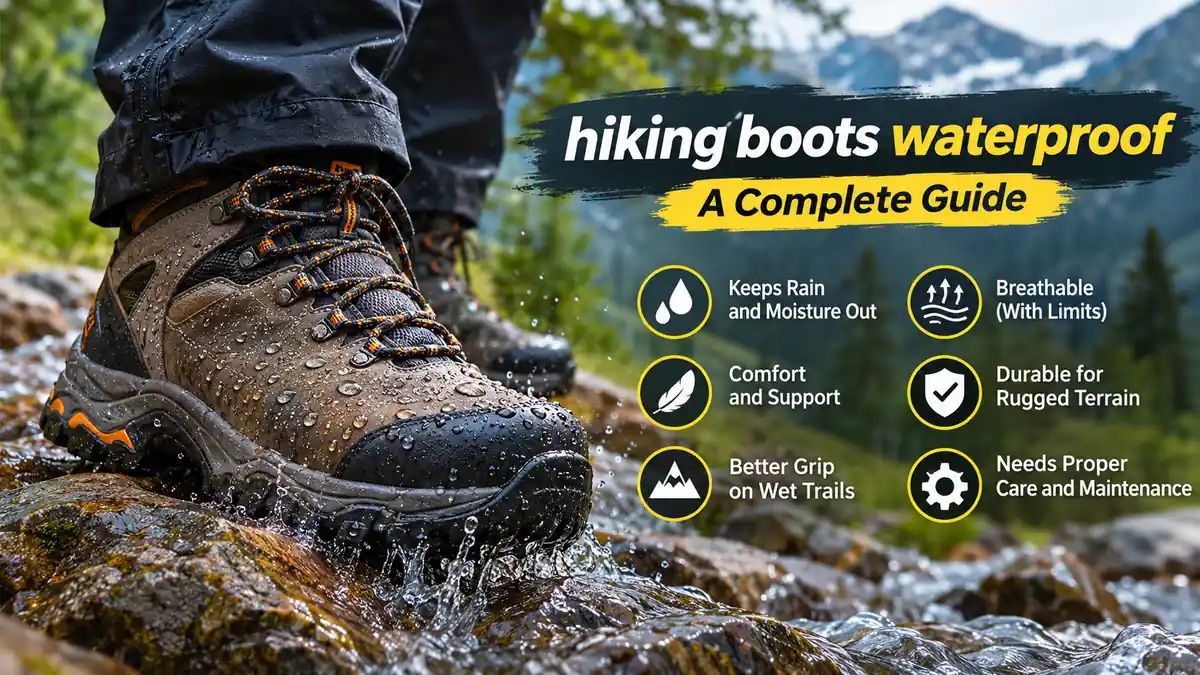
Wet socks can turn an enjoyable hike into hours of discomfort. Rain, muddy trails, shallow streams, and morning dew all challenge your footwear, but waterproof hiking boots are designed to reduce the amount of outside moisture reaching your feet.
Understanding hiking boots waterproof technology helps you choose suitable footwear, recognize its limitations, and maintain its protective performance. Not every waterproof boot works the same way, and the most weather-resistant design is not necessarily the most comfortable option for every trail.
Waterproof hiking boots use protective membranes, treated materials, and sealed construction to prevent external water from entering while allowing some perspiration vapor to escape. They are particularly useful in rain, mud, wet grass, and light snow. However, waterproofing cannot prevent water from entering over the boot opening, and these boots generally breathe less efficiently than non-waterproof alternatives.
How Does hiking boots waterproof Technology Work?
Waterproof hiking boots rely on several layers working together. Each component serves a different purpose, from stopping liquid water to protecting the materials against abrasion.
Waterproof and breathable membranes
A waterproof membrane is a thin protective barrier positioned inside the boot’s upper construction.
Its main functions are to:
- Block liquid water from entering through the upper.
- Allow some water vapor from perspiration to escape.
- Reduce wind penetration.
- Provide protection during prolonged exposure to damp conditions.
One widely recognized technology is GORE-TEX waterproof membrane. Depending on the product generation, GORE-TEX membranes can use expanded polyethylene (ePE) or expanded polytetrafluoroethylene (ePTFE), combined with other materials.
In footwear, the membrane is typically incorporated into a protective lining or bootie with sealed seams.
This creates a water-resistant barrier around the foot below the boot’s opening. gore-tex.com+1
Other waterproof technologies include eVent, KEEN.DRY, and proprietary membranes developed by footwear manufacturers.
Although their construction differs, their overall purpose is similar: keep external moisture out while permitting some internal moisture to escape.
Durable water repellent coating
Many hiking boots feature a durable water repellent (DWR) finish on their outer surfaces.
DWR encourages water droplets to bead and roll away rather than immediately soaking into the leather or textile.
It is important to distinguish between DWR and a waterproof membrane.
A DWR finish protects the outer material against saturation. A waterproof membrane provides the main barrier against liquid water entering the boot.
When DWR deteriorates, the exterior may absorb moisture even if the internal waterproof membrane remains intact.
This condition is often called wetting out.
Sealed seams and protective construction
Water can penetrate through stitching holes, poorly sealed joints, and damaged materials.
Waterproof footwear may therefore incorporate:
- Sealed membrane seams.
- Gusseted tongues attached along their sides.
- Protective rubber toe caps.
- Reinforced heel counters.
- Water-resistant upper materials.
- Protective rand construction around vulnerable areas.
A gusseted tongue is especially useful because it reduces water and debris entry through the lacing area.
However, its effectiveness depends on how high the gusset extends.
Waterproof vs. Water-Resistant Hiking Boots
The terms waterproof and water-resistant describe different levels of protection.
A water-resistant boot can tolerate limited moisture exposure but may eventually allow water to penetrate.
A waterproof boot is constructed to resist liquid water entering through its protected upper and lining, within the limits of its design.
| Feature | Waterproof hiking boots | Water-resistant hiking boots |
|---|---|---|
| Rain protection | Better for sustained exposure | Better for light or brief exposure |
| Waterproof membrane | Usually included | Not necessarily included |
| Breathability | Often lower | Often higher |
| Drying time | May be longer after soaking | Often shorter |
| Weight | Can be heavier | Often lighter |
| Typical conditions | Mud, rain, wet vegetation | Dry trails, occasional light rain |
| Water entry from above | Still possible | Still possible |
Waterproof does not mean a boot can be submerged indefinitely.
If water rises above the boot collar or enters through the tongue opening, it can soak the interior regardless of the membrane.
Similarly, a damaged membrane or separated seam can compromise protection.
Are waterproof hiking boots completely waterproof?
No hiking boot should be treated as protection against every possible water exposure.
A properly constructed waterproof boot can provide excellent resistance to rain, puddles, and wet vegetation.
However, performance depends on membrane condition, seam integrity, boot height, and how the footwear is used.
Extended submersion, physical damage, and water entering from the top can all leave your feet wet.
Types of Waterproof Hiking Boots
Waterproof hiking boots come in several constructions designed for different terrain, weather, and hiking styles.
Graninge Abisko Brown | Buy Graninge Abisko Brown here | Outnorth
Full-grain leather hiking boots
Full-grain leather is valued for durability, abrasion resistance, and its ability to withstand demanding terrain. When properly treated and paired with suitable construction, it offers effective moisture protection.
These boots are commonly associated with backpacking, rocky routes, and rugged outdoor conditions. They may require more break-in time and regular leather care.
The North Face Ultra Fastpack IV Mid Futurelight Hiking Boot – Men’s – Footwear
Synthetic waterproof hiking boots
Synthetic designs often combine nylon, polyester, engineered mesh, and protective overlays with an internal waterproof membrane.
They generally offer lower weight and quicker break-in than traditional heavy leather footwear. Their durability depends on the quality of the materials and reinforcement.
Обувки Chiruca Cares 01 GTX • ТОП Цена от ВНОСИТЕЛЯ ✔️ 4328001 – guns.bg
Nubuck and suede hiking boots
Nubuck and suede provide a softer, textured appearance and are often combined with synthetic panels.
These materials require waterproofing treatments formulated specifically for textured leather. Ordinary wax products can change their appearance and texture.
Low-cut, mid-cut, and high-cut footwear
Boot height also affects protection.
Low-cut hiking shoes offer freedom of movement and typically weigh less, but water can enter relatively easily through the ankle opening.
Mid-cut hiking boots extend above the ankle and provide additional coverage against shallow water, mud, and trail debris.
High-cut boots provide more coverage around the lower leg and can be useful in snow, deep mud, and demanding conditions.
Nevertheless, boot height alone does not guarantee ankle stability. Fit, sole stiffness, lacing, and the overall construction matter too.
Benefits and Limitations of Waterproof Hiking Boots
Waterproof footwear can improve comfort and protection, but its advantages depend on the environment.
Benefits on wet trails
Protection against rain and puddles
A waterproof membrane reduces water penetration when walking through wet vegetation, shallow puddles, and rainy terrain.
Improved comfort in cold, damp weather
Keeping external water away from socks helps preserve warmth, particularly when combined with suitable insulation and moisture-managing socks.
Protection against muddy conditions
A protective upper reduces direct contact between wet mud and the interior of the boot.
Useful versatility
For hikers who regularly encounter changing weather, waterproof boots can handle a wider range of damp conditions without requiring different footwear for every outing.
Disadvantages worth understanding
Reduced ventilation
Waterproof membranes allow some water vapor to escape, but they generally reduce airflow compared with open mesh footwear.
Sweaty feet
During warm-weather hiking, perspiration can accumulate faster than it escapes.
Longer drying times
If water enters through the boot collar, the waterproof lining can make interior drying slower.
Additional weight and cost
Waterproof models sometimes weigh more and cost more than otherwise similar non-waterproof versions.
The Washington Trails Association notes that non-waterproof footwear can be preferable during hot summer conditions because it generally offers better ventilation and dries faster after becoming wet. Washington Trails Association+1
The practical lesson is that waterproofing is a trade-off rather than an automatic upgrade.
How to Choose Waterproof Hiking Boots for Different Conditions
The most suitable footwear depends on climate, trail surface, distance, and the weight you carry.
Rainy trails and muddy paths
For regular rain and muddy hiking routes, prioritize a waterproof membrane, a gusseted tongue, and an outsole with dependable traction.
Deep, widely spaced lugs can help shed mud, although the tread pattern and rubber compound both influence grip.
A mid-cut design can provide useful coverage when walking through wet grass and shallow puddles.
Rocky trails and mountain hiking
On rocky terrain, waterproofing is only one part of the equation.
Look for a protective toe cap, stable heel construction, appropriate underfoot cushioning, and a sufficiently supportive midsole.
A rock plate or stiffened sole can help protect feet against sharp stones.
Outsoles made with specialized rubber compounds, such as Vibram designs, may offer useful traction, but performance varies between individual compounds and tread patterns.
For steep mountain terrain, prioritize grip and stability over waterproof labeling alone.
Snow and cold-weather hiking
Waterproof hiking boots can be useful in light snow, but waterproofing and insulation are different features.
A waterproof membrane helps block external moisture. Insulation slows heat loss.
For winter conditions, consider thermal insulation, room for appropriate socks, and outsole traction suited to cold surfaces.
Deep snow may require gaiters, while icy terrain can require separate traction devices.
Ordinary waterproof hiking boots are not necessarily suitable for technical mountaineering or crampon use.
Hot and humid trails
In hot climates, a waterproof membrane may trap more heat and moisture than a highly ventilated alternative.
This can make non-waterproof trail shoes more comfortable when rain exposure is limited and footwear can dry quickly.
For repeated stream crossings in warm weather, some hikers prefer fast-draining, non-waterproof footwear rather than boots that retain water after becoming flooded.
Matching footwear to hiking conditions
| Hiking environment | Useful footwear characteristics |
|---|---|
| Rainy forest trails | Waterproof membrane, good mud traction |
| Rocky mountains | Protective upper, stable midsole, durable outsole |
| Light snow | Waterproof lining, insulation as needed |
| Dry summer trails | Breathable mesh, lightweight construction |
| Multi-day backpacking | Comfortable fit, durable materials, suitable support |
| Frequent stream crossings | Quick drainage and drying, or waterproof coverage when crossings stay below the collar |
How to Get the Right Fit and Prevent Blisters
Even excellent waterproof construction cannot compensate for poor fit.
An uncomfortable boot can cause rubbing, heel movement, pressure points, and blisters.
Check toe room and boot width
Your toes should move freely without excessive space around the forefoot.
When standing or walking downhill, your longest toe should not repeatedly strike the front of the boot.
Try footwear with the same thickness of hiking socks you intend to use outdoors.
Feet can swell during extended activity, so checking the fit later in the day is often helpful.
Secure the heel
The heel should remain reasonably stable while walking.
Excessive movement can create friction, especially during steep climbs and descents.
Lacing techniques can improve heel security, but persistent slipping may indicate an unsuitable boot shape or internal volume.
Understand cushioning and support
Hiking footwear commonly uses EVA foam, polyurethane, or other cushioning materials in the midsole.
Softer midsoles may feel comfortable on smooth trails, while firmer constructions can provide a more stable platform when carrying heavy loads.
The right balance depends on your weight, pack load, terrain, and personal comfort.
Choose moisture-managing socks
Merino wool and suitable synthetic hiking socks can help move moisture away from the skin.
Cotton socks tend to retain moisture and dry slowly, making them less suitable for demanding wet-weather hiking.
The REI Co-op footwear fitting guidance recommends adequate toe space, secure heel positioning, appropriate hiking socks, and breaking in more substantial boots before long trips. REI Expert Advice+1
How to Waterproof Hiking Boots and Maintain Their Protection
Waterproof hiking boots require maintenance because dirt, abrasion, repeated flexing, and normal wear can reduce their water-repellent performance.
Fortunately, maintaining the exterior is relatively straightforward.
Step 1: Clean the boots thoroughly
Remove the laces and insoles.
Use a soft brush to remove loose dirt, dried mud, and debris from the upper, outsole, and stitching.
For more thorough cleaning, use water and a footwear cleaner suitable for the boot’s materials.
Avoid harsh household detergents unless the manufacturer explicitly recommends them.
Step 2: Identify the upper material
Different materials need different treatments.
| Upper material | Appropriate treatment approach |
|---|---|
| Full-grain leather | Leather-compatible waterproofing and occasional conditioning |
| Nubuck | Treatment specifically formulated for nubuck |
| Suede | Suede-safe water-repellent treatment |
| Fabric and leather combination | Compatible mixed-material footwear treatment |
| Synthetic fabric | Fabric-compatible DWR restoration product |
A product designed for smooth leather may alter the appearance and texture of suede or nubuck.
Always check the manufacturer’s care instructions before applying a treatment.
Step 3: Apply the waterproofing treatment
Many footwear waterproofing treatments work best when applied to clean, damp material.
Follow the product’s instructions and apply evenly across the appropriate exterior surfaces.
Pay particular attention to exposed seams, flex points, and areas around hardware where the outer material may absorb water.
Products from Nikwax include different formulations for smooth leather, nubuck, suede, and fabric-leather combinations.
Importantly, exterior waterproofing treatments cannot repair a physically damaged internal membrane. REI Expert Advice+1
Step 4: Dry the boots correctly
Allow the footwear to dry naturally at room temperature.
Remove the insoles and open the tongue to improve ventilation.
If the interior is damp, place absorbent paper inside and replace it when saturated.
Avoid direct heat from radiators, campfires, heaters, or intense hair dryers.
Excessive heat can damage leather, adhesives, and components used in waterproof construction.
Step 5: Restore water repellency when needed
There is no universal schedule for reapplying DWR.
Instead, inspect how water behaves on the boot’s exterior.
If droplets no longer bead and the upper repeatedly absorbs water, the surface treatment may need renewal.
Clean the boots first, then apply an appropriate product according to its instructions.
REI and Nikwax both emphasize cleaning, material-specific treatments, and gentle drying as key elements of footwear care. REI Expert Advice+1
Why Waterproof Hiking Boots Sometimes Leak
A wet sock does not always mean that the waterproof membrane has failed.
Several problems can produce similar symptoms.
Water enters over the collar
Rain running down your legs, deep puddles, or stream crossings can allow water to enter through the top of the boot.
Waterproof trousers worn incorrectly may direct runoff into the collar.
Gaiters can help reduce this problem by covering the gap between trousers and footwear.
Perspiration accumulates inside
Sweaty feet can make socks feel wet even when no external water has entered.
This is more likely during strenuous activity in warm or humid weather.
Try moisture-managing socks, adjust insulation, and allow the boots to ventilate during breaks.
The outer material becomes saturated
When DWR deteriorates, the upper can absorb water.
The membrane may continue blocking liquid water, but the saturated outer layer can feel heavy and cold.
Cleaning and restoring the exterior water-repellent finish can improve performance.
The membrane or seams become damaged
Waterproof membranes can develop leaks through wear, punctures, or construction failure.
Repeated flexing, abrasive debris, and deterioration can contribute to damage.
If the membrane itself has failed, an exterior spray is unlikely to restore the original waterproof barrier.
How to check for a leak
Begin by cleaning and drying the boots.
Inspect the upper, seams, tongue gusset, and sole attachment for visible damage.
Next, wear dry socks and expose the footwear to shallow water below the waterproof collar for a short, controlled test.
If a localized area becomes wet repeatedly, it may indicate a leak.
Avoid immersing the boots above their protected height. That would test water entry through the opening rather than the membrane.
For expensive footwear with suspected membrane failure, contact the manufacturer about inspection, repair, or warranty coverage.
How Long Do Waterproof Hiking Boots Last?
There is no fixed lifespan for waterproof hiking boots.
Durability depends on construction, materials, walking frequency, terrain, storage conditions, and maintenance.
A boot used occasionally on maintained trails may last considerably longer than one used frequently on abrasive, rocky terrain.
Waterproof performance and structural durability can also decline at different rates.
A boot may retain a usable outsole while its membrane begins leaking. Alternatively, the waterproof lining may remain intact after the outsole has worn down.
Signs that boots need repair or replacement
Watch for these indicators:
- Outsole tread has become noticeably smooth or uneven.
- The sole begins separating from the upper.
- The heel counter loses its structure.
- The upper develops deep cracks or tears.
- Water repeatedly enters through a confirmed membrane leak.
- Cushioning becomes compressed or uncomfortable.
- The boots no longer provide secure, stable footing.
Some traditionally constructed leather hiking boots can be resoled, but many lightweight synthetic designs cannot.
If resoling is important, check the manufacturer’s construction and repair options.
Common Mistakes When Using Waterproof Hiking Boots
Waterproof footwear performs best when its limitations are understood.
One common mistake is assuming that waterproof means permanently dry feet. Sweat, water entering from above, and material damage can still create moisture problems.
Another is using heavy waterproof boots for every hike, including hot, dry summer trails where breathable footwear may be more comfortable.
Improper care also causes avoidable problems. Applying the wrong treatment to suede, drying leather next to a fire, or storing boots while damp can shorten their useful life.
Finally, hikers sometimes overlook traction because a boot has a well-known waterproof membrane.
Waterproofing and grip are separate performance characteristics. A boot can resist rain effectively while still providing poor traction on wet rock or slippery mud.
Practical Tips for Keeping Feet Dry on Long Hikes
Keeping your feet comfortable requires more than waterproof footwear.
A few habits can make a noticeable difference during extended outdoor activity.
- Check the weather and terrain. Match footwear to expected rain, temperature, mud, and water crossings.
- Wear suitable hiking socks. Choose merino wool or moisture-managing synthetic materials.
- Use gaiters when appropriate. They help limit rain, snow, and debris entering around the boot opening.
- Adjust your laces during the hike. Feet can swell, and the ideal tension may change as terrain becomes steeper.
- Carry spare socks. A dry pair can improve comfort after prolonged moisture exposure.
- Air out footwear during breaks. Allow accumulated heat and moisture to escape when conditions permit.
- Dry boots thoroughly after hiking. Remove insoles and store the footwear only when fully dry.
For multi-day trips, consider how quickly your footwear can recover after becoming completely soaked.
Waterproof boots may keep external moisture out effectively, but they can also retain water for a long time once the interior becomes flooded.
Are Waterproof Hiking Boots Worth Using?
Waterproof hiking boots are especially useful for people who regularly hike in cool, wet environments.
They can make rainy trails, muddy paths, and wet vegetation considerably more comfortable by limiting external moisture penetration.
However, they are not automatically the best choice for every outdoor activity.
For dry climates and hot-weather hiking, breathable non-waterproof footwear may provide better temperature regulation and faster drying.
For cold, snowy conditions, waterproofing should be considered alongside insulation, boot height, and traction.
The decision ultimately depends on how frequently you encounter moisture and whether protection from outside water outweighs the reduction in ventilation.
Final Thoughts on hiking boots waterproof Protection
Understanding hiking boots waterproof construction makes it easier to distinguish genuine protection from marketing claims.
Waterproof membranes, DWR finishes, sealed seams, and protective uppers work together, but each component has limitations. Good fit, dependable traction, appropriate socks, and regular maintenance remain equally important.
For rainy and muddy hiking, waterproof boots can provide meaningful comfort and protection. For hot, dry routes or repeated deep-water crossings, breathable footwear may be more practical.
The best approach is to match your boots to the conditions you actually encounter, maintain their materials correctly, and remember that keeping feet dry involves the entire footwear system—not just the waterproof label.
