
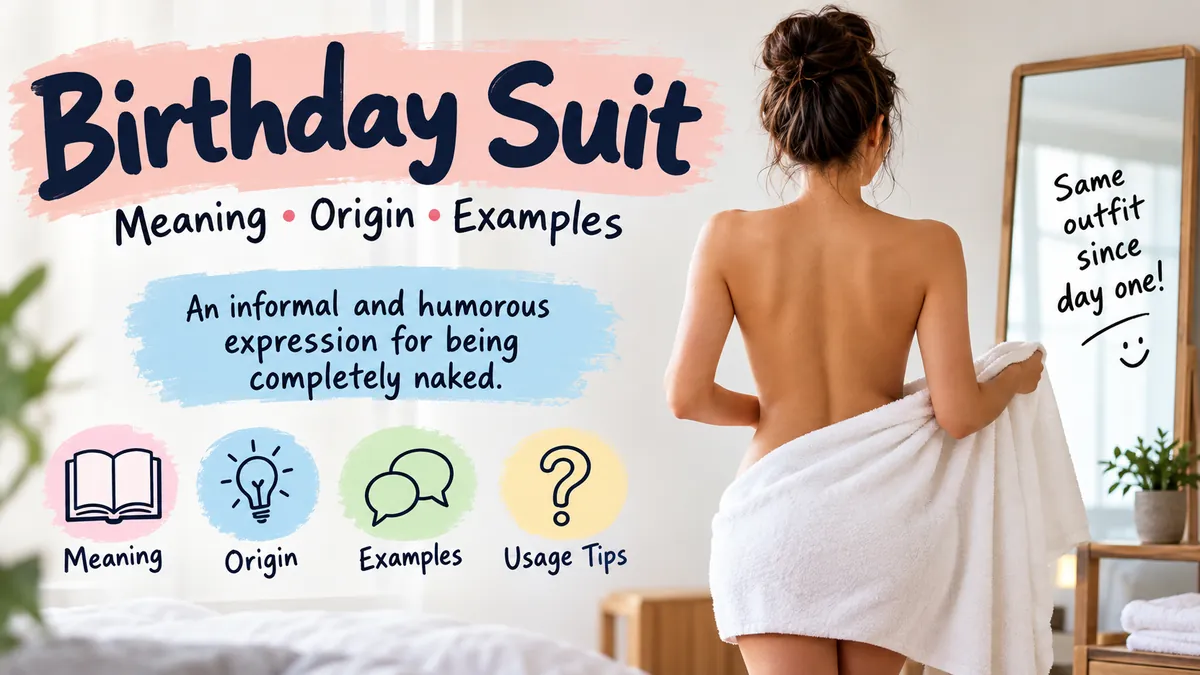
If someone says they were “in their birthday suit,” they are not talking about a jacket, trousers, or an outfit worn to a birthday party. The expression is a playful English idiom for having no clothes on at all.
The joke works because everyone enters the world without clothing. That simple image has helped the expression survive for centuries, although its history is slightly more complicated than the modern definition suggests.
Birthday suit means being completely naked or wearing no clothes. It is an informal, usually humorous euphemism for nakedness, based on the idea that your bare skin is the original “suit” you had when you were born. Dictionaries generally classify the expression as humorous and informal rather than literal.
What Does Birthday Suit Mean?
The modern meaning of birthday suit is straightforward: complete nakedness.
Cambridge English Dictionary defines the expression “in your birthday suit” as not wearing any clothes and labels it humorous. Collins similarly describes it as an informal and humorous expression for total nakedness.
The phrase is an idiom, which means its intended meaning cannot be understood by interpreting every word literally.
| Expression | Meaning |
|---|---|
| birthday suit | complete nakedness |
| in your birthday suit | wearing no clothes |
| wearing your birthday suit | being naked |
| bare | uncovered or unclothed |
| nude | not wearing clothes |
| au naturel | in a natural, unclothed state in some contexts |
A person therefore does not actually “wear” a birthday suit. The word suit is part of the joke: the person’s natural skin is humorously treated as though it were an outfit.
For example:
“I had just stepped out of the shower and was still in my birthday suit when I realized I had forgotten my towel.”
The sentence simply means the speaker had no clothes on.
Does birthday suit mean a birthday outfit?
Usually, no.
Someone encountering the words for the first time might reasonably assume that a birthday suit is special clothing worn for a birthday celebration. In contemporary everyday English, however, that is not what the idiom normally means.
If somebody says, “He was wearing his birthday suit,” the intended meaning is almost certainly that he was unclothed.
That distinction matters when learning English because the literal interpretation of the two words leads to a very different picture.
Why Is It Called a Birthday Suit?
The familiar explanation is based on birth.
A baby is born without clothing, so the expression imagines bare skin as the first “suit” a person ever possessed. In other words, someone wearing their birthday suit looks as they did on the day they were born.
The Online Etymology Dictionary records birthday suit in the sense of nakedness from the 1730s and explains the idea as the “suit” of clothes in which a person was born—that is, none. It also points to older European expressions conveying the idea of being as naked as at birth.
That makes the humor depend on a deliberate contradiction:
A suit normally means clothing, but a birthday suit means the absence of clothing.
English contains plenty of euphemisms that make uncomfortable, embarrassing, or potentially impolite subjects easier to discuss. Birthday suit does this with humor rather than using a direct word such as naked.
Birthday suit is a euphemism
A euphemism is a milder or less direct expression substituted for wording that might sound uncomfortable, blunt, or embarrassing.
Consider the difference:
- “He was completely naked.”
- “He was in his birthday suit.”
Both communicate essentially the same physical state, but their tone is different.
Naked is direct and neutral in many contexts. Birthday suit adds humor and informality.
That playful quality explains why the phrase often appears in jokes, funny stories, casual conversations, headlines, and descriptions of embarrassing situations.
Birthday Suit Origin and History
The birthday suit origin goes back several centuries, but sources differ somewhat on exactly when the nakedness meaning first appeared.
The Online Etymology Dictionary dates the sense of “nakedness” to the 1730s. Collins gives a word-origin range of 1745–55, while Dictionary.com likewise records the expression from the mid-18th century.
Those differences are normal in etymology. A phrase can circulate in speech before researchers find surviving written evidence of it.
There is also an interesting historical complication.
The older royal birthday connection
In 18th-century Britain, birthday suit could have a much more literal meaning connected with elaborate clothing worn for a royal birthday.
The American Heritage Dictionary of Idioms explains that the term originally referred to clothes worn on the king’s birthday in 18th-century Britain and was subsequently applied jokingly to bare skin, referring to a newborn baby’s condition.
Historical research also documents Birth-day Suit being used for clothing associated with royal birthdays.
So there are two closely related ideas worth distinguishing:
| Historical use | Meaning |
|---|---|
| Royal birthday suit | Special clothing associated with a monarch’s birthday |
| Humorous birthday suit | The bare skin a person has at birth |
The second meaning eventually became the familiar idiom used today.
Was the phrase inspired by The Emperor’s New Clothes?
This explanation sometimes appears online, but the dates do not support it as the origin of the expression.
Hans Christian Andersen’s famous story The Emperor’s New Clothes was published in the 19th century, whereas evidence for birthday suit meaning nakedness goes back to the 18th century. The phrase therefore existed earlier.
The similarity is easy to understand—both involve humorous references to supposedly wearing something while actually being unclothed—but that does not establish an etymological connection.
Quick takeaway: The modern expression has been documented since the 1700s. Its enduring joke is that bare skin is the “suit” everyone receives at birth.
Birthday Suit Meaning in Slang and Everyday English
Is birthday suit slang?
It can loosely be described that way, although informal idiom or humorous euphemism is more precise.
Cambridge marks the phrase as humorous, while Collins describes it as informal, humorous, or sometimes old-fashioned.
That tells you something important about how native speakers interpret it.
The phrase generally sounds:
- playful rather than clinical;
- indirect rather than blunt;
- informal rather than professional;
- humorous rather than serious.
It can also sound slightly old-fashioned depending on the speaker and context.
Is birthday suit a sexual expression?
Not inherently.
The phrase describes nudity, but nudity and sexual meaning are not automatically the same thing. Someone could be in their birthday suit while showering, changing clothes, sleeping, swimming privately, or dealing with an embarrassing wardrobe mishap.
Context determines whether a particular conversation carries any additional implication.
For example:
“The toddler escaped after bath time and ran down the hallway in his birthday suit.”
Here, the phrase simply creates a humorous image of a child running around without clothes; there is no sexual meaning.
By contrast, because the expression still refers to nakedness, it may be inappropriate in some formal or sensitive settings even when the speaker intends it innocently.
How to Use Birthday Suit Correctly
The most common construction is:
in + possessive adjective + birthday suit
For example:
- in my birthday suit
- in your birthday suit
- in his birthday suit
- in her birthday suit
- in their birthday suits
You can also use verbs such as wear, although the resulting sentence is intentionally ironic.
Birthday suit examples in sentences
Here are natural examples showing how the expression works:
Casual conversation:
“Luckily I remembered to close the curtains before walking around in my birthday suit.”
Humorous story:
“He heard the fire alarm while he was still in his birthday suit after taking a shower.”
Swimming:
“They joked about going for a midnight swim in their birthday suits.”
Embarrassing situation:
“I locked myself out of the bathroom and nearly ended up standing in my birthday suit.”
Explanation:
“When she said ‘birthday suit,’ she meant that the person wasn’t wearing any clothes.”
Notice that the phrase often works best when the situation itself is amusing or mildly embarrassing.
“In my birthday suit” meaning
If someone says “I was in my birthday suit,” they mean:
“I was completely naked.”
The same grammatical pattern works with other possessives:
“He was in his birthday suit.”
means:
“He wasn’t wearing any clothes.”
And:
“They were in their birthday suits.”
means that the people being discussed were unclothed.
The possessive changes, but the idiomatic meaning stays the same.
Birthday Suit vs Naked, Nude, Bare, and Au Naturel
English offers several ways to describe a person without clothing, but they are not interchangeable in every context.
| Term | Basic meaning | Typical tone |
|---|---|---|
| birthday suit | completely unclothed | humorous, informal |
| naked | not wearing clothes | direct, everyday |
| nude | unclothed | neutral, artistic, formal or descriptive |
| bare | uncovered | broad and context-dependent |
| bare naked | completely naked | emphatic, informal |
| au naturel | in a natural state | playful or sophisticated, context-dependent |
Cambridge’s vocabulary grouping places in your birthday suit alongside terms such as au naturel, bare, bare naked, unclad, undress, and undressed, showing the close semantic relationship among these expressions.
Birthday suit vs naked
Naked is the simplest direct equivalent.
If clarity matters more than humor, use naked. If the situation is casual and you deliberately want a lighthearted euphemism, birthday suit may fit.
Compare:
“The doctor asked whether the patient was fully naked.”
That sounds straightforward.
“The doctor asked whether the patient was in his birthday suit.”
That sounds unusually playful for a medical context.
Register matters.
Birthday suit vs nude
Nude frequently appears in more neutral descriptive contexts, including art.
A museum may describe a work as a nude portrait or nude figure. Calling the same subject a “birthday-suit portrait” would introduce humor that probably was not intended.
Birthday suit vs au naturel
Au naturel comes from French and literally relates to being in a natural state. English speakers sometimes use it euphemistically for being unclothed, but the expression has broader meanings as well.
Birthday suit, by comparison, has a much clearer idiomatic association with nakedness.
When Should You Use the Birthday Suit Idiom?
Knowing a definition is only half of learning an idiom. You also need to understand register—the social setting in which an expression sounds natural.
Birthday suit works particularly well in light, informal storytelling.
Imagine telling a friend:
“I was getting dressed when somebody started knocking on the door, and there I was in my birthday suit.”
The phrase makes an awkward event sound funny.
It is less suitable when precision, seriousness, or sensitivity matters.
Situations where it may sound natural
The expression can fit:
- conversations between friends;
- humorous anecdotes;
- light entertainment writing;
- jokes and playful captions;
- fictional dialogue;
- informal descriptions of harmless embarrassing situations.
Situations where direct language is usually better
Consider alternatives in:
- medical documents;
- legal reports;
- police reports;
- academic writing;
- formal workplace communication;
- serious news reporting;
- situations involving privacy or personal vulnerability.
A medical professional, for example, would normally use precise terms such as unclothed rather than a humorous euphemism.
That is a useful general lesson for English learners: knowing what an idiom means does not automatically mean it belongs in every situation.
Is Birthday Suit Offensive or Rude?
Usually, birthday suit is not considered a vulgar expression.
Its purpose is almost the opposite: it provides a playful way to refer to nakedness without using language that some speakers might find too direct.
However, harmless vocabulary can still become inappropriate depending on how it is used.
Talking about another person’s body, making unwanted comments about nudity, or using the phrase in a professional situation can be uncomfortable regardless of whether the individual words are considered offensive.
The safest way to judge it is by context:
Casual + humorous situation: usually natural.
Formal + serious situation: probably too informal.
Sensitive personal situation: use respectful, direct language instead.
Is it appropriate for children?
The expression itself is not inherently sexual or obscene. It simply means having no clothes on.
Adults sometimes use it humorously when talking about young children after a bath or while changing clothes. As always, the surrounding context determines whether wording is appropriate.
Why the Expression Still Makes Sense Today
Some idioms become confusing because their original objects, customs, or occupations disappear. Birthday suit requires much less historical knowledge.
Its central metaphor remains immediately understandable:
- Everyone has a birthday.
- Everyone was born without clothes.
- A suit is something a person wears.
- Therefore, bare skin is jokingly called the “suit” worn at birth.
That combination makes the idiom memorable.
There is also a useful linguistic reason for its staying power. Euphemisms let speakers control tone.
Compare three statements:
“He was unclothed.”
“He was naked.”
“He was in his birthday suit.”
The basic information is similar, but the social effect is different. Unclothed can sound formal or clinical. Naked is direct. Birthday suit signals that the speaker is treating the situation lightly.
This is why understanding synonyms alone is not enough when learning idiomatic English. Tone is part of meaning.
Common Misunderstandings About Birthday Suit
Because the phrase combines two familiar words, learners can easily interpret it literally.
It is not normally formal clothing
A birthday suit is not the equivalent of a wedding suit, business suit, dinner suit, or three-piece suit.
Those are genuine clothing categories. Birthday suit is an idiom.
It does not mean whatever clothes you wore when you were born
The expression refers to having no clothing, not to a baby’s first outfit, hospital clothing, blanket, or clothes given as a birthday present.
It does not require an actual birthday
This is probably the most useful point for new English speakers.
A person can be “in their birthday suit” on any day of the year.
Someone might say:
“I stepped out of the shower in my birthday suit.”
The speaker’s birthday is irrelevant. Birthday refers to the original metaphor of birth, not the date on which the present event occurs.
It usually refers to complete nakedness
The idiom generally means no clothes, rather than simply being shirtless, barefoot, or partly dressed. Dictionary definitions consistently associate it with complete nakedness or wearing no clothes.
Birthday Suit in British and American English
The expression is understood in both British English and American English.
Collins gives definitions for both varieties. Its British entry describes a state of total nakedness, while its American definitions similarly identify bare skin or being nude.
Dictionary.com likewise records both American and British treatments of the expression.
The essential meaning therefore does not change when crossing the Atlantic.
What can change is how often people use it and how it sounds to individual speakers. Some may hear it as a familiar joke; others may regard it as somewhat old-fashioned.
Either way, the expression remains readily understandable.
What Does Birthday Suit Mean in Different Contexts?
Most searches for birthday suit are looking for the idiom, but the words can occasionally appear as a title or name.
“Birthday Suit” has been used for songs, television episodes, artistic works, and other cultural titles. There has also been a Scottish rock band called The Birthday Suit.
Those proper-name uses should not be confused with the standard English expression.
If you encounter the words in ordinary conversation, however, context usually makes the intended meaning obvious.
Consider:
“When the hotel fire alarm sounded, he realized he was standing there in his birthday suit.”
The idiomatic meaning is unmistakable.
But:
“I listened to a song called ‘Birthday Suit.’”
Here the phrase is functioning as a title, so you cannot assume that the sentence itself is describing someone’s state of dress.
Birthday Suit Meaning: The Simple Answer to Remember
The easiest definition is:
Birthday suit = completely naked.
It is a humorous, informal English idiom based on the idea that people are born without clothes, making bare skin the original “suit” they had at birth. Major dictionaries consistently describe the modern expression in terms of nakedness and humorous or informal usage.
The birthday suit idiom has roots reaching back to the 18th century, with historical evidence also connecting the words to special clothing associated with royal birthdays. Over time, however, the playful nakedness meaning became the one English speakers commonly recognize today.
So when you hear that someone is “in their birthday suit,” don’t picture formal birthday clothing. It simply means they aren’t wearing any clothes.