
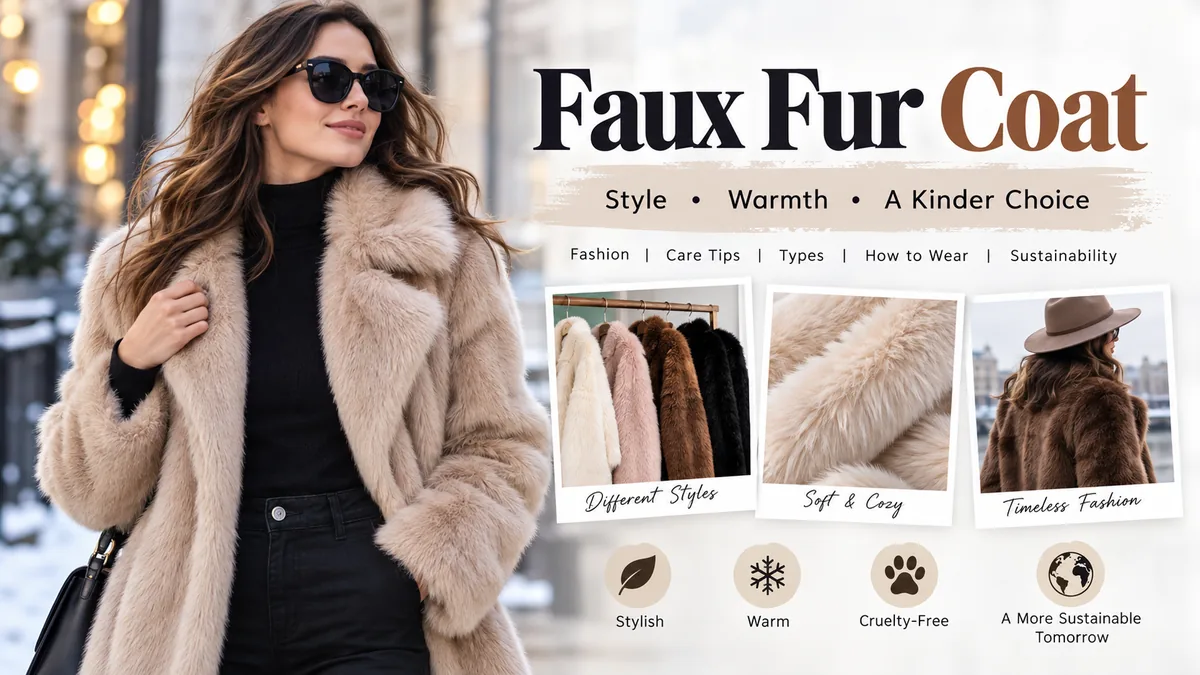
A faux fur coat delivers the plush texture and dramatic appearance associated with traditional fur without using animal pelts. What looks simple from the outside, however, can vary enormously in fiber quality, pile length, construction, warmth, weight, and durability.
Modern faux fur is generally made from synthetic fibers such as polyester, acrylic, or modacrylic attached to a knitted or woven textile backing. It can imitate mink, fox, rabbit, chinchilla, shearling, and other textures, while also allowing colors and patterns that do not exist naturally.
Quick answer: A faux fur coat is outerwear made with textile pile designed to resemble animal fur. Most versions use polyester, acrylic, modacrylic, or blended synthetic fibers. Quality depends on pile density, softness, backing, lining, construction, and how well the fibers recover after being compressed.
What Is a Faux Fur Coat?
Faux fur—also called fake fur, imitation fur, or artificial fur—is a pile fabric engineered to reproduce the appearance and feel of natural animal fur.
Instead of hairs growing from animal skin, synthetic fibers are anchored into a fabric backing. When you separate the fibers of faux fur, you will generally see a knitted, woven, or net-like textile underneath rather than leather-like hide.
The concept is much older than many people assume. Imitation fur was appearing in American fashion discussions by the 1910s, and early versions relied on pile-fabric manufacturing techniques already used for textiles such as velvet. Faux fur became increasingly prominent as manufacturing improved and attitudes toward animal fur changed.
Today’s versions range from inexpensive fashion fabrics to dense, carefully engineered textiles that create convincing differences in color, pile height, underfur, and guard-hair appearance.
What Is Faux Fur Made From?
There is no single universal faux fur composition.
Common fibers include:
| Material | Typical characteristics |
|---|---|
| Polyester | Durable, widely available and versatile |
| Acrylic | Soft, lightweight and easy to color |
| Modacrylic | Durable, colorfast and often used for realistic pile |
| Fiber blends | Combine properties such as softness, structure and durability |
Acrylic and modacrylic are commonly associated with faux fur, often with polyester used in the pile, backing, lining, or a blend.
This distinction matters because two coats that look almost identical online can behave very differently in real life.
One may feel silky and fluid. Another may feel stiff or excessively shiny. One might tolerate gentle washing according to its care label, while another requires professional cleaning.
That is why the garment’s fiber-content and care labels matter more than generic faux-fur cleaning advice.
Understanding Faux Fur Pile and Texture
One of the most useful terms to understand is pile.
Pile refers to the raised fibers that create the furry surface. Its height, density, direction, softness, and variation have a major effect on how a coat looks and feels.
Faux fur can broadly be described as:
- Short pile: compact and relatively sleek
- Medium pile: fuller without being extremely shaggy
- Long pile: dramatic, fluffy and highly textured
Different pile constructions are used to imitate particular animals or create deliberately unrealistic fashion effects. Common inspirations include faux mink, rabbit, fox, chinchilla, sable, beaver, lynx, alpaca, sheepskin, and shearling.
Faux Mink
Faux mink typically uses short, dense pile to create a smoother, more refined surface.
Because it does not have the extreme volume of long shaggy fibers, it works particularly well for people who like the fur look but want a cleaner silhouette.
Faux Fox
Faux fox generally has longer fibers and considerably more volume.
The long pile creates movement and makes collars, cuffs, jackets, and full-length coats visually prominent. It is naturally suited to statement outerwear.
Faux Shearling and Sheepskin
Faux shearling aims for the curly or woolly texture associated with sheepskin.
It often appears as the lining or trim of aviator-style jackets, though full teddy and shearling-inspired coats are also common.
Animal Prints and Fashion Colors
Synthetic construction gives designers much greater control over color.
Alongside brown, cream, black, gray, and white, faux fur appears in leopard, zebra, and other animal-inspired patterns as well as pink, blue, green, red, and multicolored designs. Animal-print faux fur remains a recurring outerwear style because the coat itself can serve as the focal point of an otherwise simple outfit.
Faux Fur Coat Styles and Lengths
A faux fur coat is not one specific silhouette. Length and construction can change both its appearance and practical use.
Cropped Faux Fur Jacket
Cropped jackets typically finish around the waist or upper hip.
They create less visual volume than a long coat and work particularly well with high-waisted trousers, jeans, skirts, and dresses.
Because less fabric is involved, cropped styles can also feel easier to move in.
Hip-Length Jacket
A hip-length faux fur jacket offers a useful middle ground.
It provides more coverage than a cropped design without the visual weight of a long overcoat. This makes it one of the easier shapes to integrate into everyday wardrobes.
Mid-Length Coat
Mid-length designs generally reach somewhere around the thigh or knee.
They provide additional coverage while retaining enough versatility for casual and dressier clothing.
Long Faux Fur Coat
A long faux fur coat creates the strongest visual statement.
Its additional coverage can be valuable in cold weather, although warmth ultimately depends on much more than length. Fabric density, wind penetration, lining, closures, and what you wear underneath all matter.
Hooded Coat
Adding a hood increases coverage around the neck and head.
Hooded designs usually lean casual, while wide lapels and structured collars tend to produce a more traditional overcoat appearance.
Faux Fur Vest
A vest removes the sleeves while retaining the texture and volume of fur around the torso.
It is better considered a layering garment than a substitute for insulated winter outerwear.
How Warm Is a Faux Fur Coat?
A common question is whether faux fur is actually warm.
Yes, it can be—but appearances are deceptive.
The pile creates spaces that can trap air, while a dense backing and good lining help reduce heat loss. Longer coats also cover more of the body.
However, warmth varies substantially between garments.
Look at:
- Pile density
- Fabric backing
- Lining
- Coat length
- Cuff construction
- Collar or hood coverage
- Front closure
- Wind resistance
- Room available for insulating layers
A thick-looking coat with loose pile and an open front can perform worse in wind than a less dramatic jacket with dense construction and secure closures.
Natural fur and synthetic faux fur also do not necessarily provide equivalent thermal performance. Claims that anything labeled faux fur will automatically be suitable for extreme cold should therefore be treated cautiously.
Quick takeaway: Judge winter performance from the whole garment—not simply how fluffy the surface looks.
Faux Fur Coat vs Real Fur
The visual similarity between high-quality faux fur and natural fur can be impressive, particularly in photographs. Their construction is fundamentally different.
| Feature | Faux Fur | Real Fur |
|---|---|---|
| Fiber source | Usually synthetic | Animal hair |
| Base | Textile backing | Animal hide |
| Colors | Naturalistic or artificial | Natural or dyed |
| Texture | Depends heavily on fiber quality | Natural variation in hairs |
| Animal pelts | Not required | Required |
| Care | Depends on fiber and garment | Specialist care often required |
| Moisture/heat response | Synthetic fibers can be heat-sensitive | Different natural-fur care requirements |
| End of life | Synthetic material presents plastic-related concerns | Biodegradability varies with processing |
One practical way to understand the construction is to gently separate the hairs in an inconspicuous area. Faux fur generally exposes textile underneath; natural fur exposes a skin-like base.
Avoid destructive home tests such as burning fibers. Checking labels, backing, construction, and reliable product documentation is safer.
Is Faux Fur More Ethical and Sustainable?
This question requires separating two issues that are often treated as if they were identical.
Animal Welfare
Faux fur does not require an animal pelt to produce the furry textile surface. For people who avoid animal-derived fur, that is its clearest distinction.
Changing attitudes toward animal welfare helped faux fur evolve from an inexpensive imitation into a fashion category with an identity of its own. Its history is intertwined with conservation campaigns, animal-rights activism, and major changes in how fashion consumers viewed natural fur.
Environmental Impact
Calling every faux fur coat “sustainable” is too simplistic.
Conventional faux fur is commonly based on synthetic polymers, including polyester and acrylic. These materials come with environmental considerations associated with fossil-fuel feedstocks, manufacturing, washing, microfiber shedding, durability, and disposal.
At the same time, sustainability cannot be judged from fiber type alone. How frequently a garment is worn, how long it lasts, whether it is repaired or reused, and what happens at the end of its useful life all affect its overall footprint.
A more accurate statement is:
Faux fur avoids animal pelts, but that does not automatically make every faux fur garment environmentally sustainable.
That distinction is frequently lost in simplified comparisons.
How to Tell Whether a Faux Fur Coat Is Good Quality
Price alone is unreliable.
Instead, inspect the garment systematically.
1. Examine the Pile
Run your hand gently with and against the direction of the fibers.
Good faux fur should generally feel pleasant rather than scratchy, and the pile should recover reasonably well instead of remaining flattened.
Look for obvious bald patches or inconsistent density.
2. Part the Fibers
Separate a small section and examine the backing.
A dense surface with limited backing visible generally produces a richer appearance than sparse pile, although construction varies intentionally by style.
3. Check the Lining
The lining should sit cleanly without excessive pulling, puckering, or loose seams.
Remember that the plush exterior is only part of the coat. Poor internal construction can make an expensive-looking surface uncomfortable to wear.
4. Inspect High-Stress Areas
Pay particular attention to:
- Underarms
- Pocket openings
- Cuffs
- Collar
- Shoulders
- Front closures
- Hem
- Lining seams
These areas reveal construction problems faster than the center of a large fur panel.
5. Look at the Coat in Motion
A product can look excellent in one carefully lit photograph yet behave differently when worn.
Pile direction, movement, scale, side profile, sleeves, hem, and collar all influence how convincing the finished garment appears. Evaluating several angles provides more information than relying on a single front-facing image.
6. Check Fiber and Care Labels
This is especially important.
Knowing whether the coat uses polyester, acrylic, modacrylic, or a blend helps explain how it may behave during wear and cleaning.
How Should a Faux Fur Coat Fit?
Faux fur naturally adds visual volume, so fit has a larger effect than it does with many smooth fabrics.
A well-fitting coat should sit comfortably across the shoulders and allow normal arm movement without pulling.
The rest depends partly on the intended silhouette.
An oversized shaggy coat is supposed to have volume. A short faux mink jacket may look better with a cleaner, more controlled shape.
The most common mistake is confusing intentional oversized styling with simply wearing a coat that is too large.
A coat that is excessively large at the shoulders can overwhelm the wearer and create uncontrolled bulk. Fit and proportion are therefore particularly important with plush outerwear.
What Size Faux Fur Coat Should You Wear?
Start with your normal outerwear size, but use the garment’s actual measurements whenever available.
Consider what you plan to wear underneath. A coat worn over chunky knitwear needs more room through the shoulders, chest, and arms than one worn primarily over evening clothing.
When trying it on:
- Cross your arms.
- Reach forward.
- Sit down.
- Fasten every closure.
- Check sleeve length.
- Look at the shoulders from behind.
- Make sure the lining does not pull.
Comfort during movement matters more than the size printed on the label.
How to Style a Faux Fur Coat Without Looking Overdone
Because fur has substantial texture, simple combinations often work particularly well.
With Jeans
A neutral coat over jeans, a plain knit, and boots allows the texture to provide the visual interest.
Straight-leg and relaxed denim can balance a fuller coat, while streamlined trousers create contrast against an oversized silhouette.
With Dresses
Faux fur works naturally with evening clothing because its texture adds visual richness without requiring complicated accessories.
A cropped jacket can preserve the proportions of a dress, while a long coat creates a more dramatic entrance.
With Tailored Clothing
A smooth turtleneck, tailored trousers, and clean footwear contrast effectively with a plush coat.
This combination is especially useful when you want the fur texture to look sophisticated rather than costume-like.
With Animal Print
Leopard, zebra, and similar patterns already command attention.
Keep the surrounding clothing relatively restrained. Black, cream, denim, and other uncomplicated pieces allow an animal-print coat to act as the statement piece.
With Bold Colors
Bright faux fur does not require equally loud accessories.
A pink, red, cobalt, or green coat often looks stronger when the remaining outfit uses a limited color palette.
How to Care for a Faux Fur Coat
Care is where generic advice becomes risky because faux fur compositions vary significantly.
Some manufacturers permit gentle cold-water washing. Others specifically require dry cleaning. Even two visually similar coats may have different instructions because their fiber blends, backing, lining, trims, or decorative finishes differ.
The care label inside your specific garment should therefore override general internet advice.
How to Wash a Faux Fur Coat
If—and only if—the label permits washing, a conservative process is:
- Check pockets and fasten or protect delicate closures.
- Use cold or lukewarm water as directed.
- Select a gentle or delicate cycle if machine washing is permitted.
- Use a small amount of suitable mild detergent.
- Avoid aggressive agitation.
- Avoid unnecessary heat.
- Reshape the garment after washing.
- Air-dry according to its care instructions.
- Gently restore the pile after it is fully dry.
Some appliance-care guidance recommends cold or lukewarm water, a gentle cycle, minimal detergent, flat air-drying, and gently combing fibers after drying.
But again, this is not universal. Certain acrylic/polyester blends may specify dry cleaning only, while other polyester faux furs permit gentle washing.
Why Heat Can Be a Problem
Synthetic fibers deserve particular caution around high temperatures.
Hot water, a hot dryer, direct high-temperature airflow, or an iron can damage some faux fur fibers, potentially causing matting, distortion, or loss of softness.
Do not assume tumble drying is safe unless the garment manufacturer explicitly permits it.
How to Spot Clean Faux Fur
For a small spill, blotting is generally better than vigorous rubbing.
Rubbing can push contamination deeper into the pile and tangle the fibers.
Follow the garment instructions for suitable cleaning products. Once the area is properly dry, gentle brushing may help restore the direction and loft of the pile.
Professional faux-fur care advice has also traditionally emphasized spot cleaning and gentle brushing between full cleanings.
How to Make Matted Faux Fur Fluffy Again
Flattening commonly develops where the coat experiences pressure or friction, especially around cuffs, elbows, shoulders, pockets, and seating areas.
Start gently.
Make sure the garment is clean and dry, then carefully separate compressed fibers with your fingers or an appropriate wide-tooth comb or brush. Work in small sections rather than pulling aggressively.
A little patience usually works better than force.
The biggest mistake is trying to solve matting with high heat. Synthetic fibers do not respond like human hair, so a hot hair dryer or iron can make the problem permanent rather than fixing it.
For severe matting or a valuable garment, professional cleaning is safer than experimenting with heat or harsh chemicals.
How to Store a Faux Fur Coat
Storage affects how the pile looks when winter returns.
Use a sturdy, preferably broad or padded hanger capable of supporting the coat without distorting its shoulders.
Choose a cool, dry storage area with enough room that other garments are not constantly crushing the pile.
Avoid compressing the coat tightly for months.
Before long-term storage:
- Deal with stains.
- Make sure the garment is completely dry.
- Empty the pockets.
- Fasten it loosely if appropriate.
- Smooth the pile.
- Give it enough wardrobe space to hang naturally.
Traditional faux-fur care guidance recommends hanging coats rather than leaving them compressed during seasonal storage.
If the coat has been stored for months, gently shaking and brushing it can help restore volume.
Common Faux Fur Coat Problems
Even good faux fur requires realistic expectations.
Shedding
A small amount of loose fiber may appear on some new garments. Persistent heavy shedding, however, can indicate weak pile construction or damage.
Avoid repeatedly pulling at individual fibers.
Matting
Friction, moisture, dirt, compression, and inappropriate cleaning can cause fibers to clump.
Regular gentle maintenance is easier than trying to restore a severely matted coat later.
Static
Synthetic fabrics can build static electricity, particularly in dry winter environments.
The effect can become more noticeable when the coat rubs against other synthetic garments.
Excessive Bulk
Sometimes the problem is not the fabric but the proportions.
Long pile, dropped shoulders, an oversized body, and a long hem all add volume. Combining all four can overwhelm some frames.
A shorter pile or more structured cut provides the fur texture with less bulk.
Loss of Shape
Poor storage, heavy objects, prolonged compression, or unsuitable washing can distort the backing and lining.
That is another reason to hang the coat properly rather than stuffing it into a crowded storage box.
Choosing Between Short-Pile and Long-Pile Faux Fur
Neither is inherently better.
The choice depends on the look and practicality you want.
| Feature | Short Pile | Long Pile |
|---|---|---|
| Appearance | Sleek, compact | Fluffy, dramatic |
| Visual volume | Lower | Higher |
| Texture | Smooth/dense | Shaggy/plush |
| Maintenance | Often easier | Can tangle more readily |
| Styling | Versatile | Statement-focused |
| Common inspiration | Mink, rabbit | Fox, shaggy fur |
| Detail visibility | Shows construction clearly | Texture dominates |
For frequent everyday wear, medium or short pile can be particularly practical.
Long pile makes more sense when texture and movement are central to the look.
What Makes a Faux Fur Coat Worth Keeping?
The best garment is not necessarily the one with the longest pile or most convincing imitation of natural fur.
Look at the entire construction.
A useful faux fur coat should combine:
- Comfortable pile
- Adequate density
- Strong textile backing
- Clean stitching
- Smooth lining
- Secure pockets and closures
- Practical sleeve length
- Enough layering room
- Appropriate warmth
- Manageable weight
- Clear care instructions
Durability deserves particular attention. A garment that still looks good after repeated wear is more useful than one whose surface is impressive only when new.
The same principle applies environmentally: wearing existing clothing longer, caring for it correctly, repairing it when practical, and considering secondhand use can reduce the pressure to continually replace garments.
Faux Fur Coat Mistakes to Avoid
A few habits cause disproportionate problems.
Do not judge warmth from fluffiness alone. Examine density, lining, closures, length, and wind protection.
Do not automatically machine wash it. Some faux fur can be washed; other garments specify professional cleaning.
Do not use high heat without explicit care-label permission. Synthetic pile can be damaged.
Do not store it crushed. Long-term compression encourages flattening and matting.
Do not ignore the backing and lining. They tell you a great deal about construction quality.
Do not assume faux automatically means environmentally sustainable. Animal welfare and environmental impact are related but distinct questions.
Do not size up automatically just because oversized coats are fashionable. Intentional volume still needs correct shoulder proportions and comfortable movement.
Is a Faux Fur Coat Right for You?
A faux fur coat makes sense when you enjoy the visual depth and tactile quality of fur-style outerwear but want a garment made without animal pelts.
Its versatility is one of its strengths. Short faux mink can look restrained and polished; shearling-inspired styles can feel casual; long shaggy designs make a dramatic statement; leopard and other animal prints turn outerwear into the center of an outfit.
The important part is looking beyond appearance.
Understand the fiber composition. Check the textile backing and lining. Consider the pile length and density. Test the fit while moving. Think realistically about your climate. Most importantly, follow the garment-specific cleaning instructions rather than assuming all synthetic fur behaves alike.
A well-made faux fur coat should ultimately do more than photograph well. It should fit comfortably, provide the level of warmth you actually need, survive normal wear, and remain attractive with sensible care. Those qualities—not simply softness or price—are what separate a useful winter coat from one that spends most of its life hanging in the wardrobe.