
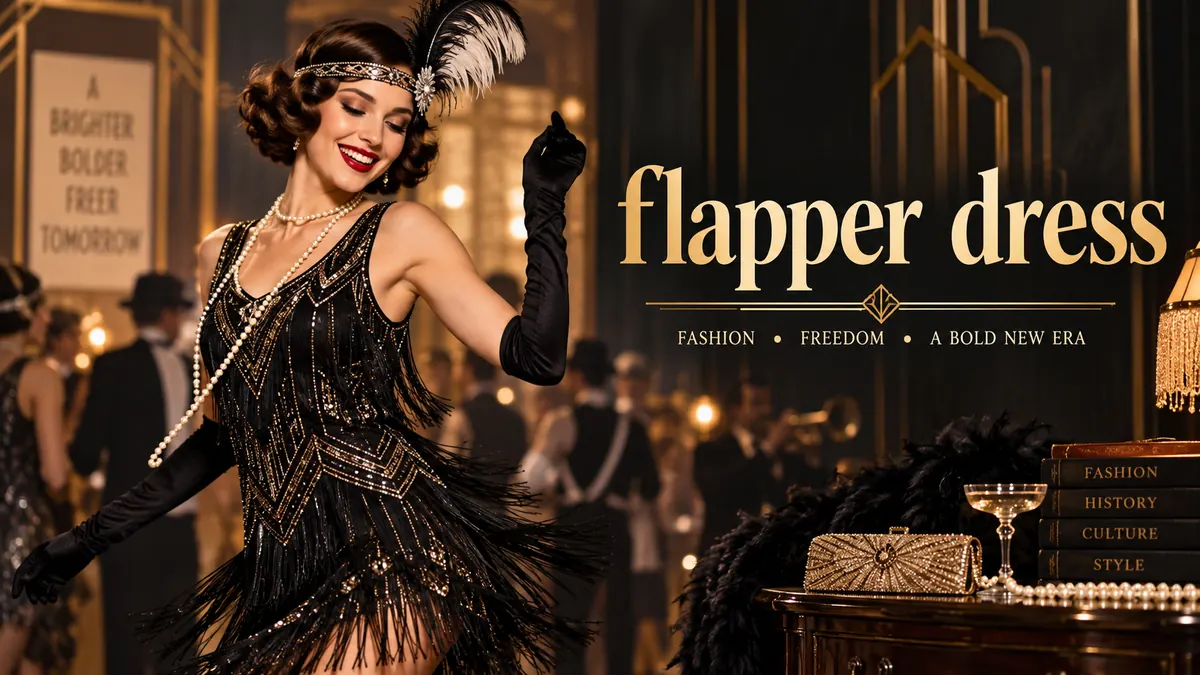
Few pieces of clothing symbolize an entire decade as instantly as the flapper dress. Its loose silhouette, low waist, shimmering beadwork, and movement-friendly construction evoke jazz clubs, bobbed hair, Art Deco glamour, and the social changes of the Roaring Twenties.
Yet the modern image is only partly accurate. Historical flapper fashion was more varied than the fringe-covered costumes commonly associated with the era today. Hemlines changed throughout the decade, not every dress had fringe, and not every woman who wore the fashionable 1920s silhouette considered herself a flapper.
A flapper dress is a loose, straight women’s dress associated with 1920s flapper culture and Jazz Age fashion. Typical features include a dropped waist, relatively short hemline, sleeveless or simple bodice, and decorative beadwork, sequins, embroidery, or fringe. Its relaxed construction reflected the decade’s movement toward greater freedom in women’s clothing.
What Is a Flapper Dress?
The term flapper dress generally describes dresses connected with the fashionable young women known as flappers during the 1920s.
The defining feature wasn’t actually fringe. It was the silhouette.
Fashion moved away from the pronounced waist and restrictive structure associated with earlier styles. The fashionable figure became straighter and more tubular, with the waistline often lowered toward the hips. The Fashion Institute of Technology describes this as the la garçonne look, characterized by a dropped waist and changing hemlines.
Typical characteristics included:
- Straight or loosely fitted construction
- Dropped or understated waist
- Sleeveless or short-sleeved designs
- Lower or scooped necklines
- Shorter skirts than earlier generations wore
- Silk, chiffon, georgette, rayon, or similar flowing fabrics
- Beading, embroidery, rhinestones, sequins, or metallic decoration
- Fringe or other details that emphasized movement
- Geometric or stylized Art Deco-inspired patterns
The silhouette allowed the body to move more naturally than heavily structured fashions of earlier decades.
That mattered because dancing was central to Jazz Age nightlife.
Were all flapper dresses covered in fringe?
No.
This is one of the biggest misconceptions about 1920s fashion.
Fringe certainly existed and worked particularly well on eveningwear because it moved dramatically while dancing. The London Museum notes that fringe details could catch the light as the wearer moved. But authentic evening dresses also featured beads, sequins, spangles, rhinestones, embroidery, and decorative textiles without fringe.
Some fashionable dresses were remarkably simple.
The exaggerated head-to-toe fringe dress seen in many modern costumes represents one interpretation of the period rather than a universal historical uniform.
Quick Takeaway: A historically inspired flapper dress is defined more reliably by its straight silhouette and lowered waist than by fringe.
The History of the Flapper Dress
Understanding the clothing requires understanding the social environment that produced it.
Before the 1920s, fashionable Western women’s clothing generally covered considerably more of the body. Floor-length skirts and strongly defined waists had been common, and corsets remained part of everyday dress.
The social disruption surrounding World War I accelerated changes already underway.
Women had entered workplaces in greater numbers during the war. Urbanization, consumer culture, automobiles, cinema, jazz, and changing ideas about women’s independence also influenced everyday life.
In the United States, the 19th Amendment, ratified in 1920, expanded women’s voting rights. The period became associated with changing expectations about women’s participation in public life, although social and political equality remained far from complete.
Fashion reflected these changes.
Clothing became easier to move in. Skirts became shorter. Corsetry became less dominant, while lighter undergarments helped produce the fashionable straight silhouette.
The resulting style looked dramatically modern compared with the clothing of previous generations.
Where did the word “flapper” come from?
Its exact origin remains disputed.
The word existed before the stereotypical American flapper of the Roaring Twenties. Various explanations have connected it with young women, youth culture, and even unfastened galoshes that supposedly “flapped” while walking.
By the early 1920s, however, the term had become closely associated with a recognizable type of modern young woman.
She might have bobbed hair, wear cosmetics, visit jazz clubs, dance, drive automobiles, smoke or drink publicly, and reject some of the behavioral expectations imposed on previous generations.
Clothing was therefore only one element of flapper identity.
What Did an Authentic 1920s Flapper Dress Look Like?
Hollywood and costume manufacturers have created a standardized image of the flapper: black mini dress, rows of fringe, feather headband, enormous pearl necklace, and cigarette holder.
Real 1920s fashion was much broader.
The straight silhouette
One of the most recognizable characteristics was the long, relatively straight line from shoulder toward hip.
Rather than emphasizing an hourglass figure, fashionable clothing could minimize the natural waist.
The effect is sometimes described as tubular, boyish, or garçonne.
This wasn’t achieved through one standardized dress pattern. Designers used different fabrics, seams, panels, pleats, belts, and decoration while preserving the fashionable vertical line.
The dropped waist
A low waistline became especially characteristic of the decade.
Instead of sitting at the natural waist, a seam, belt, sash, or decorative treatment might fall around the upper or lower hip.
The position wasn’t static throughout the 1920s. FIT’s Fashion History Timeline notes that waistlines dropped until around 1923 before beginning to rise again later in the decade.
That detail matters when dating surviving garments.
“1920s fashion” wasn’t one frozen style worn unchanged for ten years.
Shorter hemlines
The shortened skirt became one of the era’s most visible departures from previous fashion.
But the idea that genuine flappers routinely wore extremely short minidresses is historically misleading.
Hemlines rose progressively through the decade and were at their highest around the middle of the 1920s before falling again. British Vogue notes that even at their peak, fashionable hems were generally around or just below the knee rather than dramatically above it.
So a modern thigh-length “1920s dress” often owes more to contemporary costume design than historical fashion.
Beads, sequins, and embroidery
Eveningwear could be spectacular.
The simple construction of a straight dress provided an ideal canvas for surface decoration. Designers and dressmakers covered garments with:
- Glass beads
- Rhinestones
- Sequins
- Metallic elements
- Embroidery
- Appliqué
- Geometric motifs
- Floral motifs
- Fringe
FIT records elaborate 1920s eveningwear made from silk and decorated with rhinestones, while museum collections preserve numerous examples of heavily embellished garments.
Decoration could also reinforce the geometric aesthetic associated with Art Deco.
Fabrics
Luxury evening dresses frequently used materials that draped or moved attractively.
Silk, chiffon, georgette, charmeuse, velvet, and metallic textiles could appear in high-end clothing. Less expensive materials helped fashionable silhouettes reach a wider audience.
Rayon became increasingly significant as an affordable manufactured fiber.
Fabric choice affected how a dress behaved. A soft, lightweight textile complemented the relaxed silhouette, while beads and fringe added weight and movement.
Flapper Dress Styles Changed Throughout the 1920s
Treating the decade as one continuous style can lead to inaccurate recreations.
Fashion changed quickly.
| Period | Typical Fashion Direction | Key Characteristics |
|---|---|---|
| Early 1920s | Transitional | Longer hems, increasingly straight shapes |
| 1923–1925 | Strong dropped-waist trend | Tubular silhouettes, lower waistlines |
| 1925–1927 | Classic Jazz Age look | Highest hemlines, sleeveless eveningwear, decorative surfaces |
| 1928–1929 | Moving away from extreme garçonne styling | Waistlines begin returning upward, hems lengthen |
| Early 1930s | New silhouette emerges | More body-conscious, elongated and feminine lines |
Hemlines reached their fashionable high point around 1926 according to FIT’s chronology, then began moving downward again.
This evolution explains why two authentic dresses dated only several years apart can look surprisingly different.
Day Dress vs. Evening Flapper Dress
Another common historical mistake is assuming women walked around every day in elaborate beaded dresses.
They didn’t.
Everyday clothing had to be practical.
Women wore housedresses, day dresses, suits, skirts, blouses, sweaters, and sportswear depending on their social position and activity. FamilySearch notes that everyday dresses could be simple cotton garments, while elaborate beaded or sequined styles were more appropriate for special occasions and nightlife.
Eveningwear allowed greater experimentation.
Daywear
A fashionable daytime outfit might feature:
- Straight construction
- Modest decoration
- Practical fabric
- Long or short sleeves
- Lower waist
- Mid-calf or shorter skirt depending on the year
Eveningwear
A Jazz Age evening dress might include:
- Sleeveless construction
- Lower neckline
- Silk or georgette
- Elaborate beadwork
- Rhinestones
- Sequins
- Metallic embroidery
- Fringe
- Decorative geometric patterns
Evening dresses could still vary significantly in length. Some remained relatively long even when shorter daytime fashions were popular.
Why Flapper Dresses Were Made for Movement
One reason the flapper dress remains visually compelling is that many examples were designed to come alive when worn.
Jazz Age social dancing demanded movement.
The Charleston became one of the dances most strongly associated with the period. Its rapid kicks, swivels, and arm movements were easier to perform in loose clothing than in restrictive Victorian-style garments.
The Charleston also has important African American cultural roots. It developed within Black communities before becoming a national and international dance craze during the 1920s.
Design and movement worked together.
A straight dress didn’t tightly constrain the torso. Shorter skirts gave the legs greater freedom. Beads reflected light. Fringe swung in response to the dancer’s movement.
The garment wasn’t simply seen.
It performed.
Coco Chanel and Designers Who Shaped 1920s Fashion
No single designer “invented” the flapper dress.
The silhouette emerged from broader cultural and fashion developments, but several influential designers helped define the decade.
Coco Chanel
Coco Chanel became one of the most influential figures in modern women’s fashion.
Her simplified clothing, knitwear, relaxed silhouettes, and use of black helped move fashionable dress away from elaborate prewar conventions.
In 1926, Vogue famously presented a simple black Chanel dress as a remarkably universal modern garment, comparing its potential ubiquity with Ford’s Model T.
Chanel’s importance goes beyond one dress. Her work reflected the growing appetite for clothing that appeared modern, streamlined, and practical.
Jean Patou
Jean Patou was another major designer associated with relaxed women’s clothing.
His sportswear and tennis fashions helped popularize freer silhouettes appropriate to an increasingly active lifestyle.
Sportswear mattered because women’s fashion was changing beyond evening parties. Exercise, travel, motoring, and leisure increasingly influenced fashionable wardrobes.
Madeleine Vionnet
Madeleine Vionnet approached clothing differently.
She became particularly associated with the bias cut, in which fabric is cut diagonally relative to its grain. This allows textiles to drape fluidly around the body.
Her work would become especially influential as fashion moved toward more body-conscious forms around the end of the 1920s and into the 1930s.
Jeanne Lanvin
Not every fashionable woman wanted the boyish silhouette.
Designer Jeanne Lanvin offered an important alternative through the robe de style, which featured a more defined waist and fuller skirt.
The London Museum highlights the robe de style as another important form of 1920s eveningwear.
Its existence is useful evidence against the idea that every fashionable 1920s woman dressed identically.
Flapper Dress Accessories and the Complete 1920s Look
The dress was only one component of the fashionable silhouette.
Hair, hats, stockings, shoes, jewelry, cosmetics, and outerwear could completely change the effect.
Bobbed hair
Short hair became one of the strongest visual symbols of the modern woman.
Different versions included the classic bob, shingle, Marcel waves, and the extremely short Eton crop.
Actresses helped popularize the look.
Louise Brooks became especially famous for her sharply cut black bob, while Clara Bow embodied the youthful energy associated with the Jazz Age.
Cloche hats
The close-fitting cloche hat complemented short hairstyles and the streamlined silhouette.
Pulled low over the forehead, it created an instantly recognizable 1920s profile.
Stockings
As skirts became shorter, hosiery became increasingly visible.
Silk and rayon stockings therefore played a larger role in fashion. Neutral and flesh-toned shades could create the impression of exposed legs while maintaining the convention of wearing stockings.
Shoes
Dancing encouraged secure footwear.
Mary Jane and T-strap styles are strongly associated with the decade because straps helped keep shoes on during energetic movement.
Heels were generally far more moderate than the very high stilettos common in later fashion.
Jewelry
Long necklaces worked particularly well with the vertical line of 1920s dresses.
Pearls became strongly associated with modern interpretations of flapper fashion, although genuine jewelry choices were much more diverse. Costume jewelry also became increasingly fashionable, and Chanel played an important role in legitimizing decorative jewelry that didn’t depend entirely on precious stones.
Makeup
Visible cosmetics became increasingly acceptable among fashionable young women.
Darkened eyes, rouge, defined brows, and strongly colored lips helped create the dramatic look seen in advertisements and cinema.
The effect was particularly powerful alongside a bob haircut and cloche.
Art Deco and the Flapper Dress
The visual relationship between 1920s clothing and Art Deco deserves more attention than it usually receives.
Art Deco favored stylization, symmetry, geometry, luxury, modernity, and bold decorative surfaces.
Those qualities translated naturally into fashion.
Beaded evening dresses could feature zigzags, diamonds, fans, chevrons, sunbursts, and repeating geometric arrangements. When beads caught electric light in dance halls, those patterns became even more striking.
But 1920s design drew from sources far beyond geometric modernism.
The National Museum of Finland documents influences including Japanese and Chinese imagery, ancient Egypt, African art, Russian traditions, Cubism, Futurism, and other artistic movements.
The discovery of Tutankhamun’s tomb in 1922 contributed to a wider fascination with Egyptian imagery in Western decorative culture.
These influences should also be understood within their historical context. Western designers frequently borrowed visual elements from other cultures in ways that would now raise questions about exoticism and cultural appropriation.
Quick Takeaway: Authentic Jazz Age design wasn’t simply “black dress plus fringe.” Its decorative vocabulary could incorporate Art Deco geometry, embroidery, metallic surfaces, international influences, and luxurious textiles.
Flapper Dress and Women’s Changing Social Roles
The flapper became much larger than fashion.
She represented a public debate about what a modern woman could do, wear, and become.
After World War I, women had greater visibility in employment, universities, consumer culture, politics, and urban entertainment. Automobiles increased personal mobility. Cinema created new celebrities and fashion models. Jazz clubs offered new forms of nightlife.
Clothing made these changes visible.
A woman with cropped hair, visible makeup, a loose dress, exposed lower legs, and a cigarette represented a dramatic break from Victorian ideals of respectable femininity.
That image could be celebrated as liberation or condemned as rebellion.
Did flapper fashion liberate women?
To an extent—but the story needs nuance.
Abandoning highly restrictive clothing could provide genuine physical freedom. Shorter skirts and looser dresses made movement easier. Fashion also offered young women a visible way to challenge older social expectations.
But clothing did not create equality.
Flapper culture could be commercialized, class-specific, and exclusionary. The freedoms associated with the Roaring Twenties weren’t experienced equally across race, class, nationality, or geography.
Even in the United States, where the decade is often portrayed as a period of women’s liberation, major legal, economic, and social inequalities remained.
The flapper should therefore be understood as a symbol of changing womanhood—not proof that women’s equality had been achieved.
Jazz, Cinema, and the Popular Image of the Flapper
Mass media turned the flapper into an international cultural figure.
Writers, illustrators, advertisements, magazines, and Hollywood films repeatedly presented the modern young woman to the public.
F. Scott Fitzgerald became closely associated with the Jazz Age and helped popularize the cultural image through his fiction.
His 1920 collection Flappers and Philosophers strengthened that association. Five years later, The Great Gatsby captured many of the tensions surrounding wealth, modernity, status, and nightlife in 1920s America.
His wife, Zelda Fitzgerald, was herself widely portrayed as an embodiment of the modern flapper.
Cinema amplified the image further.
Actress Colleen Moore became strongly associated with flapper characters after films such as Flaming Youth.
Clara Bow became the famous “It Girl” after the 1927 film It. Louise Brooks developed another enduring version of the image with her unmistakable bob haircut.
Anna May Wong also adopted elements of flapper fashion and became an important style figure while navigating Hollywood’s racial stereotypes.
These celebrities helped turn a social phenomenon into a visual archetype that survived long after the decade ended.
Flapper Dress vs. Modern “Great Gatsby” Costume
A historical flapper dress and a modern Gatsby-themed costume aren’t necessarily the same thing.
Modern versions usually exaggerate recognizable elements so the decade can be identified instantly.
| Feature | Historical 1920s Fashion | Typical Modern Costume |
|---|---|---|
| Silhouette | Straight and loose | Often fitted |
| Waist | Frequently dropped | Natural or dropped |
| Hem | Varied; often below or around knee | Frequently above knee |
| Fringe | One possible decoration | Often covers entire dress |
| Beading | Common in eveningwear | Common |
| Colors | Broad range | Often black, gold, silver |
| Headwear | Cloche hats and varied accessories | Feather headband |
| Jewelry | Varied | Oversized faux pearls |
| Overall effect | Fashionable contemporary clothing | Deliberately theatrical |
That doesn’t make a modern costume “wrong” for a themed party.
It simply means it shouldn’t automatically be treated as a faithful historical reconstruction.
If historical accuracy matters, prioritize silhouette and proportion before accessories.
How to Identify a Historically Accurate Flapper Dress
Start with the shape.
A convincing 1920s-inspired garment should generally hang relatively straight rather than contouring tightly around the bust, waist, and hips.
Then examine the waist.
A dropped waist around the hips is particularly characteristic of mid-decade fashion.
Check the hemline next. A skirt ending around the knee or below is usually more historically convincing than a very short mini dress.
Finally, look at decoration.
Beading, embroidery, sequins, rhinestones, metallic threads, and fringe can all work. Decoration should complement the dress rather than compensate for an otherwise modern silhouette.
For a more convincing 1920s look:
- Choose a straight silhouette. Avoid an exaggerated hourglass shape.
- Use the right waist placement. A low hip-level waist immediately changes the proportions.
- Keep the hem historically plausible. Knee-length or below works better than a mini.
- Add period-style surface decoration. Beads and geometric embroidery can be more convincing than excessive fringe.
- Choose suitable shoes and stockings. T-straps or Mary Janes work naturally.
- Use accessories selectively. A cloche can be more historically meaningful than piling on every stereotypical Gatsby accessory.
- Match the exact year when possible. A 1921 outfit shouldn’t necessarily look like one from 1927.
What actually works is restraint. One accurate silhouette with thoughtfully chosen details usually looks more authentic than an outfit overloaded with pearls, feathers, fringe, and sequins.
Common Flapper Fashion Myths
Popular culture has simplified 1920s clothing so successfully that several myths now seem like historical facts.
Myth: Every woman was a flapper
Most women were not living the stereotypical flapper lifestyle.
The fashionable silhouette spread far beyond the relatively small group of young women whose behavior earned the label. Women of different ages could wear contemporary clothing without identifying as flappers.
Myth: Flapper dresses were extremely short
Generally false.
Hemlines became dramatically shorter by contemporary standards, but the modern minidress silhouette is largely an anachronism. Even around the decade’s shortest point, fashionable skirts typically hovered around the knee.
Myth: Every dress had fringe
False.
Fringe was one decorative technique among many.
Beading, embroidery, sequins, rhinestones, metallic textiles, and undecorated fabrics were also used.
Myth: Everyone wore feather headbands
Feathers existed in evening accessories, but the modern elastic headband with a single upright feather has become disproportionately associated with flappers through costume culture.
The cloche hat was far more central to everyday 1920s fashion.
Myth: The Great Gatsby invented flapper style
No.
The Great Gatsby was published in 1925, when the cultural and fashion transformation was already well underway.
Fitzgerald helped document and popularize the Jazz Age image rather than inventing its clothing.
Why the Flapper Dress Still Matters
The flapper dress survives because it represents more than a fashion trend.
Its straight shape challenged older ideas about how women’s bodies should be presented. Its shorter skirt changed the visual proportions of fashionable clothing. Its light construction accommodated a more active lifestyle, while beads, sequins, embroidery, and fringe turned movement into spectacle.
It also emerged at a fascinating intersection of women’s changing social roles, jazz, cinema, consumer culture, Art Deco, modernism, and post-World War I life.
The familiar image—a bob-haired woman dancing the Charleston in a sparkling dress—is real enough to be recognizable, but incomplete.
Authentic 1920s fashion included simple day dresses and spectacular evening gowns, dropped waists and changing waistlines, knee-skimming skirts and longer hems, restrained designs and extraordinarily intricate beadwork. Coco Chanel, Jean Patou, Madeleine Vionnet, and Jeanne Lanvin each contributed different ideas to a decade that refused to stand still.
Understanding those differences is the best way to understand the flapper dress itself: not as a standardized costume, but as one of the most memorable expressions of the Jazz Age and the rapidly changing world that created it.