
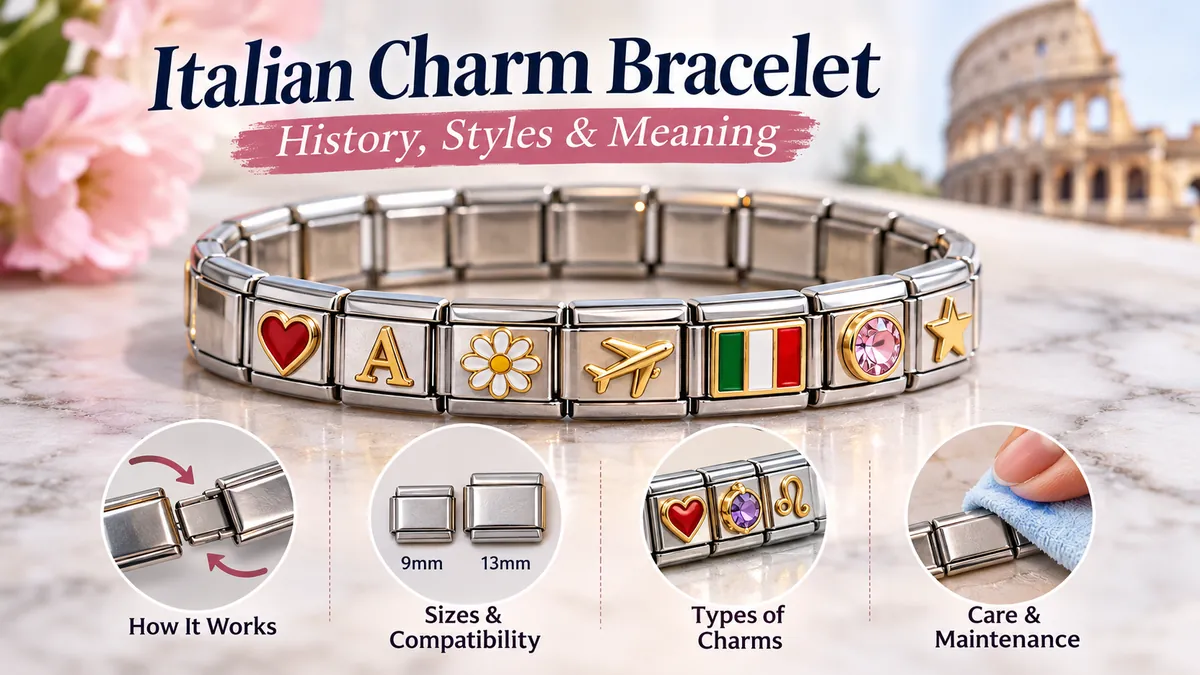
An italian charm bracelet looks simple at first: a smooth band made from small, rectangular metal links. But each link can represent something personal, from a favorite hobby or memorable trip to a meaningful date or symbol.
Unlike traditional dangling charm bracelets, Italian charm bracelets use interchangeable links that fit together into a flexible, watchband-style design. Their modular construction makes it possible to change individual charms without replacing the entire bracelet.
An italian charm bracelet is a customizable piece of jewelry made from connected metal links, many featuring decorative images, letters, symbols, gemstones, or enamel designs. Most classic versions use spring-loaded links that expand to allow charms to be added or removed. The result is a flat, personalized bracelet that can evolve over time.
What Is an italian charm bracelet?
An Italian charm bracelet is a modular bracelet built from individual rectangular links rather than a conventional chain with hanging pendants.
Each decorative link forms part of the bracelet itself. When the links are connected, they create a continuous band that wraps around the wrist.
The defining characteristics include:
- Interchangeable charms: Individual links can be replaced to change the bracelet’s appearance.
- Flat profile: Decorative elements generally sit against the wrist instead of hanging below it.
- Expandable construction: Many traditional designs use spring mechanisms to connect and release links.
- Personalized designs: Letters, birthstones, flags, animals, hobbies, and meaningful symbols can all become part of the bracelet.
- Flexible sizing: Adding or removing links changes the bracelet’s circumference.
The bracelet can be worn as a simple metallic accessory or turned into a collection of personal memories.
How Italian Charm Bracelets Differ From Traditional Charm Bracelets
The biggest difference is how the charms attach.
Traditional charm bracelets usually feature a chain with pendants suspended from individual loops or clasps. Italian charm bracelets integrate decorative links directly into the band.
| Feature | Italian charm bracelet | Traditional charm bracelet |
|---|---|---|
| Structure | Interlocking rectangular links | Chain or solid bracelet |
| Charm style | Flat decorative links | Hanging pendants |
| Customization | Replace individual links | Attach or remove pendants |
| Movement | Charms remain relatively flat | Pendants swing freely |
| Sizing | Add or remove links | Adjust chain or clasp |
| Overall look | Compact, watchband-like | Layered, dangling design |
Neither style is inherently better. The choice depends on comfort, appearance, and the type of customization someone enjoys.
The History of Italian Charm Bracelets
Italian charm bracelets became internationally recognizable during the late 1990s and early 2000s, when modular jewelry developed a particularly strong following.
Their design drew on Italy’s established jewelry-making traditions, including metalworking, decorative enamel, and personalized accessories.
The concept was appealing because it combined fashion with collectibility. Instead of selecting one permanent bracelet design, wearers could build a unique arrangement of charms and change it whenever they wanted.
The Rise of Nomination and the Composable Bracelet
One of the most influential names associated with this jewelry style is Nomination.
Founded in Florence, Italy, in 1987 by Paolo Gensini, Nomination became known for its Composable bracelet system.
The Composable concept allowed wearers to create a bracelet from individual decorative links. Its recognizable rectangular shape helped establish the style that many people now associate with Italian charm bracelets.
Over time, the range of decorative motifs expanded to include letters, hearts, travel symbols, zodiac signs, sports, and special occasions.
Nomination is a specific brand, however, while Italian charm bracelet is also used more broadly to describe similar modular bracelets from other manufacturers.
Why Italian Charm Bracelets Became Popular in the 2000s
During the early 2000s, personalized jewelry was especially popular among teenagers and young adults.
Italian charm bracelets worked well as collectible accessories because people could add individual links for birthdays, holidays, friendships, and other milestones.
A bracelet might begin with an initial and a heart charm, then gradually develop into a collection representing years of experiences.
The relatively compact design also made it convenient for everyday wear.
The Return of Italian Charm Bracelets
Italian charm bracelets have attracted renewed attention through nostalgia for early-2000s fashion, often called Y2K style.
Social media platforms such as TikTok, Pinterest, and Instagram have helped introduce the look to younger audiences interested in customizable accessories and vintage-inspired jewelry.
The renewed interest reflects several broader fashion preferences: personal expression, nostalgic designs, and jewelry that can be rearranged rather than treated as a finished, unchangeable piece.
How Does an italian charm bracelet Work?
The traditional Italian charm bracelet uses a system of connected links that can expand slightly to reveal their attachment points.
Although designs differ between manufacturers, many classic bracelets contain spring-loaded mechanisms that hold the links together.
When the bracelet is relaxed, the links form a smooth, flexible band. When a link is extended, a small opening becomes accessible, allowing another compatible link to be connected or removed.
Understanding the Link Mechanism
A typical modular charm link includes a decorative upper surface, a metal body, and an internal attachment mechanism.
The decorative surface might feature enamel artwork, an engraved letter, a raised metal symbol, or a gemstone.
The spring mechanism helps the bracelet flex and maintains the connection between adjacent links.
Not every bracelet uses an identical system. Some inexpensive alternatives rely on different connectors, and some modern designs are not compatible with classic Italian charm links.
How to Add Charms to an Italian Charm Bracelet
Adding a charm becomes easier once you understand how the link opens.
- Place the bracelet on a clean, stable surface.
- Identify the link you want to replace or the point where you want to add a new charm.
- Carefully extend the spring-loaded section to expose the connector.
- Disconnect the existing link if necessary.
- Align the new charm’s attachment points with the neighboring link.
- Connect the links and allow the spring mechanism to return to its normal position.
- Check that the charm is securely attached before wearing the bracelet.
Some people use a dedicated charm-link tool to make the process easier.
Avoid forcing a link open with sharp metal objects. Excessive pressure can damage the spring or scratch the decorative surface.
How to Remove Italian Bracelet Charms
Removing a charm generally follows the same process in reverse.
Extend the appropriate link, expose the connection, and carefully release the neighboring link.
Work slowly, especially with older bracelets. Springs can weaken with age, and excessive bending may permanently damage the mechanism.
If a link feels unusually stiff, check the manufacturer’s instructions before applying additional force.
Italian Charm Bracelet Sizes and Link Compatibility
One of the most common sources of confusion is whether all Italian charm bracelet links are the same size.
They are not.
Although many bracelets share a similar appearance, manufacturers may use different link widths, attachment systems, and decorative dimensions.
Standard 9mm Italian Charm Links
The classic 9mm Italian charm link is widely associated with traditional modular bracelet designs.
The measurement generally refers to the approximate width of the link along the bracelet’s length, although manufacturers may describe dimensions differently.
Standard-size links are often used in bracelets designed for adults and older children.
A typical bracelet contains enough links to fit the wearer’s wrist comfortably, but the exact number depends on the individual link dimensions and the preferred fit.
13mm Italian Charm Links
Some Italian charm systems use larger links, often described as 13mm or Big links.
These create a wider, more prominent bracelet with larger decorative surfaces.
Larger links may appeal to people who prefer bold jewelry or want more visible designs.
However, 13mm links generally cannot be mixed freely with standard 9mm links.
Italian Charm Bracelet Size Comparison
| Link type | Approximate size | Typical appearance | Compatibility |
|---|---|---|---|
| Standard | 9mm | Slim, classic band | Standard systems only |
| Big | 13mm | Wider, bolder band | Matching large-link systems |
| Brand-specific | Varies | Depends on collection | Manufacturer-dependent |
| Generic modular | Varies | Similar rectangular design | Must be verified |
A matching measurement alone does not guarantee compatibility. The connector shape and spring mechanism must also match.
How Many Links Do You Need?
The number of links required depends on wrist circumference, link dimensions, and how tightly the bracelet is intended to fit.
Some standard bracelets are commonly assembled with approximately 17–19 links, but this is only a general reference, not a universal sizing rule.
To estimate the correct fit, measure your wrist using a flexible tape measure and compare the result with the assembled bracelet length provided by the manufacturer.
For example, a wrist measuring 16 cm may require a bracelet slightly longer than 16 cm for comfortable movement.
The exact allowance depends on personal preference and the bracelet’s construction.
A properly fitted bracelet should move slightly without sliding excessively or pinching the skin.
Types of Italian Charm Bracelet Charms
The wide variety of decorative links is central to the appeal of Italian charm jewelry.
Some designs are purely decorative, while others carry personal or symbolic meaning.
Letter and Initial Charms
Alphabet charms are among the most recognizable Italian charm designs.
They can be arranged to spell a name, display initials, or create a short meaningful word.
Popular arrangements include first names, nicknames, initials, and short expressions such as LOVE or HOPE.
Letter charms often use engraved metal, enamel lettering, or raised gold-tone designs.
Birthstone and Zodiac Charms
Birthstone charms associate decorative stones or colored crystals with particular months.
Zodiac charms feature astrological symbols such as Aries, Taurus, Gemini, and Leo.
These designs are commonly chosen to represent birthdays, family members, or personal identity.
Not every charm marketed as a birthstone contains a natural gemstone. Many use synthetic stones, glass, or colored crystals.
Heart, Love, and Friendship Charms
Heart motifs are frequently used to symbolize affection, friendship, and meaningful relationships.
Other designs include infinity symbols, flowers, stars, and interlocking shapes.
A friendship bracelet might feature matching initials or symbols shared between two people.
Travel and Country Flag Charms
Travel-themed charms can represent destinations, cultural interests, or memorable experiences.
Common examples include national flags, landmarks, airplanes, and city symbols.
A person might add a charm after visiting Paris, Rome, London, or New York, gradually creating a wearable travel record.
Animal and Pet Charms
Animal charms are popular among people who want to represent a favorite pet or wildlife interest.
Dogs, cats, horses, butterflies, and paw prints are common motifs.
A pet-themed bracelet can combine an animal symbol with initials or a heart charm.
Hobby, Sport, and Music Charms
Italian charm links can also reflect personal interests.
Sports designs may feature footballs, basketballs, tennis rackets, or team-inspired colors.
Music-related charms may display notes, instruments, or decorative symbols.
Other hobby motifs include books, cameras, paintbrushes, and gaming-inspired artwork.
Religious and Spiritual Charms
Some bracelets incorporate crosses, angels, religious symbols, or other spiritual imagery.
These may be worn as expressions of faith, cultural identity, or personal significance.
Because symbols can carry different meanings across communities, their interpretation depends on the wearer and the design.
Materials Used in Italian Charm Bracelets
The material affects how a bracelet looks, feels, and withstands regular use.
Many classic modular bracelets use stainless steel, while decorative surfaces may include enamel, precious-metal accents, or crystals.
Stainless Steel Italian Charm Bracelets
Stainless steel is widely used because it is strong, relatively resistant to corrosion, and suitable for detailed metal construction.
It also provides the structural strength needed for small spring-loaded components.
However, stainless steel is not completely immune to scratches or corrosion, particularly after prolonged exposure to harsh chemicals.
Some steel alloys contain nickel, which may matter for people with metal sensitivities.
Gold Italian Charm Bracelets
The phrase gold Italian charm bracelet can describe several different constructions.
Some charms contain genuine gold components or accents, while others use gold plating or gold-tone finishes.
These are not equivalent.
Solid gold, gold accents, gold plating, and gold-colored base metal differ significantly in composition and durability.
A gold-tone appearance alone does not establish precious-metal content.
Enamel Italian Charm Links
Enamel is used to create colorful decorative images, letters, and patterns.
Traditional enamel involves a glass-like material, while many contemporary fashion-jewelry pieces use resin-based coatings or enamel-style finishes.
Both can produce bright designs, but their manufacturing methods and durability differ.
Decorative coatings may chip or wear if repeatedly struck against hard surfaces.
Gemstone and Crystal Charms
Some charms incorporate cubic zirconia, glass crystals, synthetic stones, or natural gemstones.
Cubic zirconia is commonly used for diamond-like sparkle at a lower material cost.
The type of stone and its setting affect durability. Small stones held by adhesive may be more vulnerable to loosening than securely set stones.
How to Personalize an Italian Charm Bracelet
Personalization works best when the bracelet follows a theme or tells a story.
A bracelet does not need to contain a different symbol in every link. Plain metal links can create visual balance and make important charms stand out.
Create a Name or Initial Bracelet
A straightforward approach is to arrange letter charms in a meaningful sequence.
For example, a bracelet could feature the initials of family members separated by small heart or star designs.
Another approach is to place a name near the center of the bracelet and surround it with decorative links.
Before arranging the letters, consider how the bracelet will appear when worn. The orientation of the links can affect readability.
Build a Memory Bracelet
A memory bracelet represents significant events through individual charms.
Possible themes include graduation, birthdays, travel, friendships, family milestones, and achievements.
For example, someone could combine a graduation cap, a favorite city symbol, a meaningful date, and an initial.
The bracelet then becomes a personal timeline rather than simply a collection of decorative pieces.
Choose a Consistent Color Theme
A coordinated color palette can make a bracelet feel more intentional.
Popular combinations include silver and black, gold and white, pastel colors, or alternating bright enamel designs.
A balanced arrangement might use a few colorful charms surrounded by plain stainless-steel links.
There is no requirement for every link to match. Contrasting styles can create a distinctive look.
Mix Decorative and Plain Links
One common mistake is filling every available position with highly detailed charms.
This can make the bracelet look visually crowded.
Alternating decorative links with plain metal sections gives the design more breathing room.
A central focal charm, such as an initial or birthstone, can also help organize the overall appearance.
How to Identify an Authentic Italian Charm Bracelet
Because Italian charm bracelets are produced by multiple manufacturers, authenticity requires understanding what is being claimed.
A bracelet may be a genuine modular charm bracelet without being an original Nomination product.
Similarly, an Italian-inspired design is not necessarily manufactured in Italy.
Check Brand Markings
Branded bracelets may include engraved logos, manufacturer markings, or identifying details on individual links.
Nomination products, for example, are associated with specific branding and collection designs.
However, markings alone are not conclusive proof of authenticity because imitation products can reproduce logos.
Packaging, provenance, construction quality, and reliable product documentation provide additional evidence.
Examine the Link Construction
Well-made links should connect securely and move smoothly without excessive looseness.
Check for uneven edges, rough metal surfaces, damaged springs, or poorly aligned connectors.
Decorative elements should appear properly positioned and securely attached.
A bracelet that repeatedly separates during ordinary movement may have worn or incompatible links.
Understand the Difference Between Branded and Generic Charms
Generic Italian-style charms can be attractive and functional, but they should not automatically be assumed to meet the specifications of a branded system.
A charm described as compatible may still have small differences in connector dimensions.
Using mismatched components can create an uneven bracelet or damage neighboring links.
When compatibility matters, verify the specific collection and attachment mechanism rather than relying only on a generic size label.
How to Clean and Care for an Italian Charm Bracelet
Regular maintenance helps preserve the bracelet’s appearance and protects its moving parts.
Because the bracelet contains small connections and decorative surfaces, gentle cleaning is generally preferable to aggressive polishing.
Cleaning a Stainless Steel Charm Bracelet
For ordinary dirt and skin oils:
- Wipe the bracelet with a soft, dry microfiber cloth.
- Use a slightly damp cloth with a small amount of mild soap for stubborn residue, if the manufacturer permits it.
- Clean carefully around the edges of individual links.
- Remove soap residue with another lightly damp cloth.
- Dry the bracelet thoroughly, especially around the spring mechanisms.
Avoid soaking a bracelet unless its manufacturer specifically confirms that immersion is safe.
Water trapped around springs or decorative attachments may cause problems over time.
Protecting Enamel and Gold-Plated Charms
Enamel surfaces and plated finishes require extra care.
Avoid abrasive cleaning pads, harsh detergents, and metal-polishing compounds that are not intended for the specific finish.
Perfume, hairspray, lotions, and household cleaning products can also affect decorative coatings.
Allow skincare products to dry before putting on the bracelet.
Can You Wear an Italian Charm Bracelet in the Shower?
Removing the bracelet before showering is generally the safer choice.
Although stainless steel can tolerate occasional moisture, a complete bracelet may contain enamel, plating, adhesives, stones, and spring components that respond differently to water.
Soap residue and repeated exposure to moisture can also accumulate between the links.
The same caution applies to swimming pools, hot tubs, and saltwater.
How to Store Italian Charm Bracelets
Store the bracelet in a clean, dry jewelry pouch or a compartment separate from harder accessories.
This reduces unnecessary scratching and protects raised decorative details.
If the bracelet will not be worn for an extended period, wipe away moisture and skin oils before storing it.
Common Italian Charm Bracelet Problems and Solutions
Modular bracelets are convenient, but their moving parts can develop problems after repeated use.
Understanding the likely cause can help prevent further damage.
| Problem | Possible cause | Recommended action |
|---|---|---|
| Charm will not connect | Incompatible link or misalignment | Check the link system and connector shape |
| Bracelet feels too tight | Insufficient assembled length | Add compatible links |
| Bracelet slips excessively | Too many links | Remove one or more links |
| Link is difficult to open | Stiff or damaged spring | Use the correct tool and avoid force |
| Decorative finish is fading | Wear, chemicals, or abrasion | Clean gently and limit exposure |
| Bracelet separates unexpectedly | Worn or poorly connected links | Inspect and replace faulty components |
Why Do Italian Charm Links Get Stuck?
A link may become difficult to open because of dirt buildup, misalignment, corrosion, or a damaged internal spring.
Do not twist the link aggressively or pry it apart with a knife.
Try cleaning the accessible area gently and using a suitable charm tool.
If the mechanism remains stuck, professional jewelry assistance may prevent permanent damage.
Can You Mix Different Italian Charm Brands?
Sometimes, but not always.
Certain generic links may fit particular branded systems, while others may be incompatible despite looking nearly identical.
Link width, spring tension, connector geometry, and overall thickness all influence compatibility.
The safest approach is to use links confirmed to work with the exact bracelet system.
Can a Broken Italian Charm Bracelet Be Repaired?
Minor problems may be resolved by replacing a damaged link.
If the bracelet’s spring mechanism is permanently bent or broken, replacing the affected component is often more practical than attempting to rebuild it.
For expensive or sentimental jewelry, consult a qualified jeweler before making repairs.
Are Italian Charm Bracelets Comfortable for Everyday Wear?
Italian charm bracelets can be comfortable because they have a relatively flat design without numerous hanging pendants.
Their flexible construction allows the band to follow the wrist’s movement.
However, comfort depends on correct sizing, link quality, and individual skin sensitivity.
A bracelet that is too tight may pinch the skin or catch fine hairs between its moving parts.
A bracelet that is too loose may rotate excessively or catch on nearby objects.
For regular wear, choose a fit that allows slight movement without creating pressure.
People with known metal allergies should also check the bracelet’s material specifications rather than assuming all stainless-steel jewelry is hypoallergenic.
Italian Charm Bracelet Styling Ideas
Italian charm bracelets can complement casual outfits, vintage-inspired fashion, and simple everyday jewelry.
Their modular design also makes it possible to change the look without replacing the entire accessory.
Minimalist Styling
A minimalist bracelet might use mostly plain stainless-steel links with two or three decorative charms.
Small initials, geometric motifs, or subtle stones can provide detail without overwhelming the design.
This approach works well with understated jewelry and neutral clothing.
Y2K-Inspired Styling
For an early-2000s look, combine colorful enamel charms, playful symbols, and nostalgic motifs.
Butterflies, stars, hearts, smiley faces, and bright lettering fit this style.
The result can be expressive without requiring oversized jewelry.
Layering With Other Bracelets
Italian charm bracelets can be worn alongside slim bangles, simple chain bracelets, or a wristwatch.
When layering, consider how the different pieces move against one another.
Hard metal surfaces may scratch delicate finishes, especially plated or polished jewelry.
Keeping some space between accessories can reduce friction.
Matching Friendship Bracelets
Two people can create related bracelets using matching colors, initials, or symbols.
The bracelets do not need to be identical.
For example, both might include a shared heart charm while using different letters or personal motifs elsewhere.
This creates a connection while preserving individual style.
What Makes an Italian Charm Bracelet Meaningful?
The strongest appeal of an Italian charm bracelet is its ability to represent experiences through small, changeable details.
A single link might commemorate a birthday. Another could represent a friendship, a family member, a favorite animal, or a place visited years earlier.
Over time, the bracelet becomes a collection of symbols chosen by the wearer.
Unlike a fixed piece of jewelry, its arrangement can change as interests, relationships, and memories evolve.
That flexibility is what makes the modular design distinctive.
An italian charm bracelet combines decorative jewelry with personal storytelling. Understanding its history, link sizes, materials, and attachment mechanisms makes it easier to customize and maintain one properly. Start with a comfortable, compatible bracelet base, choose a few meaningful links, and allow the design to develop naturally over time.