
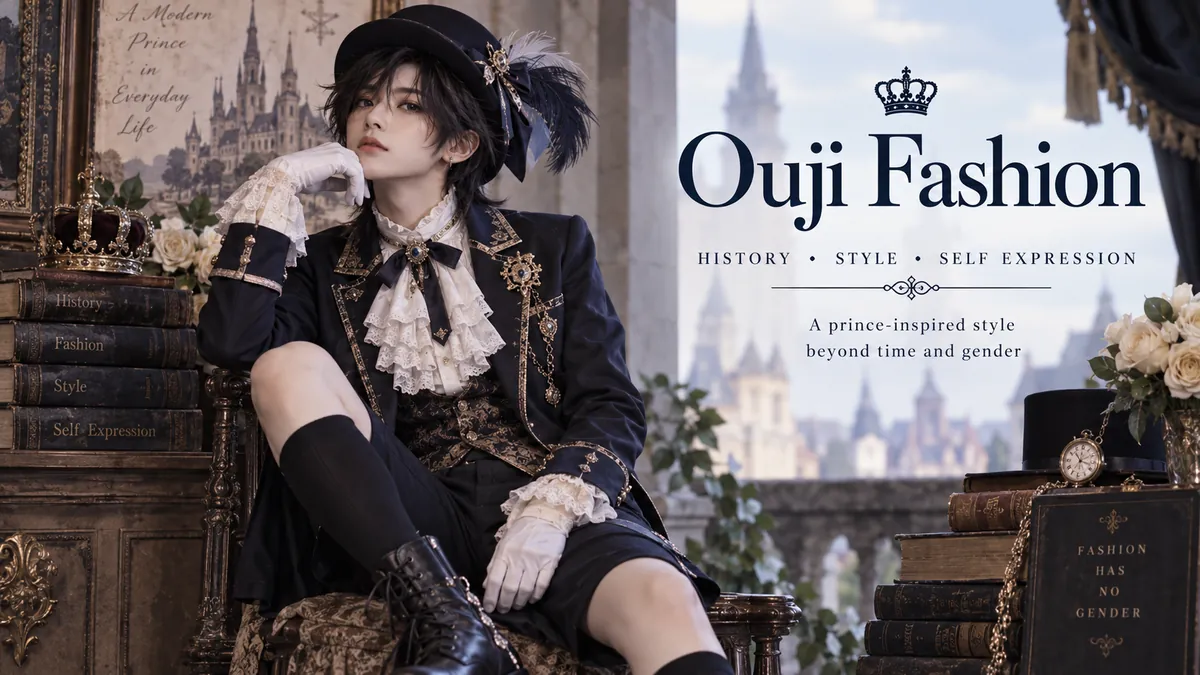
Ouji fashion can look as though a young European prince stepped out of an old portrait and into the streets of modern Japan. Tailored shorts, elaborate blouses, waistcoats, polished boots, lace, hats, and dramatic coats all play a part—but the style is more than simply wearing historical-looking clothes.
Ouji fashion is a Japanese alternative fashion built around a youthful, prince-inspired silhouette. It combines European historical menswear influences with Japanese street fashion, using tailored trousers or shorts, decorative shirts, waistcoats, jackets, socks, boots, hats, and carefully coordinated accessories. Although masculine-inspired, ouji can be worn by people of any gender.
Understanding the silhouette is the key. Once you understand proportion, layering, and coordination, the elaborate details become much easier to work with.
What Is Ouji Fashion?
The word ouji (王子) means “prince” in Japanese, which neatly captures the central idea of the style. Ouji creates the impression of a youthful aristocratic or storybook prince through clothing influenced by historical European menswear.
You may also encounter terms such as boystyle, prince style, dandy, and kodona. Terminology has varied between Japanese and international fashion communities, and these labels are not always used in exactly the same way. Boystyle is often treated as the broader family, while ouji commonly describes its youthful princely expression.
A recognizable coordinate often includes:
- A high-collared, ruffled, pintucked, or otherwise decorative blouse
- A fitted waistcoat or vest
- Knee-length shorts, knickerbockers, pumpkin pants, or tailored trousers
- Knee-high or over-the-knee socks
- Structured jackets, tailcoats, capes, or military-inspired outerwear
- Boots, oxfords, or other formal-looking shoes
- Neckwear such as a jabot, cravat, ribbon, bow, or tie
- Headwear such as a beret, top hat, tricorn, or newsboy-style cap
- Details such as chains, brooches, pocket watches, lace, ribbons, or embroidery
No single garment automatically makes an outfit ouji. The complete silhouette and coordination matter more than checking off individual pieces.
Is ouji fashion the same as Lolita fashion?
Not exactly.
Ouji is closely associated with Lolita fashion, and enthusiasts of both styles often share brands, events, communities, historical references, and an emphasis on creating a complete coordinate. However, boystyle/ouji is generally treated as a related fashion rather than simply another Lolita dress substyle.
Lolita’s recognizable silhouette is usually constructed around a skirt or dress with significant volume. Ouji instead builds its silhouette around shorts or trousers, tailoring, waistcoats, jackets, hosiery, and masculine-inspired historical shapes.
Calling it simply “male Lolita” can therefore be misleading. It describes the relationship between the fashions, but not ouji’s full identity.
And despite its masculine references, ouji is not restricted to men. People of any gender can wear it.
Where Did Ouji Fashion Come From?
Ouji belongs to the wider world of Japanese alternative and street fashion. Sources commonly place its development around the late 1990s and early 2000s, during a period when Lolita, gothic fashion, Harajuku street style, and visual kei were highly visible parts of Japan’s alternative-fashion culture.
Its visual vocabulary draws heavily on imagined and reinterpreted European historical dress.
Victorian influences
Victorian-inspired menswear is particularly important to the familiar ouji silhouette.
Tailored jackets, waistcoats, high collars, formal shirts, short trousers, knee socks, and elaborate accessories can evoke the appearance of an upper-class Victorian boy. Boystyle references specifically describe the fashion as drawing from clothing associated with young upper-class boys of the Victorian period.
Regency and Rococo references
More elaborate coordinates can borrow visual ideas associated with Regency and Rococo clothing as well. Decorative shirts, ornate neckwear, embroidery, luxurious fabrics, fitted coats, and flamboyant detailing contribute to the romantic “prince” image.
These references should not be interpreted too literally.
Ouji is not historical reenactment. A coordinate does not need to reproduce an authentic outfit from a particular European decade. Designers reinterpret historical ideas through modern Japanese fashion.
That freedom is why a military jacket, Victorian-looking blouse, modern platform shoes, and fantasy-themed accessories can coexist successfully in one coordinate.
Visual kei and gothic fashion
The development of Japanese gothic and visual kei aesthetics also overlaps with the visual language surrounding ouji and aristocrat fashion.
Dark palettes, elaborate tailoring, dramatic makeup, ornate jackets, and gender-fluid presentation all appear across these interconnected scenes.
Atelier Boz, for example, became known for elegant gothic clothing with simple silhouettes and military influences, while its garments appeared in Japanese gothic and Lolita publications and on musicians.
This helps explain why some ouji coordinates feel romantic and youthful while others look much darker and more theatrical.
The Ouji Fashion Silhouette Matters Most
The easiest beginner mistake is focusing on accessories before establishing the silhouette.
A miniature crown, ruffled shirt, and pocket watch cannot compensate for proportions that feel disconnected.
A strong ouji coordinate usually creates deliberate visual structure through the torso and legs.
Upper body
Blouses establish the historical character of many coordinates.
Common details include:
- High collars
- Ruffles
- Pintucks
- Lace
- Bishop sleeves
- Decorative cuffs
- Frills
- Bows or detachable neckwear
A waistcoat can then define the waist and make the outfit feel more tailored.
Structured jackets add another layer. Depending on the substyle, these might resemble military coats, frock coats, cropped jackets, tailcoats, or gothic outerwear.
Lower body
Ouji offers considerably more variety than the stereotype of “ruffled blouse plus knee-length shorts.”
Traditional boystyle references include everything from full-length trousers to knee-length bottoms and shorter pumpkin pants.
The choice dramatically changes the coordinate.
Short, voluminous bottoms create a youthful, whimsical silhouette. Slim knee-length trousers can appear cleaner and more formal. Full-length trousers usually create a taller, more mature line.
That means two outfits can share the same blouse and jacket but communicate very different characters simply through trouser shape.
Legs and footwear
When shorts expose much of the lower leg, hosiery becomes visually significant.
Knee-high socks are common, while some coordinates use patterned stockings or other legwear that complements the outfit’s motifs.
Footwear should carry enough visual weight to balance the clothing above it. Depending on the coordinate, common choices include boots, lace-up shoes, oxfords, platform shoes, or other historically inspired footwear.
The shoes do not have to be historically accurate. They need to support the silhouette.
Quick Takeaway: Build an ouji outfit from silhouette outward: bottoms first, blouse second, waistcoat or jacket third, then shoes, headwear, and smaller accessories.
Essential Ouji Fashion Clothing
You do not need an enormous wardrobe to understand the style. A relatively small collection of compatible pieces can produce multiple coordinates.
| Piece | Role in the outfit | Common characteristics |
|---|---|---|
| Blouse | Creates the historical foundation | Ruffles, lace, high collars, statement sleeves |
| Shorts/trousers | Defines the silhouette | Knee-length, pumpkin, fitted or full-length |
| Waistcoat | Shapes the torso | Tailored, brocade, embroidered or plain |
| Jacket | Adds structure | Military, gothic, cropped, long or tailcoat |
| Socks/stockings | Connects bottoms and shoes | Knee-high, patterned or solid |
| Shoes | Grounds the silhouette | Boots, oxfords, platforms |
| Neckwear | Adds detail near the face | Jabots, cravats, bows, ties |
| Headwear | Completes the coordinate | Berets, top hats, tricorns, caps |
Blouses and shirts
A good blouse is one of the most reusable pieces in an ouji wardrobe.
White and ivory blouses work particularly well because they can sit underneath black, navy, brown, burgundy, patterned, or colorful outer layers.
Black blouses naturally suit darker gothic coordinates.
Rather than choosing a shirt purely because it contains lace, look at its collar, sleeves, cuffs, and how much detail remains visible underneath a waistcoat or jacket.
Waistcoats and vests
Waistcoats are common but not mandatory.
Their usefulness comes from proportion. A fitted vest can provide a clear transition between a decorative blouse and more voluminous trousers.
Brocade, embroidery, metallic buttons, lapels, chains, and contrasting trims can make the waistcoat the focal point. A plain fitted vest, meanwhile, can calm down a heavily printed coordinate.
Shorts, breeches, and trousers
This is where experimenting with proportion pays off.
Try thinking in three broad categories:
- Voluminous short bottoms for playful, youthful coordinates.
- Tailored knee-length bottoms for the recognizable classic prince silhouette.
- Long trousers for elegant, gothic, military, or mature interpretations.
There is no universal requirement that ouji must use shorts.
Jackets and coats
Outerwear can transform a simple coordinate.
Military-inspired jackets introduce sharp lines, rows of buttons, epaulettes, braid, and structured shoulders. Long gothic coats create drama. Tailcoats emphasize historical fantasy, while cropped jackets preserve a youthful proportion.
Atelier Boz became especially associated with elegant silhouettes and military-influenced details, including prominent button arrangements.
Ouji Fashion Accessories: How Much Is Enough?
Accessories are important, but more decoration does not automatically mean a better coordinate.
The goal is repetition and visual connection.
If your jacket has antique-gold buttons, a gold-toned pocket-watch chain or brooch can repeat that detail. If burgundy appears in the socks, repeating it in a ribbon or hat decoration can make the palette feel deliberate.
Neckwear
Common choices include:
- Jabots
- Cravats
- Ribbon ties
- Bow ties
- Decorative ties
- Brooches at the collar
A dramatic jabot works well when the rest of the torso is relatively controlled. With a heavily embellished blouse and patterned waistcoat, simpler neckwear may look more balanced.
Hats and headwear
Headwear has long been prominent in boystyle. Top hats, miniature hats, pirate tricorns, berets, and even small crowns have all appeared within the fashion.
A hat should match the visual language of the coordinate.
A tricorn makes sense with pirate styling. A military cap supports a military coordinate. A beret can soften a casual or school-inspired outfit.
Jewelry and small details
Pocket watches and chains are classic choices. Other possibilities include rings, brooches, gloves, corsages, medals, ribbons, decorative pins, and bags.
Feminine-coded details such as flowers, bows, lace, and veils can also appear in boystyle despite its masculine foundation.
That flexibility is one of the fashion’s strengths.
Major Ouji Fashion Styles
Ouji is better understood as a flexible fashion framework than a single uniform.
Different coordinates can share the same basic prince silhouette while expressing completely different moods.
Classic ouji fashion
Classic coordinates emphasize refined tailoring and restrained elegance.
Think ivory blouse, fitted waistcoat, tailored shorts, knee socks, polished shoes, and a structured jacket.
Brown, cream, navy, burgundy, black, antique gold, and muted jewel tones work naturally here.
Decoration tends to support the tailoring rather than overwhelm it.
Gothic ouji fashion
Gothic ouji pushes the style toward darker imagery.
Black dominates many outfits, sometimes paired with white, navy, deep red, purple, silver, or jewel tones. Crosses, gothic architecture, dramatic lace, long coats, platform footwear, chains, and elaborate neckwear may appear.
Brands connected with Japanese gothic and Lolita scenes—such as Moi-même-Moitié, Atelier Boz, Miho Matsuda, Sheglit, and Alice and the Pirates—help illustrate the overlap between these aesthetics.
Military ouji
Military-inspired coordinates rely on structure.
Typical elements include:
- Double-breasted jackets
- Decorative buttons
- Braiding
- Epaulettes
- Medals
- Tall boots
- Fitted trousers
- Military-style caps
Navy, black, white, burgundy, olive, and metallic accents are natural choices.
The danger is becoming too literal. Ouji usually works best when military references are blended with elegant fashion details rather than treated as a reproduction of an actual uniform.
Pirate ouji
Pirate-inspired ouji is one of the most visually recognizable interpretations.
Tricorn hats, boots, elaborate blouses, asymmetrical layers, waistcoats, chains, nautical motifs, and dramatic outerwear create the effect.
Alice and the Pirates, the sister/sub-label associated with Baby, The Stars Shine Bright, is particularly relevant here. Established as a label in the mid-2000s, its concept combines pirate imagery with decorative Lolita and gothic clothing, including prince-style coordinates based around jackets, trousers, and hats.
Sweet or lighter ouji
Ouji does not have to be black.
Cream, dusty blue, pink, lavender, ivory, pale gold, and other softer colors can create a youthful fantasy-prince aesthetic.
The trick is preserving the tailored boystyle silhouette. If the palette becomes sweeter, structure from the waistcoat, shorts, jacket, or footwear helps keep the coordinate recognizable.
Ouji vs. Kodona vs. Dandy vs. Aristocrat
These terms frequently cause confusion because usage has changed between communities and eras.
| Term | General association |
|---|---|
| Ouji | Youthful, prince-like Japanese boystyle |
| Boystyle | Broad masculine-inspired fashion category |
| Kodona | Older/alternative term often encountered outside Japan |
| Dandy | More mature gentleman-like interpretation |
| Aristocrat | Longer, mature, elegant and often gothic silhouette |
The boundaries are not absolute.
“Kodona” became particularly familiar to Western fans as a label for boy-style fashion, while contemporary enthusiasts frequently prefer ouji or boystyle terminology. Sources also connect the term kodona with Ryūtarō Arimura, vocalist of the Japanese band Plastic Tree.
Ouji vs. aristocrat fashion
The distinction is especially useful.
Ouji generally communicates youth: prince, page, schoolboy, young noble, or fantasy adventurer.
Aristocrat fashion tends to communicate maturity and elongated elegance.
Aristocrat styling commonly uses long skirts, dresses, trousers, corsetry, long sleeves, and gothic elements while emphasizing androgyny and elegance. Elegant Gothic Aristocrat (EGA) is specifically associated with Mana and his Moi-même-Moitié brand.
Imagine two characters from the same fictional royal household: the young prince might inspire an ouji coordinate, while the mysterious adult noble might inspire aristocrat styling.
That is more useful than trying to enforce a rigid checklist.
How to Build an Ouji Fashion Outfit
For a first coordinate, restraint usually works better than attempting the most elaborate outfit possible.
1. Choose your concept
Decide what kind of character or mood you want.
For example:
- Victorian prince
- Gothic prince
- Military academy
- Pirate
- Romantic aristocratic boy
- Fantasy royal
- Dark storybook character
This creates a filter for every later decision.
2. Choose the bottoms
Start with shorts or trousers because they establish the proportions.
Suppose you choose black knee-length shorts with moderate volume. You already know that knee socks and boots could work naturally and that the upper body should visually balance the width of the shorts.
3. Add a compatible blouse
Choose a blouse with enough historical or decorative character to support the look.
A white high-collared ruffled blouse is versatile. A black bishop-sleeve blouse produces a darker effect. An ivory shirt with restrained pintucks suits classic styling.
4. Define the torso
Add a waistcoat, corset-style vest, fitted jacket, or another structured layer.
Pay attention to where the garment ends.
If every piece is oversized or long, the silhouette can lose definition. Conversely, extremely tight upper pieces paired with tiny bottoms may make the proportions feel accidental rather than princely.
5. Connect the legs and shoes
Match hosiery to the overall palette.
Then choose footwear substantial enough to finish the outfit. Boots are particularly useful, but they are not compulsory.
6. Add neckwear and headwear
Now introduce the stronger styling signals: a jabot, ribbon, brooch, beret, tricorn, top hat, or other suitable accessory.
7. Edit the outfit
This final step is often ignored.
Stand in front of a mirror—or better, take a full-length photograph. Accessories that looked small individually can become visually noisy when combined.
Remove anything that does not strengthen the concept.
What actually works: repeat two or three motifs, colors, or materials across the outfit instead of adding ten unrelated “Victorian” accessories.
Color, Fabric, and Pattern in Ouji Fashion
Black and white may be highly recognizable, but the style supports a much larger palette.
Common colors include black, white, grey, navy, blue, burgundy, brown, cream, and jewel tones, while contemporary coordinates can extend into pastels and brighter combinations. Historical boystyle descriptions particularly associate black, white, blue, and burgundy with the fashion.
Fabrics
Texture can make even a limited palette interesting.
Ouji garments may incorporate:
- Cotton
- Wool
- Velvet
- Brocade
- Jacquard
- Lace
- Chiffon
- Satin accents
- Faux leather
A black coordinate combining matte cotton, velvet, metal hardware, and lace can have considerable visual depth without adding another color.
Prints
Prints are perfectly compatible with ouji when they support the theme.
Heraldry, crowns, playing cards, architecture, books, clocks, nautical imagery, crests, florals, stripes, and fantasy motifs can all work.
When wearing a strong print, allow it to lead the coordinate. Pull one or two colors from it for your blouse, socks, jacket, or accessories rather than introducing several unrelated motifs.
Hair and Makeup in Ouji Style
There is no mandatory ouji haircut.
Historically inspired boystyle references note that short hair is common for creating a boyish impression, while longer hair may be styled up.
Modern coordinates are far more flexible.
Natural hair, short cuts, long hair, curls, styled wigs, ponytails, and elaborate fantasy hairstyles can all work if they complement the clothing.
The same applies to makeup.
Classic coordinates might use understated makeup, while gothic or visual-kei-influenced outfits can support sharper eyeliner, stronger contouring, or a more theatrical face.
The useful question is not “Is this masculine enough?”
Ask: Does this styling support the character and proportions of the coordinate?
Ouji Fashion Brands and Their Influence
You do not need brand clothing to wear ouji, but learning established labels is useful because their archives demonstrate how the silhouette has developed.
Alice and the Pirates
Alice and the Pirates / Baby, The Stars Shine Bright has been particularly influential in the crossover between Lolita, gothic, pirate, and prince styling.
The label began developing in 2004 and became known for darker and more unusual pirate and military influences compared with its sister brand. It also produces masculine garments and prince-style coordinates.
Atelier Boz
Atelier Boz is strongly associated with elegant gothic tailoring, solid colors, jackets, vests, blouses, top hats, and military-inspired detailing. The original label was founded by Takashi Shibata after his fashion education and time studying in Paris.
Its clean, structured designs are particularly useful references for understanding how ouji can look sophisticated without excessive lace.
Other names worth knowing
The broader boystyle and Japanese alternative-fashion ecosystem has included labels such as Alice Auaa, Fanplusfriend, Metamorphose Temps de Fille, Miho Matsuda, Moi-même-Moitié, Ozz On Japan, Sheglit, h.NAOTO, Atelier Pierrot, Innocent World, Marble, MAXICIMAM, and others. Availability and the amount of specifically ouji-suitable clothing vary considerably between brands and collections.
Studying these brands is often more useful than copying a single outfit. Look at how designers control jacket length, waist placement, trouser volume, sock height, footwear, and accessory scale.
Can You Wear Ouji Fashion Without Buying Japanese Brands?
Yes.
Brand authenticity and style authenticity are not the same thing.
A convincing coordinate can combine specialty pieces with vintage garments, secondhand clothing, altered menswear, handmade accessories, and carefully selected mainstream basics.
The challenge is finding the correct shape.
A generic modern office vest may technically be a waistcoat, for example, but its low neckline and contemporary cut may not create the same effect as a high-waisted, decorative piece designed around an ouji silhouette.
When adapting ordinary clothing, prioritize:
- Silhouette
- Fit
- Fabric
- Construction
- Color harmony
- Historical-looking details
- Accessories
This approach is usually more successful than buying anything labeled “prince,” “Victorian,” or “Lolita.”
Common Ouji Fashion Mistakes
Ouji is flexible, but a few mistakes repeatedly make coordinates feel less cohesive.
Treating it as a costume
Historical inspiration does not mean historical costume.
A generic Halloween prince jacket plus random knee socks rarely captures the deliberate layering and tailoring of Japanese street fashion.
Study complete coordinates rather than isolated costume pieces.
Adding too many accessories
More chains, bows, crosses, clocks, crowns, rings, ribbons, and lace do not automatically create more visual impact.
Strong coordinates usually have hierarchy: one focal point, several supporting details, and enough quiet space for those details to register.
Ignoring proportion
This is probably the biggest issue.
An oversized blouse, long waistcoat, knee-length jacket, baggy shorts, tall socks, and bulky boots can divide the body into too many competing shapes.
Check the full silhouette, not each garment independently.
Assuming ouji must be black
Gothic ouji is highly visible, but the fashion itself is not limited to gothic colors.
Classic, military, pirate, romantic, printed, and pastel interpretations all demonstrate how broadly the prince silhouette can be adapted.
Confusing ouji with cosplay
Both can be elaborate, and both may draw on fantasy or historical imagery, but their goals differ.
Cosplay usually represents a particular character. Ouji is a fashion system used to create personal outfits.
Someone can therefore wear ouji to a convention without cosplaying anyone.
Believing only men can wear it
This misconception conflicts with how boystyle has long been described within the fashion community. Its inspiration is masculine clothing, but the style itself can be worn by any gender.
How to Make Ouji Fashion More Wearable
Not every coordinate needs a tailcoat and top hat.
For a toned-down outfit, keep the recognizable structure while reducing ornamentation.
Try tailored knee-length shorts, a high-collared blouse, a simple waistcoat, knee socks, and polished shoes. Add one strong accessory—perhaps a ribbon tie or beret—rather than several.
For colder weather, long trousers, wool jackets, capes, velvet, and layered waistcoats make sense naturally.
Warm-weather coordinates require more care. Lighter blouses, short trousers, fewer layers, breathable fabrics, and minimal headwear can preserve the silhouette without creating unnecessary discomfort.
This is also where separating rules from conventions becomes useful. The objective is not to recreate a museum display. It is to maintain enough of the silhouette and visual vocabulary that the outfit still reads clearly as ouji.
Why Ouji Fashion Remains Distinctive
Ouji sits at an unusual intersection of fashion influences.
It can be historically inspired without being historical reenactment. It can be masculine without restricting who wears it. It can be elaborate without becoming cosplay. And it can exist beside Lolita fashion while maintaining a silhouette of its own.
Its connection with Japanese street fashion, Harajuku culture, Lolita, gothic fashion, visual kei, Victorian-inspired clothing, aristocrat fashion, and alternative fashion gives wearers a remarkably large visual vocabulary to explore.
The strongest coordinates still return to one basic principle: proportion before decoration.
Start with the shape of the blouse, waist, shorts or trousers, hosiery, and shoes. Establish a coherent palette. Then introduce jackets, jabots, hats, brooches, pocket watches, chains, lace, and other details where they actually contribute something.
That is the heart of ouji fashion. It is not simply dressing like a prince. It is a Japanese fashion language that takes the idea of princely dress and turns it into something structured, expressive, and open to continual reinterpretation.