
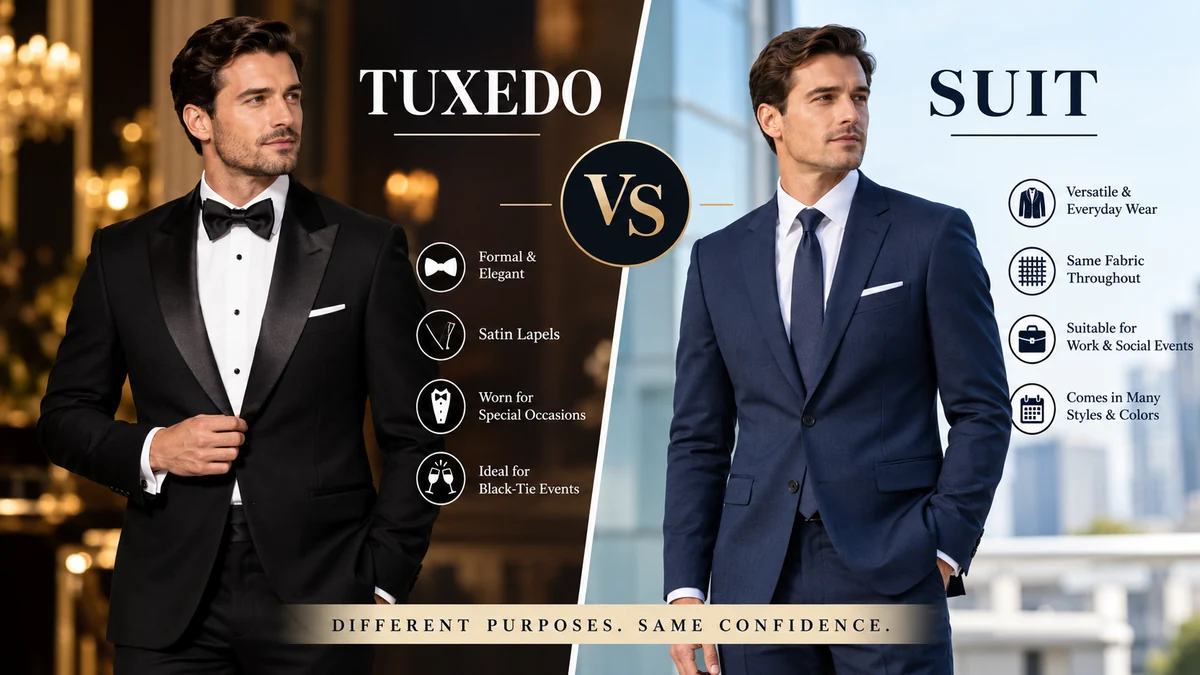
A tuxedo and a suit can look almost identical from across the room. Get closer, though, and the differences become obvious. Satin-faced lapels, covered buttons, trouser stripes, shirt choices, footwear, and even the occasion itself separate one from the other.
The tuxedo vs suit distinction comes down mainly to formality and detailing. A traditional tuxedo is formal evening wear featuring satin or grosgrain on the lapels, buttons, and trouser seams. A suit generally uses the same fabric throughout and works across a much wider range of occasions, from business meetings to weddings.
The easiest rule to remember is simple: black tie normally calls for a tuxedo; most less-formal dress codes allow or favor a suit.
Tuxedo vs Suit: Quick Comparison
Before getting into the finer details, this table shows how the two garments traditionally differ. Modern designers sometimes bend these conventions, so individual garments may not follow every rule exactly.
| Feature | Tuxedo | Suit |
|---|---|---|
| Formality | Formal evening wear | Business to formal/social wear |
| Lapels | Usually satin/grosgrain-faced | Usually same fabric as jacket |
| Common lapel styles | Peak or shawl | Notch or peak |
| Jacket buttons | Often fabric-covered | Usually horn, plastic, corozo, or similar |
| Trousers | Traditionally satin stripe | No satin stripe |
| Belt loops | Traditionally absent | Common |
| Shirt | Formal white dress shirt | Standard dress shirt |
| Neckwear | Traditionally black bow tie | Necktie or bow tie |
| Waist covering | Cummerbund or formal waistcoat may be worn | Waistcoat optional |
| Shoes | Highly polished black shoes or formal pumps | Oxfords, Derbies, loafers and other dress shoes |
| Typical occasion | Black-tie evening event | Work, weddings, funerals, dinners, celebrations |
| Colors | Traditionally black or midnight blue | Wide variety |
| Versatility | Specialized | High |
A black suit does not automatically become a tuxedo simply because the two share the same color. The construction and styling details matter much more than color.
What Is a Tuxedo?
A tuxedo—also called a dinner suit in some parts of the world—is a specialized form of formal evening dress.
The classic version combines a black or midnight-blue dinner jacket with matching trousers. The jacket normally has silk, satin, or grosgrain-faced lapels, while the trousers traditionally carry a matching braid or stripe along the outside seam.
A traditional black-tie ensemble may include:
- Black or midnight-blue tuxedo jacket
- Matching formal trousers
- Satin or grosgrain lapel facings
- White formal shirt
- Black bow tie
- Cufflinks and shirt studs where appropriate
- Cummerbund or low-cut evening waistcoat
- Black dress shoes
- Suspenders or side adjusters instead of a belt
Modern tuxedos can depart considerably from this formula. Velvet dinner jackets, colored jackets, double-breasted cuts and contemporary shirts are common, especially at weddings and fashion-focused events.
Those variations don’t erase the traditional distinction: a tuxedo remains associated primarily with formal evening dress.
What makes a tuxedo a tuxedo?
The most recognizable clue is contrasting formal trim.
Traditional tuxedo jackets have satin or grosgrain facings on the lapels. Similar material may cover the buttons and trim the pockets, while a matching stripe runs along the trousers.
That’s why simply putting a bow tie on a black business suit doesn’t turn it into a tuxedo.
What Is a Suit?
A suit consists of a matching jacket and trousers made from the same—or intentionally coordinated—fabric. A three-piece suit adds a matching waistcoat.
Unlike a tuxedo, a conventional suit does not depend on contrasting satin detailing. Its jacket body and lapels are generally made from the same cloth, creating a more uniform appearance.
That seemingly small design difference gives suits enormous versatility.
A navy worsted-wool suit can work for an office meeting in the morning, a wedding ceremony in the afternoon and dinner that evening simply by changing the shirt, tie, shoes and accessories.
Common suit colors include:
- Navy
- Charcoal
- Medium gray
- Black
- Brown
- Beige
- Tan
- Olive
Patterns such as pinstripes, checks and subtle plaids further expand the possibilities.
Suits also come in single-breasted, double-breasted and three-piece configurations. Tuxedos offer variations too, but their styling remains more closely tied to formal dress conventions.
Tuxedo vs Suit Lapels: One of the Easiest Ways to Tell
If you’re standing in a store wondering whether you’re looking at a tuxedo or suit, inspect the lapels first.
Traditional tuxedo lapels are faced with a contrasting material, usually satin or grosgrain. The resulting sheen is particularly noticeable under evening lighting.
Two styles dominate.
Peak lapel
A peak lapel points upward toward the shoulders. It’s strongly associated with formal tailoring, although peak lapels also appear on regular suits.
Shawl collar
A shawl collar has a smooth, continuous rounded edge rather than the angular notch or peak of conventional lapels.
It is closely associated with dinner jackets and tuxedos.
Notch lapel
The notch lapel has a visible indentation where the lapel meets the jacket collar. It is extremely common on business and everyday suits.
Notch-lapel tuxedos exist, particularly in modern rental and ready-to-wear collections, so lapel shape alone isn’t enough to identify a garment. The material covering the lapel is a stronger clue.
Quick Takeaway: Don’t assume that every peak-lapel jacket is a tuxedo or every notch-lapel jacket is a suit. Look for the satin or grosgrain facing first.
Tuxedo vs Suit Pants: The Stripe Makes a Difference
The jacket receives most of the attention, but the trousers provide another reliable clue.
Classic tuxedo trousers have a strip of satin or silk braid running vertically along each outside seam. The material visually connects the trousers to the jacket’s lapel facing.
Suit trousers normally have no such stripe.
Traditional tuxedo trousers also avoid belt loops. Instead, they may have side adjusters or be held in position with suspenders.
There’s a practical reason for that convention: a belt creates an unnecessary horizontal break around the waist of an otherwise streamlined formal outfit.
Suit trousers commonly include belt loops, although higher-end tailoring frequently uses side adjusters instead.
So belt loops alone don’t prove something is a suit. Think of them as another clue rather than an absolute definition.
Tuxedo vs Suit Shirts
The shirt underneath the jacket changes the entire character of the outfit.
Traditional tuxedo shirt
A classic tuxedo is paired with a white formal shirt.
Depending on the style, it may have a pleated or piqué front, French cuffs, studs instead of ordinary visible buttons, or a concealed placket.
Contemporary black tie frequently uses a clean white turndown-collar shirt with French cuffs. This produces a simpler appearance without making the outfit look casual.
Suit shirt
Suits allow considerably more freedom.
A white or pale-blue dress shirt works almost anywhere, but depending on the occasion you can also wear patterned shirts, striped shirts, knitwear, polos or—in less formal situations—even a quality T-shirt.
That flexibility is one reason suits are more useful as everyday tailored clothing.
Bow Tie vs Necktie
The black bow tie is one of the defining components of traditional black-tie dress.
In fact, “black tie” refers to the dress code, not merely to wearing clothing that happens to be black. A classic black-tie outfit centers on a tuxedo and black bow tie.
Suits have fewer restrictions.
You can pair a suit with:
- Silk necktie
- Knit tie
- Bow tie
- Open-collar shirt
- Turtleneck or knitwear in appropriate settings
This produces another useful distinction: tuxedo styling is governed more heavily by formal conventions; suit styling is much more adaptable.
Modern fashion sometimes pairs tuxedos with long neckties, open-neck shirts or unconventional accessories. Those are stylistic departures rather than the traditional black-tie formula.
Tuxedo vs Suit Buttons and Pockets
Small details often reveal what you’re wearing.
Tuxedo jacket buttons are traditionally covered in the same satin or silk-like material used on the lapels. Suit buttons are generally exposed and may be made from horn, corozo, mother-of-pearl, plastic or another material.
Pockets can differ as well.
Formal dinner jackets commonly use jetted pockets, which create a clean opening without an external flap. Regular suit jackets frequently use flap pockets.
Again, modern tailoring creates exceptions. A suit can have jetted pockets and a tuxedo can deviate from historical conventions.
Look at the complete garment rather than trying to classify it from one feature.
Tuxedo vs Suit Shoes
Shoes should match the formality of everything above them.
Traditional black-tie footwear is deliberately understated. Highly polished black leather Oxfords are widely used, while patent-leather shoes and formal opera pumps represent more traditional evening choices.
Suits allow a much broader footwear selection.
Depending on suit color and occasion, appropriate choices can include Oxfords, Derbies, monk straps, loafers or dress boots.
Brown shoes can work naturally with navy, gray, brown and other suits.
For traditional black tie, black footwear remains the standard.
Is a Tuxedo More Formal Than a Suit?
Yes. Under conventional Western dress codes, a tuxedo occupies a higher level of formality than an ordinary business or lounge suit.
But it isn’t the most formal menswear category.
A simplified hierarchy looks like this:
- White tie — full evening dress, traditionally including a tailcoat and white waistcoat
- Black tie — tuxedo/dinner suit
- Black-tie optional or formal — depending on the invitation, tuxedo or appropriately formal dark suit
- Cocktail attire — typically a suit
- Business formal/business professional — suit
- Smart casual and below — progressively less formal clothing
White tie therefore shouldn’t be confused with black tie. Traditional white-tie clothing includes a black tailcoat, formal trousers, white waistcoat, formal white shirt and white bow tie.
Dress-code wording also varies between countries, venues and hosts, so the invitation itself should always take priority.
When to Wear a Tuxedo vs Suit
Knowing the physical differences is useful. Knowing when those differences matter is even more useful.
Black-tie event
Wear a tuxedo.
A genuine black-tie dress code traditionally calls for a dinner jacket/tuxedo, matching formal trousers, white formal shirt, black bow tie and appropriate evening shoes.
A plain black suit may look smart, but it isn’t technically equivalent.
Black-tie optional event
This dress code gives guests more flexibility.
A tuxedo fits naturally, while a sophisticated dark suit is generally an accepted alternative.
If choosing a suit, keep the overall outfit appropriately formal: dark tailoring, white or restrained dress shirt, conservative tie and polished dress shoes.
Cocktail attire
A suit is normally the better choice.
A tuxedo can look unnecessarily formal when everyone else is dressed in cocktail attire.
Business meeting
Wear a suit.
The satin details and evening associations of a tuxedo make it unsuitable for conventional business environments. Navy and charcoal suits are especially versatile professional choices.
Job interview
A suit may be appropriate depending on the industry and employer; a tuxedo generally isn’t.
The goal is professional clothing appropriate to the workplace, not evening formalwear.
Funeral
A conservative dark suit is the conventional option in cultures where Western business dress is customary.
A tuxedo isn’t simply a “more formal black suit.” Its association with celebratory evening events generally makes it inappropriate for funerals.
Gala or formal dinner
Read the invitation.
If it says black tie, wear a tuxedo. If it specifies cocktail attire, a suit is normally appropriate. “Formal” can be more ambiguous, so consider the host’s instructions, venue, time and local convention.
Tuxedo vs Suit for a Wedding
Weddings create more tuxedo-versus-suit confusion than almost any other event.
That’s because both can be perfectly appropriate.
The decision depends primarily on the wedding’s dress code, time, venue and intended level of formality.
When a tuxedo works best
A tuxedo is a natural choice for:
- Black-tie weddings
- Formal evening ceremonies
- Elegant ballroom receptions
- Highly formal wedding parties
- Weddings where the couple specifically requests black tie
When a suit works best
A suit is usually more appropriate for:
- Cocktail weddings
- Semi-formal weddings
- Daytime ceremonies
- Outdoor weddings
- Civil or courthouse ceremonies
- Business-formal-style celebrations
A well-tailored navy or charcoal suit can look extremely refined without crossing into black-tie territory.
Should a groom wear a tuxedo or suit?
Either can work.
The groom doesn’t automatically need a tuxedo simply because he’s getting married. The outfit should reflect the overall formality of the wedding.
For a formal evening wedding, a tuxedo creates a natural visual hierarchy. For a daytime, destination, garden or less-formal wedding, a suit may fit the setting better.
The most practical rule is to establish the wedding dress code first and choose the clothing second.
Can You Wear a Black Suit Instead of a Tuxedo?
Sometimes—but not simply because both garments are black.
A black suit has ordinary suit lapels, standard buttons and trousers without the characteristic tuxedo stripe. A tuxedo traditionally incorporates satin or grosgrain detailing specifically associated with formal evening dress.
For cocktail attire, many weddings, dinners and similar events, a black suit can be entirely appropriate.
For a strict black-tie event, it isn’t a direct substitute for a tuxedo.
For black-tie optional, however, a dark formal suit is commonly acceptable.
That distinction prevents one of the most frequent formalwear mistakes: assuming black clothing and black tie mean the same thing.
They don’t.
Can You Turn a Suit Into a Tuxedo?
Not convincingly just by changing the accessories.
Putting a bow tie, French-cuff shirt and shiny shoes with a regular black suit may make the outfit more formal, but the underlying garment remains a suit.
It still lacks the construction details traditionally associated with a tuxedo, particularly the faced lapels, covered buttons and formal trousers.
Actually converting one would require tailoring work such as adding lapel facings and altering other details. At that stage, you’re essentially reconstructing the garment rather than simply styling it differently.
The reverse presents similar problems.
Removing a tuxedo’s bow tie doesn’t suddenly make its satin lapels and striped trousers appropriate business attire.
Does a Tuxedo Have to Be Black?
No.
Black is the classic choice, but midnight blue has a long history in evening wear and remains fully established in modern black-tie dressing. GQ, for example, identifies midnight blue as a classic alternative to black.
Contemporary formalwear goes considerably further.
You may encounter:
- Midnight-blue tuxedos
- Ivory dinner jackets
- White dinner jackets
- Burgundy jackets
- Deep-green jackets
- Velvet dinner jackets
- Patterned formal jackets
A contrasting dinner jacket can still belong within formal evening wear when paired correctly with black formal trousers and suitable accessories.
Color, therefore, isn’t what defines the tuxedo.
Construction and context matter more.
Does a Tuxedo Always Need Satin?
Traditional tuxedos are strongly associated with silk-faced lapels and coordinating formal trim, but “satin” is sometimes used too broadly when explaining the distinction.
The facing may actually be satin or grosgrain, with grosgrain providing a ribbed, less glossy texture.
Modern tuxedos can also experiment with velvet, tonal fabrics and unconventional trims.
So “look for satin” is an excellent shortcut for beginners, but the deeper principle is that traditional dinner clothes use contrasting formal facings and details that distinguish them from ordinary lounge suits.
Can You Wear a Belt With a Tuxedo?
Traditionally, no.
Classic tuxedo trousers don’t have belt loops. They are designed to stay in place through proper tailoring, side adjusters or suspenders. Men’s Wearhouse similarly distinguishes tuxedo trousers by their use of side adjusters or suspenders rather than the conventional belt arrangement found on many suits.
A visible belt also interrupts the clean line that black-tie clothing is designed to create.
If your tuxedo trousers have belt loops because of a modern design, that doesn’t make the outfit invalid. But when following classic black-tie conventions, skip the belt.
Tuxedo vs Three-Piece Suit
A three-piece suit can look extremely formal because it includes a matching waistcoat, but it still isn’t necessarily a tuxedo.
The distinction remains in the construction.
A three-piece suit normally has:
- Matching jacket
- Matching trousers
- Matching waistcoat
- Standard suit lapels
- Standard suit buttons
- No formal trouser stripe
A tuxedo may also be worn with a waistcoat, but the tuxedo retains its formal evening details.
This illustrates an important point: more pieces don’t automatically mean a higher dress-code category.
Tuxedo vs Dinner Jacket
These terms can become confusing because their meanings vary by region and context.
In American usage, “tuxedo” generally describes the complete black-tie ensemble and its jacket.
“Dinner jacket” can refer to the tuxedo jacket itself, but the term is also frequently used for a contrasting evening jacket—such as an ivory or velvet jacket—worn with black formal trousers.
In British English, “dinner jacket” is commonly the term used where Americans would say “tuxedo.”
So if an international invitation mentions a dinner jacket, don’t assume it means an ordinary blazer.
Context matters.
Fit Matters More Than Most People Expect
The difference between expensive formalwear and inexpensive formalwear is immediately visible when construction is poor, but price isn’t the only factor.
Fit has enormous visual impact.
A good jacket should sit cleanly across the shoulders without pulling or collapsing. The collar should rest against the shirt collar rather than leaving a large gap.
Sleeves should reveal a controlled amount of shirt cuff.
Trousers should sit comfortably at the intended waist and fall cleanly over the shoes without excessive fabric collecting around the ankles.
This applies equally to suits and tuxedos.
One common mistake is buying a larger size simply because formalwear feels restrictive. That can leave the shoulders oversized and trousers unnecessarily loose.
Instead, start with the shoulders and chest, then use tailoring for smaller adjustments.
Common Tuxedo vs Suit Mistakes
Several misconceptions cause most formalwear problems.
Thinking every black jacket is a tuxedo: Color doesn’t determine garment type. Check the lapels, buttons, trousers and construction.
Treating black tie as a color request: Black tie is a formal evening dress code, not an instruction that every item must simply be black.
Wearing a tuxedo to ordinary business events: Greater formality isn’t always better. Clothing should match the occasion.
Wearing a regular black suit to strict black tie: A suit and tuxedo occupy different positions in traditional dress codes.
Using a belt with traditional tuxedo trousers: Side adjusters or suspenders maintain a cleaner waistline.
Assuming every tuxedo needs a cummerbund: Waist coverings belong to traditional black tie, but modern styling varies. If one is used, it should work with the overall construction rather than being added randomly.
Ignoring tailoring: Correct accessories can’t compensate for shoulders that don’t fit or trousers that are badly proportioned.
How to Decide Between a Tuxedo and Suit
When you’re still unsure, work through the decision in this order:
- Read the dress code. “Black tie” strongly points to a tuxedo. Cocktail and business dress normally point to a suit.
- Consider the occasion. Galas and highly formal evening celebrations lean toward tuxedos; professional and broadly social settings lean toward suits.
- Consider the time. Traditional tuxedos are evening wear, while suits work day or night.
- Check the venue and host’s expectations. A ballroom charity dinner and an outdoor afternoon ceremony can have very different standards.
- Prioritize fit. Whichever garment is appropriate, proper tailoring will improve the finished appearance more than unnecessary accessories.
When an invitation provides explicit instructions, follow those rather than trying to dress “more formally” than requested.
Tuxedo vs Suit: The Final Difference
The tuxedo vs suit question becomes straightforward once you stop judging the garments by color alone.
A suit is the versatile option. Its jacket and trousers generally use consistent fabric, and it can move between professional, social, daytime and evening settings depending on how it’s styled.
A tuxedo is specialized formal evening wear. Satin or grosgrain-faced lapels, covered buttons, formal trousers, a white shirt and traditionally a black bow tie create the visual language associated with black tie.
So remember the simplest version: a suit is designed for versatility; a tuxedo is designed for ceremony and formal evening dress.
When an invitation gives you a dress code, start there. It will usually answer the tuxedo-or-suit question before you ever open the closet.