
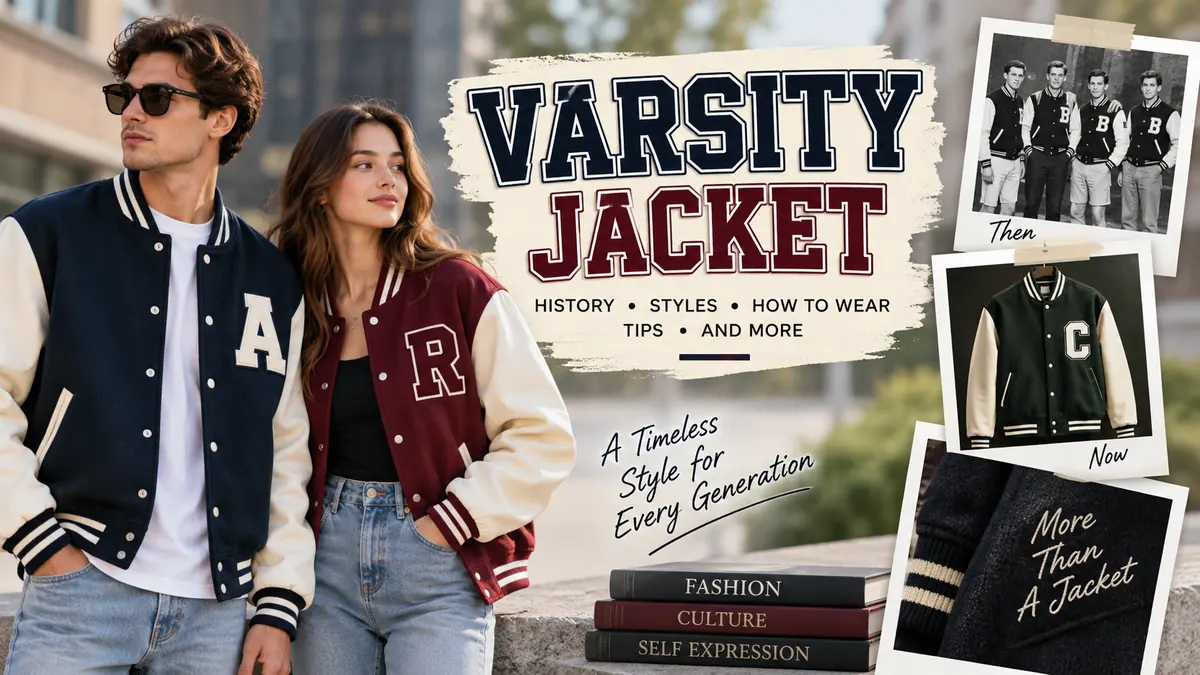
Few jackets are as easy to recognize as the varsity jacket. A contrasting body and sleeves, striped rib-knit trim, snap buttons, and bold letter patches can instantly evoke American schools, sports teams, and classic collegiate style. Yet the jacket has grown far beyond the playing field.
A varsity jacket is a waist-length jacket inspired by American school athletics, traditionally made with a Melton wool body, leather sleeves, ribbed collar, cuffs and waistband, snap-button front, and chenille lettering. Also called a letterman jacket, it began as an achievement garment for student athletes and later became a staple of casual fashion and streetwear.
The basic silhouette is simple, but the details tell a much richer story. Materials, letters, patches, colors, and even the way the jacket fits can reflect athletic achievement, school identity, fashion trends, or personal style.
What Is a varsity jacket?
A varsity jacket is a short, sporty outerwear style associated with American high school and college athletics. Traditional versions combine a structured wool body with contrasting leather sleeves and knitted trim around the neck, wrists, and waist.
The front usually closes with metal snap fasteners rather than a zipper. Traditional letterman versions may display a large school letter on the chest along with embroidered names, numbers, championship patches, graduation years, or other symbols of achievement.
Modern fashion versions are much broader. A jacket can use the familiar varsity silhouette without being connected to a school or athletic program. Contemporary versions may use cotton, polyester, satin, faux leather, denim, fleece, or other fabrics and may replace school letters with artwork, logos, embroidery, or minimalist detailing.
That distinction explains why someone can wear a varsity-style jacket without ever having played varsity sports.
The classic varsity jacket at a glance
| Feature | Traditional Construction |
|---|---|
| Body | Melton wool or wool blend |
| Sleeves | Genuine leather |
| Collar | Rib-knit |
| Cuffs | Rib-knit |
| Waistband | Rib-knit |
| Closure | Metal snap buttons |
| Chest decoration | Chenille school letter |
| Other decoration | Embroidery, numbers and patches |
| Lining | Taffeta or quilted lining |
| Length | Waist/hip length |
| Overall shape | Structured, sporty silhouette |
Traditional construction remains recognizable even when designers change individual materials. Manufacturers today commonly produce versions using wool or wool-blend bodies, leather or PU sleeves, knitted trim, snap closures, linings, and chenille or embroidered decoration.
Quick Takeaway: A varsity jacket describes both a historic achievement garment and, increasingly, a fashion silhouette. The traditional version is wool-and-leather with an earned letter; fashion versions can reproduce the shape with many different materials.
varsity jacket History: From Letter Sweaters to Modern Fashion
The history of the varsity jacket starts before the jacket itself existed.
Accounts of the tradition commonly trace it to Harvard University’s baseball team in the 1860s. Players wore heavy knitted sweaters marked with a prominent “H,” establishing the idea of displaying a school letter on athletic clothing. The garment is widely described as an early ancestor of today’s letterman jacket.
From the letter sweater to the jacket
The original concept was not primarily fashion.
A school letter represented participation or achievement. Receiving one allowed a student athlete to visibly demonstrate membership in a team and recognition from the school.
As the tradition spread through American educational institutions, the sweater evolved. By the early decades of the 20th century, more structured outerwear became associated with the letter tradition, and by around the 1930s the familiar wool-body and contrasting-sleeve jacket was emerging.
The resulting design was practical as well as symbolic.
Dense wool provided insulation. Leather made the sleeves durable. Ribbed knitted sections helped create a closer fit around the neck, wrists, and waist. The front snaps were easy to operate, while the broad wool panels provided plenty of space for letters and other decorations.
Why the letter mattered
The large chest letter gave the garment its “letterman” identity.
Historically, students earned letters by meeting requirements established by their schools or athletic programs. Over time, jackets could accumulate other markers such as:
- sport or activity symbols
- player numbers
- names
- graduation years
- championship patches
- award bars
- team emblems
- school mascots
The result was something closer to a wearable record of school life than ordinary outerwear.
From school tradition to popular culture
The jacket’s strong visual identity eventually carried it outside educational settings.
It became associated with American youth culture and later appeared throughout music, film, celebrity fashion, sportswear, designer collections, and streetwear. Contemporary interpretations can preserve little more than the striped ribbing, snap front, and contrasting sleeves while still being immediately recognizable as varsity-inspired.
That ability to change without losing its identity is one reason the silhouette has remained relevant for generations.
varsity jacket vs. Letterman Jacket: Are They the Same?
The terms varsity jacket and letterman jacket are often used interchangeably, and many manufacturers and fashion retailers treat them as names for the same basic garment. Some modern guides, however, make a useful distinction: “varsity jacket” can describe the broader fashion silhouette, while “letterman jacket” more specifically refers to a school-related jacket carrying an earned letter.
Consider these two examples.
A high school athlete wearing a wool-and-leather jacket with an earned chenille school letter is wearing a letterman jacket and a varsity jacket.
A fashion jacket with the same ribbed collar, contrast sleeves, and snap front but no school affiliation can reasonably be described as a varsity jacket, although calling it a traditional letterman jacket is less precise.
Varsity jacket vs. bomber jacket
These jackets can look similar because both are usually short and have fitted cuffs and waistbands, but their histories and construction differ.
| Feature | Varsity Jacket | Bomber Jacket |
|---|---|---|
| Historical roots | School athletics | Military aviation |
| Traditional body | Wool | Leather or flight fabrics |
| Sleeves | Often contrasting leather | Usually same material as body |
| Front | Snap buttons | Usually zipper |
| Collar | Rib-knit, often striped | Rib-knit or other flight-jacket collar |
| Decoration | Letters, patches, numbers | Usually simpler |
| Identity | Collegiate/sport | Military/utilitarian |
A varsity jacket is therefore not simply another name for a bomber jacket. Their silhouettes overlap, but their design language comes from different traditions.
What Is a varsity jacket Made Of?
Material is one of the biggest differences between an authentic heritage-style jacket and a lightweight fashion interpretation.
Melton wool body
Traditional jackets commonly use Melton wool, a dense woolen fabric with a compact surface.
It provides warmth and structure and creates a stable base for patches and embroidery. Traditional or premium jackets may use substantial wool, while affordable versions often use wool-polyester blends.
The blend is not automatically inferior. Polyester can reduce cost and sometimes simplify maintenance. The trade-off is that a high-synthetic-content fabric may not have the same hand feel, insulation, drape, or aging characteristics as quality wool.
Leather sleeves
Contrasting leather sleeves are perhaps the most recognizable traditional detail.
Cowhide and other genuine leathers offer abrasion resistance and develop visible character as they age. Genuine leather also raises the jacket’s weight, price, and maintenance requirements.
Modern alternatives include PU and other synthetic leathers. These provide the visual contrast of traditional sleeves at a lower cost and may appeal to people who prefer not to wear animal leather.
They do not necessarily age like genuine leather, however. Depending on quality and storage conditions, synthetic coatings can eventually peel or crack.
Rib-knit trim
Look closely at a classic varsity jacket and you will usually find knitted material at three points:
- collar
- cuffs
- waistband
This ribbing helps the garment sit securely against the body.
Striped ribbing is especially associated with collegiate styling. Two-tone or multicolor combinations frequently echo school or team colors.
Chenille patches
The raised, fuzzy letter found on many traditional jackets is commonly made using chenille embroidery or chenille combined with a felt backing.
Its thick texture makes the letter visually prominent even from a distance. Chenille can also be used for mascots, numbers, words, and decorative graphics.
Embroidery and felt
Not every detail needs chenille.
Names, dates, small logos, numbers, and fine graphics are often embroidered because embroidery handles detailed shapes more cleanly.
Felt can serve as a backing material for letters and patches, adding structure and contrasting layers.
Lining
The exterior gets most of the attention, but lining changes how a jacket feels.
Common constructions include lightweight polyester or taffeta linings and warmer quilted linings. A quilted lining adds insulation but also makes the garment bulkier.
This matters when comparing jackets that look nearly identical online. Two jackets with the same wool-and-leather exterior can feel completely different if one has substantial insulation and the other has a thin lining.
Snap buttons
Metal snaps are another signature feature.
Traditional designs use a row of snap fasteners down the front. Some contemporary jackets substitute a zipper or occasionally combine the two.
A zipper can be practical, but snaps preserve the classic collegiate appearance.
How to Recognize a Well-Made varsity jacket
Price alone does not reveal construction quality. Instead, inspect the parts that receive the most stress.
1. Examine the body fabric
A quality wool or wool-blend body should feel substantial rather than thin and loosely constructed.
Check whether the fabric quickly loses its shape when handled. Excessive loose fibers or immediate surface pilling can indicate a fabric that will show wear quickly.
2. Inspect the sleeves
If the sleeves are genuine leather, they should feel reasonably supple rather than dry and cardboard-like.
For synthetic leather, examine areas around the elbows, underarms, pockets, and cuffs. These are likely to experience repeated flexing and friction.
3. Check the ribbing
Stretch a cuff gently and release it.
Good ribbing should recover rather than remain stretched. Loose ribbing at the waist can make even an otherwise excellent jacket look worn out.
4. Look closely at patches
Chenille letters should be securely attached around their edges. Embroidery should be dense enough to create a clean design without excessive loose threads.
Large patches deserve particular attention because poor stitching becomes obvious as the jacket moves.
5. Test the snaps
Open and close the front several times.
They should fasten firmly without requiring excessive force. A weak snap is annoying; a snap attached poorly enough to pull through the surrounding fabric is a construction problem.
6. Examine the lining and internal seams
Turn the jacket inside out.
Straight stitching, reinforced stress points, clean seam finishing, and a properly fitted lining often reveal more about manufacturing quality than decorative details on the exterior.
Quick Takeaway: Judge the jacket as a complete garment. Strong wool is not enough if the ribbing stretches, the lining twists, or the patches are poorly attached.
How Should a varsity jacket Fit?
A traditional varsity jacket generally has a structured but comfortable fit. It should provide enough room for natural movement and light layering without becoming excessively loose through the shoulders and body.
Modern versions complicate the answer because cropped, slim, relaxed, and oversized cuts are all common.
Start with the shoulders
Shoulder fit has the greatest effect on the overall silhouette.
For a classic fit, the shoulder seam should sit near the natural end of your shoulder. A deliberate oversized design may extend beyond that point, but it should look intentional rather than simply too large.
Check sleeve length
Sleeves should generally reach the wrist, with the ribbed cuff sitting securely rather than covering most of the hand.
Leather sleeves can feel somewhat structured when new. That is different from being so tight that bending your arms becomes uncomfortable.
Watch the waistband
The traditional jacket ends around the waist or upper hip.
The rib-knit waistband should sit close enough to retain the classic shape without squeezing the body or riding upward whenever you move.
Leave room for layering
Think about what will actually be worn underneath.
If the jacket will usually sit over a T-shirt, a closer fit can work. If you expect to wear hoodies, sweaters, or other substantial layers, extra room through the chest, shoulders, and sleeves becomes necessary.
Classic vs. oversized fit
| Fit | Appearance | Works Well With |
|---|---|---|
| Classic | Structured and balanced | Jeans, chinos, T-shirts |
| Slim | Closer through torso and arms | Minimal outfits |
| Relaxed | More room without extreme proportions | Everyday layering |
| Oversized | Dropped shoulder, wider body | Streetwear and loose silhouettes |
| Cropped | Shortened body | High-rise trousers and layered outfits |
The right fit therefore depends partly on the intended silhouette. Sizing up a classic jacket does not always create a good oversized jacket because purpose-built oversized patterns alter the shoulder, sleeve, body width, and length together.
varsity jacket Patches and Letters: What Do They Mean?
Patches are not merely decoration in the traditional letterman system.
The best-known element is the large varsity letter, normally associated with the wearer’s school. Historically, earning that letter represented recognized participation or achievement in an athletic or extracurricular program.
Other jacket elements can communicate different information.
School letter
Usually positioned prominently on the chest, this is the defining feature of a traditional letterman jacket.
Athlete or student name
Names may appear on the chest, back, or through embroidered patches.
Jersey number
Numbers commonly connect the jacket to the wearer’s athletic identity.
Graduation year
A year can indicate the student’s class or expected graduation date.
Sport symbols
Football, baseball, basketball, wrestling, track, cheerleading, and other activities can be represented with embroidered or chenille patches.
Championship and award patches
These can record specific achievements, competitions, titles, or seasons.
This personalization explains the emotional value of authentic school jackets. The decoration creates a physical record of events and accomplishments rather than simply reproducing a fashion trend.
Fashion-oriented jackets use the same visual vocabulary differently. Numbers and letters may be purely graphic, while oversized logos, fictional team names, mascots, brand marks, and artistic embroidery replace actual school awards.
Different Types of Varsity Jackets
The original formula has produced several recognizable variations.
Traditional wool and leather
This is the heritage construction: wool body, leather sleeves, rib-knit trim, snap front, and letter patches.
It offers the strongest connection to American letterman tradition.
Wool varsity jacket
Some versions use wool or wool blends for both body and sleeves.
The result can feel softer and visually more understated because the contrasting leather disappears.
Full leather varsity jacket
Here, leather becomes the primary exterior material while the ribbed trim preserves the varsity silhouette.
Compared with wool, leather typically provides greater wind resistance and develops a distinctive patina, but it is heavier and requires its own maintenance routine.
Satin varsity jacket
Satin and satin-like synthetic fabrics create a lighter, smoother interpretation.
These jackets often lean toward fashion, team merchandise, or retro styling rather than traditional school-award construction.
Cotton varsity jacket
Cotton versions can be useful when the classic wool-and-leather combination is too heavy.
They preserve the silhouette while making it more practical in mild conditions.
Faux-leather varsity jacket
Synthetic leather can reproduce the visual effect of contrasting sleeves without genuine leather.
Quality varies significantly, so flexibility, coating quality, seam construction, and long-term cracking deserve attention.
Minimal varsity jacket
Some contemporary designs remove almost all patches and branding.
What remains is the recognizable structure: short body, contrasting sleeves, snap closure, and ribbed trim. This makes the jacket easier to integrate into understated everyday outfits.
How to Style a varsity jacket
A varsity jacket already has a strong visual identity, so effective styling usually involves letting the jacket provide the structure rather than making every other garment compete with it.
With jeans and a T-shirt
This is the simplest combination and one of the hardest to get wrong.
A plain T-shirt, straight or relaxed denim, and clean sneakers create a casual outfit that suits the jacket’s athletic origins without looking like a uniform.
If the jacket contains several colors, picking up one of those shades elsewhere in the outfit can make everything feel more connected.
With chinos
Chinos make the jacket slightly more polished.
Neutral trousers in beige, olive, navy, charcoal, or black can balance a brightly colored jacket without removing its casual character.
With a hoodie
A hoodie under a varsity jacket creates a stronger streetwear silhouette.
Fit matters here. The jacket needs enough room in the shoulders and sleeves for the hoodie without creating bunching around the upper arms.
Keep the hood outside the collar rather than forcing it underneath.
With wide-leg trousers
An oversized varsity jacket works naturally with wider trousers because both pieces share relaxed proportions.
A more fitted top underneath can prevent the outfit from becoming visually shapeless.
With skirts and dresses
Varsity styling is not limited to menswear.
The jacket’s sporty structure can create deliberate contrast with skirts and dresses, particularly when the jacket is cropped or moderately oversized.
Keep competing graphics under control
If a jacket already contains a large chenille letter, sleeve numbers, embroidery, and a back graphic, another heavily printed layer underneath can make the outfit visually crowded.
A plain base often gives detailed jackets more impact.
When Can You Wear a varsity jacket?
Traditional wool-and-leather jackets work particularly well in cool transitional weather.
They are commonly suitable for autumn and spring and can work in mild winter conditions depending on wool weight, lining, local climate, and what is layered underneath.
A lightweight cotton or satin version may work in warmer weather where traditional Melton wool would be uncomfortable.
A heavily quilted jacket can provide significantly more insulation.
This means “Are varsity jackets warm?” has no universal answer.
A heavy wool body, leather sleeves, close ribbing, and quilted lining can make one quite warm. A thin polyester fashion version that merely copies the silhouette may provide far less insulation.
Always judge the actual materials rather than the style name.
How to Clean and Care for a varsity jacket
Care is where traditional varsity jackets require more attention than ordinary casual jackets.
A classic model can combine wool, leather, knitted ribbing, chenille, felt, metal snaps, embroidery, and a synthetic lining in a single garment. Each material responds differently to water, heat, detergent, and friction.
Read the care label first
The manufacturer’s label takes priority over generic advice.
Two jackets that look identical may contain completely different fibers, leather treatments, adhesives, linings, or finishes.
Do not automatically machine wash wool-and-leather jackets
Traditional wool-and-leather constructions are particularly poorly suited to routine machine washing.
Agitation and water can affect wool, while soaking, detergent, and drying can damage leather. Specialist care guidance for mixed wool-and-leather varsity jackets recommends avoiding machine washing and using cleaners experienced with mixed-material garments.
Deal with small marks carefully
For minor dirt, start with the least aggressive treatment permitted by the care label.
Do not soak the whole garment just because one small area is dirty.
Leather should generally be treated with products intended specifically for the relevant type of leather, while wool requires its own approach.
Never apply direct high heat
High heat can shrink wool, distort knitted trim, damage synthetic components, and dry or deform leather.
Avoid putting a traditional jacket in a tumble dryer unless its manufacturer specifically states that it is safe.
Protect chenille patches
Direct ironing can flatten or damage textured chenille.
If wrinkles require treatment, follow the manufacturer’s instructions and avoid applying a hot iron directly to patches or leather.
Store it correctly
A substantial jacket belongs on a broad, supportive hanger.
Avoid narrow wire hangers that concentrate the garment’s weight at two small points. Store the jacket dry and with enough space around it to prevent crushing.
For wool garments, long-term storage should also account for moths.
Leather requires separate attention
Leather sleeves can dry over time.
When conditioning is appropriate for the specific leather, use a compatible product sparingly and keep oily conditioner away from the wool. Mixed-material care guidance warns that leather products transferred onto wool can cause staining.
Quick Takeaway: The safest assumption is that a traditional wool-and-leather varsity jacket should not be treated like a sweatshirt. Check its label and use a cleaner familiar with wool, leather, and decorated garments when deeper cleaning is required.
Common Varsity Jacket Mistakes
Understanding what goes wrong can extend the life of the garment considerably.
Buying by chest size alone
Chest measurement matters, but so do shoulder width, sleeve length, body length, and layering room.
Two jackets labeled the same size can fit very differently.
Assuming all “wool” jackets are equivalent
Check fiber composition.
A pure or high-wool-content fabric and a mostly synthetic blend may have very different texture, warmth, weight, pilling behavior, and maintenance requirements.
Ignoring the lining
A jacket’s lining affects comfort and warmth more than many people expect.
A thick quilted lining can transform a relatively similar outer shell into a much warmer garment.
Overloading the jacket with patches
Personalization is part of varsity tradition, but more is not automatically better.
On fashion jackets especially, giving important patches enough visual space can create a cleaner result than covering every available panel.
Machine washing without checking instructions
This is one of the easiest ways to damage a mixed-material jacket.
Leather, wool, chenille, ribbing, and lining do not necessarily tolerate the same cleaning process.
Confusing a fashion varsity with an earned letterman jacket
There is nothing wrong with wearing varsity-inspired fashion.
The useful distinction is simply historical: traditional letterman jackets can represent actual school or athletic achievement, while modern varsity fashion often borrows the appearance without that institutional meaning.
Why the varsity jacket Has Lasted So Long
Many garments associated with a particular era eventually look dated. The varsity jacket has repeatedly avoided that fate.
One reason is its instantly recognizable construction.
Designers can alter almost everything—fabric, proportions, graphics, sleeve material, lining, color, or patch placement—and striped ribbing with a short body and contrasting sleeves can still communicate the original idea.
The second reason is symbolism.
The traditional letterman jacket connects clothing with identity and achievement. A school letter, player number, or championship patch can represent a real event in the wearer’s life.
The third is adaptability.
Remove the school insignia and the same silhouette becomes casual outerwear. Enlarge the proportions and it fits naturally into streetwear. Strip away the graphics and it becomes a minimalist jacket. Replace leather with satin or cotton and the design works in different climates.
That flexibility has allowed a garment rooted in American collegiate athletics to move between sportswear, youth culture, fashion, and everyday wardrobes without losing its basic identity.
Is a varsity jacket the Same as a Baseball Jacket?
The terms sometimes overlap, especially in fashion retail, but they are not always technically identical.
“Baseball jacket” can refer broadly to baseball-inspired outerwear, including lightweight jackets that do not use traditional letterman materials.
A varsity or letterman jacket is more strongly associated with school achievement and the recognizable combination of ribbed trim, snap closure, contrasting panels, and often letters or patches.
The historical connection is understandable because the early letter tradition itself is associated with collegiate baseball.
Can Anyone Wear a varsity jacket?
Yes. The modern varsity jacket is a mainstream clothing style rather than a garment reserved exclusively for athletes.
There is, however, a useful cultural distinction between wearing a fashion-inspired jacket and wearing a specific achievement jacket.
Generic letters, decorative numbers, brand logos, and fictional team graphics are common in fashion. An authentic school jacket covered with someone else’s personal name, awards, graduation year, or earned athletic symbols has a different meaning because those elements may represent that individual’s accomplishments.
Understanding that distinction allows the history of the garment to coexist with its modern fashion role.
What to Know Before Choosing a Varsity Style
Rather than focusing on one feature, consider how the entire construction fits the intended use.
For heritage appearance, look toward Melton wool, genuine leather sleeves, rib-knit trim, snap buttons, chenille lettering, and a structured shape.
For everyday casual wear, wool blends, cotton, or synthetic fabrics can reduce weight and maintenance.
For warmer climates, lightweight fabric and minimal insulation matter more than recreating historically heavy construction.
For cold conditions, examine wool weight, lining, sleeve material, collar design, and how closely the ribbed cuffs and waistband fit.
For streetwear styling, proportion becomes especially important. An intentionally oversized pattern will generally look more balanced than simply buying a traditional jacket several sizes too large.
And for a jacket carrying real school or team significance, the placement and meaning of the letter, name, year, sport, and award patches matter as much as the materials themselves.
Final Thoughts on the varsity jacket
The varsity jacket has lasted because it manages to be both specific and adaptable. Its roots lie in American collegiate athletics and the tradition of earning a school letter, while its recognizable wool body, leather sleeves, chenille patches, rib-knit trim, and snap front created a design that could survive far beyond the campus.
Today, traditional letterman jackets still carry personal meaning, while modern varsity styles range from minimalist wool versions to oversized streetwear, satin jackets, cotton designs, and full-leather interpretations.
The most useful way to understand one is to look beyond the patches. Check its materials, construction, lining, fit, sleeve design, ribbing, and intended purpose. Those details reveal whether you are looking at a traditional achievement jacket, a modern fashion interpretation, or something that successfully combines both.