
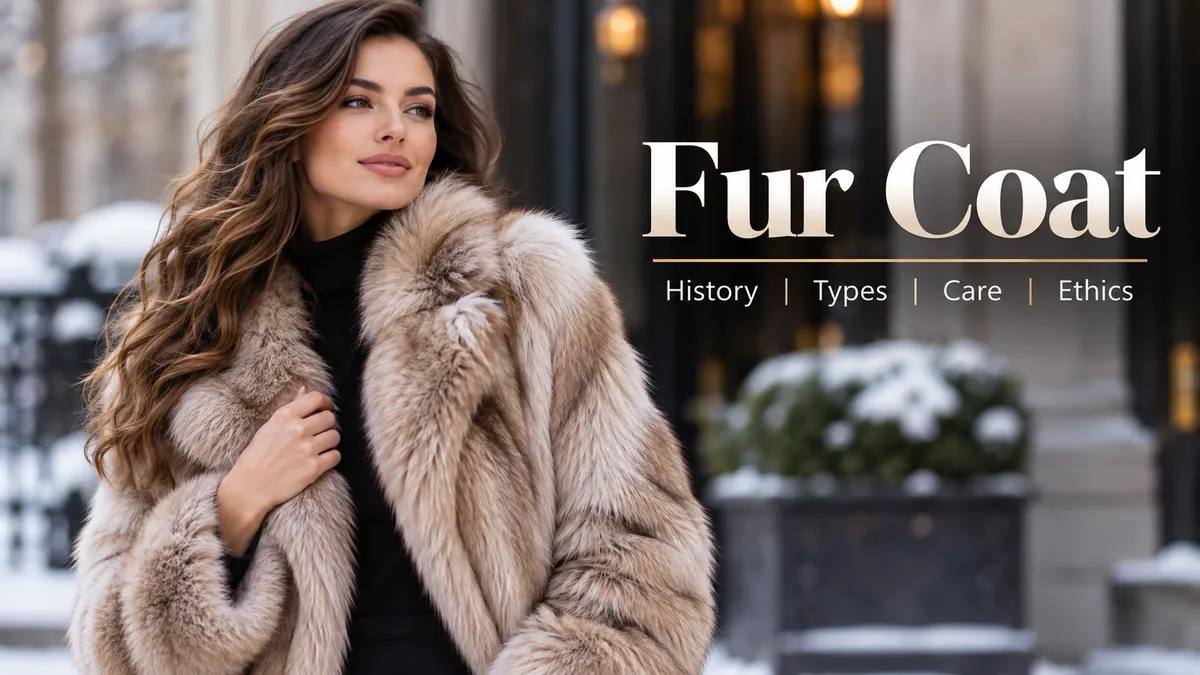
A fur coat is one of the most distinctive forms of winter outerwear. Its appeal comes from a combination of insulation, texture, visual depth, and a long history in clothing and fashion. Yet the term now covers very different garments, from traditional mink and fox coats to modern faux fur made from synthetic fibers.
A fur coat is an outer garment made either from animal pelts with the hair left attached or from textile fibers engineered to imitate natural fur. Real fur typically combines dense underfur with longer guard hairs, while faux fur generally uses acrylic, polyester, or other manufactured fibers attached to a fabric backing.
Understanding the difference matters because material affects warmth, weight, durability, cleaning, storage, appearance, ethics, and environmental considerations. It also helps explain why two coats that look similar in a photograph can behave very differently after years of wear.
What Is a Fur Coat?
Traditionally, a fur coat is constructed from processed animal pelts. Unlike ordinary wool, where fibers are removed from the animal and spun into yarn, natural fur retains the hair on the skin.
The structure of natural fur usually includes two visually important components:
- Underfur: short, dense, soft fibers that trap air close to the body.
- Guard hairs: longer outer hairs that influence color, shine, texture, and protection.
Different animals naturally produce very different combinations of these layers. Mink is relatively sleek and dense, for example, while fox has noticeably longer guard hairs and a fuller silhouette.
A modern faux fur coat takes another approach. Instead of hair growing from a skin base, manufactured fibers are anchored to a knitted or woven textile backing. Acrylic and polyester are common materials, although fiber blends and newer alternative materials continue to develop.
That distinction—skin backing versus textile backing—is one of the most useful ways to understand the entire category.
Fur Is More Than a Surface Texture
People often judge fur only by softness. That can be misleading.
Pile density, backing construction, lining, seams, garment length, weight distribution, and fiber recovery all influence how a coat actually performs. A visually convincing material may still flatten quickly or have weak construction.
With vintage garments, the condition of the underlying skin or fabric can matter even more than how attractive the outer pile looks.
Quick Takeaway: Natural fur is hair attached to animal skin; faux fur is manufactured pile attached to textile backing. Construction underneath the visible fibers affects durability almost as much as the surface itself.
Types of Fur Coat and How They Differ
There is no single material simply called “fur.” Mink, fox, sable, rabbit, beaver, chinchilla, and Persian lamb can have dramatically different textures and appearances.
Current specialist guides commonly identify mink, sable, fox, rabbit, Swakara, and Persian lamb or Astrakhan among the major categories encountered in fur outerwear.
| Type | Typical Texture | Visual Character | Relative Weight | Notable Trait |
|---|---|---|---|---|
| Mink | Short, smooth, dense | Sleek and polished | Light to moderate | Dense pile |
| Fox | Long and fluffy | Full and dramatic | Moderate | Long guard hairs |
| Sable | Silky and fine | Soft, flowing appearance | Relatively light | Highly prized texture |
| Rabbit | Very soft | Smooth or plush | Usually light | Less durable than many premium furs |
| Beaver | Dense and substantial | Plush, especially when sheared | Moderate | Dense underfur |
| Chinchilla | Extremely soft and dense | Fine, luxurious surface | Light | Delicate |
| Persian lamb/Astrakhan | Short and curly | Sculpted, patterned surface | Moderate | Distinctive curls |
| Faux fur | Highly variable | Can imitate many species | Variable | Textile rather than skin backing |
These are general characteristics rather than guarantees. Processing techniques such as dyeing, shearing, plucking, knitting, and combining pelts can substantially change a finished garment.
Mink Fur
Mink is perhaps the material most strongly associated with the traditional luxury fur coat.
Its relatively short guard hairs and dense underfur produce a smoother silhouette than long-haired varieties. Good mink can combine substantial insulation with comparatively low bulk.
Natural mink also occurs in different shades, while dyeing expands the available color range considerably.
Fox Fur
Fox creates a completely different effect.
Its longer guard hairs produce volume and movement, which is why fox is commonly associated with statement coats, collars, cuffs, and trim. The material tends to look larger and fluffier than mink even when garments have similar dimensions.
Different fox varieties can also produce markedly different natural coloration.
Sable
Sable is known for fine, silky fur and has historically occupied the luxury end of the market. Its combination of softness, lightness, and appearance helps explain its reputation and high valuation in traditional fur markets.
Rabbit Fur
Rabbit offers a soft, plush surface but generally does not have the same reputation for long-term wear as more durable varieties.
It may be used for complete garments, linings, accessories, or fashion pieces. Because it can be dyed and processed in numerous ways, rabbit does not always look immediately recognizable.
Beaver
Beaver has particularly dense underfur—an adaptation that helps the animal retain warmth in cold water.
Garment makers can use the fur with its guard hairs intact or shear and pluck it to reveal a shorter, velvet-like surface.
Chinchilla
Chinchilla is recognized for an exceptionally dense, fine surface. The material feels notably soft but requires careful handling.
Its delicate character makes condition especially important when evaluating older garments.
Persian Lamb, Astrakhan, and Swakara
These terms are associated with lamb fur characterized by a short, patterned or curled surface rather than the fluffy pile associated with fox.
The resulting coat has a flatter, more sculptural silhouette, making it visually distinct from most long-haired furs.
Real Fur Coat vs Faux Fur Coat
The debate around real fur vs faux fur extends beyond appearance. The two materials have fundamentally different structures.
Real fur consists of natural animal hair anchored in skin. Faux fur is usually constructed from manufactured fibers such as polyester or acrylic attached to textile backing.
| Feature | Real Fur | Faux Fur |
|---|---|---|
| Base | Animal skin | Textile backing |
| Fibers | Natural hair | Usually synthetic fibers |
| Hair tips | Often naturally tapered | Often more uniform or blunt |
| Texture | Naturally varied | Depends heavily on manufacturing quality |
| Pile | Underfur plus guard hairs in many species | Engineered pile |
| Care | Usually specialist care | Depends on care label |
| Moisture/heat sensitivity | Skin can dry or stiffen | Synthetic fibers can react to heat |
| Ethical issue | Animal welfare | Avoids animal pelts |
| Environmental issue | Animal production and processing | Often fossil-derived synthetic materials |
| Longevity | Potentially decades with appropriate care | Highly dependent on construction and fiber quality |
Neither category can be judged accurately by appearance alone.
Premium faux fur can reproduce natural color variation and pile surprisingly well. Conversely, heavily sheared, dyed, or processed natural fur may look much more uniform than people expect.
How Can You Tell Real Fur From Faux Fur?
The safest approach is to combine the garment label with visual inspection rather than relying on a single home test.
Start by gently separating the hairs somewhere unobtrusive.
Real fur generally reveals a leather-like skin underneath. Faux fur generally reveals woven, knitted, or mesh-like fabric backing. Natural hairs may also vary in length and taper toward their tips, whereas synthetic fibers can appear more uniform.
Look for these clues:
- Check the label. Read the stated material composition and origin information.
- Part the pile. Look at what the fibers are attached to.
- Examine several hairs. Natural, uncut guard hairs generally taper rather than ending uniformly.
- Look for variation. Natural fur often shows subtle differences in length, direction, and coloration.
- Inspect the lining and seams. Construction can reveal information that the surface hides.
Avoid destructive internet “tests” involving flames or heated objects. They can damage the garment and create unnecessary fire and fume risks.
For consumers in the United States, labeling provides another important clue. The Federal Trade Commission states that covered fur apparel must disclose information including the animal name and, for imported fur, fur origin; disclosures can also be required for treatments such as dyeing.
How Warm Is a Fur Coat?
The reputation of fur as winter clothing is closely connected to its physical structure.
Dense fibers create pockets of relatively still air. Because trapped air slows heat transfer, a dense pile can provide substantial insulation without requiring the same construction as some other winter garments.
Natural fur’s combination of underfur and guard hairs can be particularly effective, but asking simply whether fur is “warm” misses several variables.
Actual warmth depends on:
- fur or fiber density;
- coat length;
- lining;
- garment fit;
- wind exposure;
- humidity and moisture;
- construction quality;
- openings around the neck and cuffs.
A full-length dense coat naturally provides more body coverage than a cropped jacket made from the same material.
Is Real Fur Warmer Than Faux Fur?
There isn’t a universal answer for every garment.
Natural fur can provide excellent warmth relative to its weight because of the structure of its fibers and underfur. High-quality faux fur can also be very warm, particularly when dense pile is combined with an effective backing and lining.
The better comparison is therefore garment versus garment, rather than assuming that the material name alone determines thermal performance.
A thin natural-fur jacket can provide less total protection than a densely constructed synthetic coat with an insulated lining. Fit and wind resistance matter as well.
Quick Takeaway: Fiber type matters, but density, coverage, lining, fit, and construction determine how warm a particular coat feels in real conditions.
How to Judge Fur Coat Quality
Quality becomes easier to understand when you stop looking only at shine.
For natural fur, the condition of the skin beneath the hair is critical. An old coat can still appear impressive externally while its leather has become dry and fragile.
1. Examine the Pile
The pile should look consistent with the type of fur and intended finish.
Gently run a hand over it. Watch how the hairs move and recover. Excessive shedding, bald areas, matting, or unexplained unevenness can indicate wear or damage.
2. Check the Backing
If accessible without damaging the lining, examine the underlying construction.
Natural skin should not feel obviously brittle. In faux fur, inspect the textile backing for stretched areas, loose fibers, visible adhesive, or weak stitching.
3. Inspect High-Friction Areas
Cuffs, pockets, shoulders, collar edges, and the areas where handbags or seat belts rub against the garment often show deterioration first.
This is especially useful when evaluating a vintage fur coat.
4. Look at Seams and Lining
A coat is an engineered garment, not simply a collection of attractive fibers.
Check whether seams lie properly, the lining hangs cleanly, closures function, and the coat feels balanced across the shoulders. Specialist comparison guidance similarly emphasizes backing, pile recovery, lining, edges, and weight distribution when evaluating construction.
5. Consider Odor
Persistent mustiness can indicate poor storage.
Heavy perfume or deodorizer may also be worth investigating because it can mask an underlying odor rather than solve it.
6. Read the Label Carefully
Do not assume a vague fashion term identifies the material.
In the U.S., the FTC’s Fur Products Labeling Act requires covered products to identify the true English name of the animal and includes other disclosure requirements. The FTC also warns that an animal’s presence in its Fur Product Name Guide does not itself mean that fur is legal to sell; other wildlife laws may prohibit particular products.
This is particularly relevant with vintage, inherited, and secondhand pieces whose original documentation may be missing.
How to Care for a Fur Coat
Proper care differs substantially between natural and faux materials.
For a natural fur coat, heat and poor storage conditions are major concerns because the underlying skin contains oils and can become dry and brittle.
How to Store Real Fur
Use a broad, sturdy hanger that properly supports the shoulders.
Give the garment enough closet space that neighboring clothes do not crush the pile. Keep it away from radiators, heating vents, strong sunlight, and consistently hot spaces.
Specialist fur-care guidance warns against prolonged heat, friction, cramped storage, and overly dry conditions. Professional temperature- and humidity-controlled storage is commonly recommended for valuable natural fur during warm seasons.
Avoid squeezing natural fur into an airtight plastic garment bag for long-term storage. Air circulation is preferable.
Cedar storage is sometimes recommended casually for clothing, but it can be problematic for natural fur because excessively dry conditions can contribute to deterioration of the leather.
What If a Fur Coat Gets Wet?
A few drops of snow are different from soaking the garment.
For minor moisture, shake off the excess gently and allow the coat to dry naturally in a ventilated area away from direct heat.
Do not use:
- a hair dryer;
- radiator heat;
- clothes dryer;
- iron;
- other concentrated heat sources.
If natural fur becomes thoroughly saturated, professional assessment is safer than aggressive home drying.
Can You Wash a Fur Coat?
A natural fur coat should not be treated like ordinary washable clothing.
Specialist cleaning addresses both the hair and the skin beneath it. Conventional washing can affect the leather, oils, shape, and construction of the garment. Fur-care authorities recommend professional cleaning rather than ordinary home laundering for natural fur.
Faux fur is different. Some garments permit careful home cleaning, while others require professional treatment. Follow the specific care label because heat can damage or distort synthetic pile.
Avoid Excessive Friction
Repeated rubbing can flatten or wear fur.
Common trouble spots include shoulder-bag straps, backpack straps, tight car seat belts, jewelry, and heavily used pocket edges.
Rotating where a bag sits can make a noticeable difference over years of wear.
How Long Can a Fur Coat Last?
There is no meaningful universal lifespan because material, construction, climate, frequency of use, and storage history vary enormously.
A high-quality natural fur garment that receives appropriate care can remain usable for decades. The American Fur Council likewise states that properly maintained fur can last for decades and may later be remodeled or repurposed.
That does not mean every old coat is durable.
Poor storage can cause the skin to dry and weaken even when the visible hair still looks reasonably good. Once the underlying leather becomes brittle, alterations and repairs become increasingly difficult.
Faux fur has its own aging pattern. Depending on quality and use, synthetic pile can become matted, permanently crushed, tangled, or worn at high-contact areas.
Age alone therefore tells you surprisingly little. Condition is more informative than the date on the label.
Fur Coat Styles and Silhouettes
Material gets most of the attention, but silhouette strongly influences how a fur garment feels and functions.
Full-Length Coat
A long coat provides maximum body coverage and creates the traditional dramatic fur silhouette.
The tradeoff is additional weight and bulk, especially when sitting, driving, or moving through crowded spaces.
Mid-Length Coat
Knee-length and three-quarter designs balance coverage with mobility. They can retain much of the visual presence of a long coat without reaching the ankles.
Fur Jacket
A shorter jacket is generally easier for driving and everyday movement.
Less material also changes the overall visual effect, making the garment feel less formal than many full-length styles.
Cropped Fur
Cropped designs emphasize fashion and layering rather than maximum cold-weather coverage.
They work differently from traditional winter coats because the lower body remains largely unprotected.
Fur-Trimmed Outerwear
Some wool coats, parkas, leather jackets, and other garments use fur only at the hood, collar, or cuffs.
Material labeling still matters. In the United States, FTC guidance covers garments made wholly or partly with fur and establishes disclosure requirements for covered products.
The History of the Fur Coat
Humans used animal skins for warmth long before fur became associated with luxury fashion.
Over centuries, however, fur acquired economic and social meanings beyond insulation. In Europe it became associated with status and wealth, while the North American fur trade became deeply connected with colonization, commerce, Indigenous communities, territorial competition, and the exploitation of wildlife resources. Smithsonian historical material describes fur as a major commodity in colonial North America and a significant force in international competition.
Beaver was particularly important because of its use in clothing and felt hats.
By the nineteenth and early twentieth centuries, fashionable furs appeared in coats, capes, collars, muffs, and other accessories. Demand could have serious ecological consequences. Smithsonian research notes, for example, that the popularity of sealskin garments in the late nineteenth century contributed to severe pressure on seal populations.
Faux Fur Is Older Than Many People Think
Artificial fur is not simply a twenty-first-century response to animal-welfare concerns.
Textile makers experimented with imitation fur for centuries. The Smithsonian’s National Museum of American History holds imitation-fur samples donated in 1884, including plush fabrics designed to resemble natural seal fur.
Early alternatives included wool and silk-based plush fabrics.
Synthetic fibers later transformed the category. By the mid-twentieth century, manufacturers were developing artificial versions intended to imitate mink, beaver, chinchilla, raccoon, and other natural furs.
Faux fur subsequently developed an identity of its own rather than serving only as an imitation.
Ethics, Sustainability, and the Real-vs-Faux Debate
Few clothing materials generate as much disagreement as fur.
The central ethical objection to real fur concerns raising or killing animals for clothing. Animal-welfare organizations therefore advocate synthetic, plant-based, recycled, or other non-animal alternatives.
Supporters of natural fur often emphasize longevity, repairability, biodegradability of natural materials under appropriate conditions, and the possibility of wearing or repurposing a garment over many years.
Faux fur eliminates the use of animal pelts, but conventional versions are commonly made with acrylic, polyester, or other synthetic fibers.
That creates a different set of questions involving fossil-derived materials, durability, shedding, manufacturing, and eventual disposal.
As a result, simple statements such as “real is sustainable” or “faux is sustainable” are too broad. Environmental impact depends on raw materials, manufacturing, transportation, frequency of wear, lifespan, repair, reuse, and end-of-life treatment.
For someone trying to reduce demand for newly manufactured clothing, an existing vintage coat presents yet another scenario. Reusing something already produced is materially different from commissioning a new garment.
Ethics remain personal, while environmental comparisons require a full life-cycle perspective rather than a single attribute.
Understanding Vintage Fur Coats
Vintage fur deserves separate consideration because age changes what matters.
A decades-old coat may have excellent pelts but weakened seams. Another may look pristine yet have dried leather caused by years in unsuitable storage.
Before assuming that a vintage piece is valuable or wearable, inspect:
- skin flexibility;
- shedding;
- bald or thinning areas;
- seams;
- lining;
- closures;
- odor;
- previous repairs;
- alterations;
- labels and provenance.
Do not assume that “vintage” automatically means rare or expensive.
Species, condition, craftsmanship, size, style, provenance, current demand, and legal restrictions can all influence collectability and resale possibilities.
Vintage garments can also contain materials subject to modern wildlife-trade restrictions. If the species is uncertain, professional identification may be necessary before selling, exporting, importing, or substantially altering the piece.
Common Fur Coat Terms Explained
Fur terminology can become confusing because some words describe an animal while others describe processing techniques.
Sheared Fur
Shearing shortens the hair to create a smoother surface.
A sheared beaver coat, for example, can look substantially different from untreated long-haired beaver.
Plucked Fur
Plucking removes longer guard hairs, exposing softer underfur and creating a more velvet-like appearance.
Dyed Fur
Natural fur can be colored to create shades that differ from the animal’s original coloring.
In the United States, FTC rules require relevant disclosure when fur has been dyed, bleached, or artificially colored.
Natural Fur
In ordinary conversation, “natural fur” generally means real animal fur rather than synthetic faux fur.
On regulated labeling, however, terminology can carry more specific meaning. Under FTC guidance, untreated color may be labeled “natural,” while artificial coloring requires disclosure.
Faux Fur
Faux fur is a textile designed to provide the appearance or texture associated with animal fur without using an animal pelt.
The phrase does not identify one specific fiber. Polyester, acrylic, blends, backing structures, pile heights, and manufacturing quality vary between products.
Guard Hair
Guard hairs form the longer visible outer layer in many natural furs.
They contribute substantially to shine, movement, coloration, and weather protection.
Underfur
Underfur is the shorter, denser layer beneath the guard hairs.
Its ability to hold air is a major reason many fur-bearing animals remain insulated in cold environments.
Mistakes That Damage Fur
Many problems associated with aging fur are actually storage or handling problems.
One of the worst habits is hanging a natural fur coat for months in a hot, dry, tightly packed closet. Even when the surface initially appears unchanged, deterioration can occur underneath.
Other common mistakes include:
- storing fur beside a radiator;
- crushing it between tightly packed clothes;
- covering it in non-breathable plastic for extended periods;
- using household detergents on natural fur;
- applying perfume directly to the pile;
- repeatedly carrying a heavy shoulder bag over the same area;
- drying wet fur with direct heat;
- ignoring damaged seams;
- assuming softness alone proves good condition.
With faux fur, high temperatures deserve particular attention because synthetic fibers may distort.
Care should always follow the actual material and garment construction rather than generic advice found online.
What Makes a Fur Coat Different From Other Winter Outerwear?
A fur coat does not function exactly like a down jacket, wool overcoat, shearling coat, or synthetic insulated parka.
A wool coat relies on the properties of wool fabric and its construction. Down uses clusters that create insulating loft. Shearling combines wool with the skin it grows from. Technical synthetic insulation uses engineered fibers to trap air inside an outer shell.
Fur achieves insulation primarily through dense hair or pile while also providing a highly textured exterior.
That combination explains its distinctive appearance.
The tradeoff is that natural fur generally requires more specialized care than everyday technical outerwear. Faux fur can simplify some aspects of ownership, although care requirements still vary significantly between garments.
How to Make Sense of a Fur Coat Today
The phrase fur coat now describes a broader category than it once did.
It can refer to a vintage mink inherited through a family, a voluminous fox coat, a short rabbit jacket, a curled Persian lamb garment, or a synthetic polyester design made to reproduce the appearance of natural pile.
The most useful way to understand any example is to look beyond the surface. Identify the material, examine its backing and construction, consider the density and condition of the pile, read the label, and understand the care requirements.
Real and faux fur solve the same visual and insulation problem through fundamentally different materials. Real fur offers natural variation, dense hair structures, and potentially very long service life when carefully maintained, but it carries significant animal-welfare considerations and specialist-care requirements. Faux fur avoids animal pelts and offers enormous variety, but conventional synthetic versions introduce their own durability and environmental questions.
Whichever material is involved, longevity depends heavily on care. Store the coat correctly, minimize heat and crushing, deal with damage early, and follow material-specific cleaning instructions. Those practical details ultimately determine whether a fur coat remains wearable for a few seasons or becomes a garment that survives for many years.