
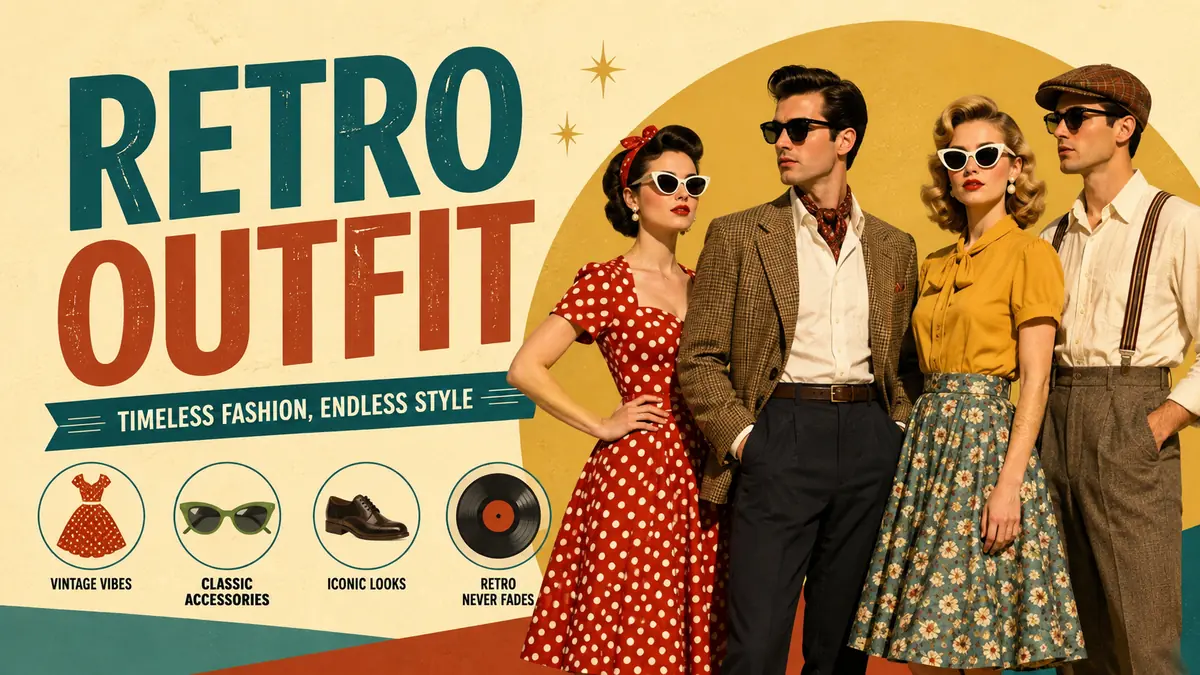
A great retro outfit does not require dressing like you have walked straight out of an old photograph. The most convincing looks borrow recognizable shapes, colors, fabrics, and accessories from earlier decades, then combine them with pieces that make sense today.
A retro outfit is a modern look inspired by fashion from a previous era. It may feature 1950s full skirts, 1960s mini dresses, 1970s flared jeans, 1980s oversized silhouettes, 1990s denim and grunge, or early-2000s Y2K details. The key is capturing an era’s visual character without making the outfit feel like a costume.
That distinction matters. Retro fashion and vintage clothing overlap, but they are not exactly the same thing. You can build a completely retro-inspired look without owning a single genuinely vintage garment.
Once you understand what made each decade visually distinctive, creating your own throwback wardrobe becomes much easier.
What Is a Retro Outfit?
A retro outfit recreates or references fashion associated with an earlier period. The clothing itself can be old or newly made.
For example, new flared jeans worn with a fitted turtleneck, suede jacket, platform shoes, and tinted sunglasses can create a distinctly 1970s-inspired appearance. None of those pieces needs to have been manufactured during the 1970s.
Vintage has a more specific meaning in fashion. It generally describes clothing that actually comes from an earlier period, while retro describes the aesthetic or inspiration behind a look.
This gives you three useful approaches:
- Authentic vintage: original garments from an earlier decade
- Retro-inspired: modern clothing designed or styled to resemble older fashions
- Vintage-modern mix: genuine older pieces combined with contemporary basics
For everyday wear, the third approach is often the easiest.
Current fashion continues to reinterpret earlier eras rather than simply reproduce them. Recent fashion coverage, for example, has highlighted renewed interest in 1970s flares, suede, platform footwear and accessories, while 1980s-inspired denim silhouettes are also appearing in contemporary styling.
What Makes an Outfit Look Retro?
There is no single garment that automatically makes clothing retro. The effect usually comes from several visual cues working together.
Silhouette
Start with shape.
Different periods developed recognizable proportions:
| Era | Signature silhouettes |
|---|---|
| 1950s | Fitted waists, full skirts, pencil skirts |
| 1960s | A-line shapes, mini skirts, shift dresses |
| 1970s | Flares, flowing dresses, wide-leg trousers |
| 1980s | Oversized tops, strong shoulders, high waists |
| 1990s | Relaxed denim, slip dresses, straight silhouettes |
| 2000s | Low-rise bottoms, fitted tops, mini skirts |
You can often communicate a decade more effectively through silhouette than through logos or obvious novelty pieces.
Color
Color is another powerful shortcut.
The 1950s are frequently associated with pastels, red, black and white. The 1960s embraced bright primary colors and striking combinations.
Earthy brown, rust, mustard, burnt orange, cream and avocado tones immediately suggest the 1970s, while neon pink, electric blue and saturated brights evoke the 1980s.
The 1990s moved easily between grunge-inspired dark neutrals and cleaner minimalist palettes.
Prints
Prints can instantly strengthen a vintage aesthetic.
Think:
- Polka dots
- Gingham
- Paisley
- Florals
- Checkerboard patterns
- Geometric prints
- Animal prints
- Plaid and tartan
Paisley and psychedelic florals naturally complement a 1970s look, while plaid flannel is strongly associated with casual 1990s grunge styling.
Fabrics and Texture
Texture is frequently overlooked.
Suede, corduroy, crochet and denim can give an outfit a seventies mood. Satin and sequins lean toward disco. Leather, acid-wash denim and shiny synthetic fabrics can suggest the eighties.
Slip-style satin, faded denim, ribbed cotton and flannel work particularly well for the nineties.
Accessories
Accessories are where a subtle outfit can suddenly become recognizably retro.
Cat-eye sunglasses, scarves, belts, hoop earrings, pearls, clutches, platform shoes and vintage-inspired handbags can change the entire character of otherwise ordinary clothing.
The trick is knowing when to stop.
Retro Outfit Ideas by Decade
Rather than combining every old-fashioned item you like, choose a specific decade as your starting point.
Each period has its own fashion vocabulary.
1950s Retro Outfit: Polished and Feminine
The 1950s produced some of fashion’s most recognizable silhouettes.
One was built around a fitted waist and dramatically fuller skirt. Another relied on slim pencil skirts, fitted knitwear and tailored separates.
Classic 1950s Outfit Formula
Try:
Fitted top + high-waisted full skirt + low heels + structured handbag
A cardigan can replace the fitted top for a softer everyday version.
For a less dressy approach:
High-waisted straight jeans + tucked blouse + loafers + cat-eye sunglasses
This keeps the retro reference without creating a complete pin-up costume.
Key 1950s Pieces
Look for:
- Circle skirts
- Pencil skirts
- High-waisted trousers
- Cardigans
- Polka-dot dresses
- Button-down blouses
- Capri pants
- Structured handbags
- Pearls
- Loafers and low heels
Red lipstick and cat-eye eyeliner can reinforce the aesthetic, although neither is necessary for the clothing to work.
Quick takeaway: Concentrate on the waist. A defined waist combined with clean tailoring is one of the easiest ways to suggest a 1950s silhouette.
1960s Retro Outfit: Mod Shapes and Graphic Details
The sixties shifted fashion toward shorter hemlines, youthful silhouettes and graphic experimentation.
Mini skirts, shift dresses and geometric patterns became defining visual references. Mod fashion remains particularly easy to adapt because many of its pieces are simple by modern standards.
Easy 1960s Outfit Formula
Try:
A-line mini skirt + fitted turtleneck + knee-high boots
Or:
Shift dress + tights + Mary Janes + structured mini bag
Keep the lines clean.
If the dress already has a strong geometric pattern, avoid covering it with too many accessories.
Key 1960s Pieces
Useful pieces include:
- Mini skirts
- A-line dresses
- Shift dresses
- Turtlenecks
- Cropped jackets
- Knee-high boots
- Mary Janes
- Headbands
- Oversized sunglasses
- Geometric prints
Go-go boots are perhaps the most obvious sixties reference, but ordinary knee-high boots create a more wearable interpretation.
How to Avoid Looking Like You’re Wearing a Costume
Do not combine a printed mini dress, white go-go boots, enormous sunglasses, headband and highly stylized makeup unless you specifically want a themed-party outfit.
Instead, select two or three recognizable cues.
A black turtleneck, A-line skirt and contemporary loafers can communicate the decade without looking theatrical.
1970s Retro Outfit: Flares, Boho and Disco
Few decades provide as much retro outfit inspiration as the 1970s.
The period was not defined by one aesthetic. Bohemian fashion, disco glamour, denim, tailoring and increasingly casual clothing all existed alongside one another.
Flares remain one of the quickest ways to introduce the decade into a modern wardrobe, while suede jackets, platforms, halter tops and headscarves are among the era’s details still regularly reinterpreted in contemporary fashion.
Casual 70s Outfit
Try:
Flared jeans + fitted ribbed top + suede jacket + ankle boots
This formula works because the silhouette does most of the work.
Choose dark blue denim and a cream, brown, rust or mustard top for a warmer seventies palette.
Boho 70s Outfit
Try:
Floral maxi dress + suede vest + boots + layered jewelry
You can replace the dress with wide-leg trousers and a peasant blouse.
Fringe, crochet, paisley and flowing fabrics reinforce the bohemian direction.
70s Disco Outfit
For something bolder:
Wide-leg trousers + halter top + platforms + metallic accessories
Jumpsuits also fit naturally into this aesthetic.
Sequins and satin can add disco energy, but one reflective or glamorous fabric is usually enough.
Key 1970s Pieces
- Bell-bottom or flared jeans
- Wide-leg trousers
- Halter tops
- Peasant blouses
- Denim jackets
- Suede jackets
- Fringe
- Crochet
- Maxi dresses
- Jumpsuits
- Platform shoes
- Clogs
- Tinted sunglasses
Quick takeaway: If you only want a hint of the seventies, start with flared denim. Pair it with a simple fitted top and modern shoes before adding more period-specific accessories.
1980s Retro Outfit: Bold Proportions and Statement Dressing
Eighties fashion rarely apologized for taking up space.
Strong shoulders, oversized outerwear, high-waisted denim, leather, bright colors and conspicuous accessories all played a role.
That makes an 80s retro outfit fun—but also easy to overdo.
Casual 80s Outfit
A practical formula is:
High-waisted jeans + tucked graphic tee + oversized denim jacket + sneakers
Acid-wash denim can make the reference more obvious.
Straight-leg, balloon, ripped and boyfriend-style jeans are among the 1980s-associated denim shapes currently being revisited in fashion styling.
80s Power-Dressing Outfit
Try:
Oversized blazer + fitted top + high-waisted trousers + pointed shoes
Shoulder structure gives the outfit its period character.
Keep the rest relatively clean if you want a contemporary result.
Sporty 80s Look
Try:
Color-block track jacket + relaxed jeans + retro sneakers
Alternatively, pair leggings with an oversized sweatshirt and simple trainers for an aerobics-influenced look without reproducing full workout gear.
Key 1980s Pieces
Look for:
- Oversized blazers
- Shoulder pads
- Acid-wash denim
- High-waisted jeans
- Leather jackets
- Graphic tees
- Leggings
- Track jackets
- Chunky jewelry
- Statement belts
- Bright sneakers
The eighties reward confidence, but modern styling benefits from restraint.
If your blazer has huge shoulders, you probably don’t also need neon leggings, enormous earrings and three contrasting prints.
1990s Retro Outfit: Minimalism Meets Grunge
The 1990s are interesting because two apparently opposite aesthetics became defining references.
One was stripped-back minimalism: slip dresses, straight jeans, simple knitwear and neutral colors.
The other was grunge: flannel shirts, ripped denim, band tees and chunky boots.
Both remain easy to wear today.
90s Grunge Outfit
Try:
Band or graphic tee + relaxed jeans + flannel shirt + combat boots
Wear the flannel open or tie it loosely around your waist.
Distressed denim can strengthen the look, but ordinary faded jeans work just as well.
90s Minimalist Outfit
Try:
Slip dress + simple cardigan + minimal jewelry + loafers
For colder weather, add an oversized blazer or leather jacket.
Recent nostalgia-driven styling around 1990s romantic-comedy fashion has similarly emphasized simple pieces such as cardigans, straight-leg jeans, slip dresses and oversized blazers.
Casual 90s Outfit
One of the easiest combinations is:
Mom jeans + fitted baby tee + sneakers
Add a denim jacket for another layer.
Key 1990s Pieces
- Mom jeans
- Straight-leg jeans
- Baggy denim
- Baby tees
- Slip dresses
- Oversized blazers
- Flannel shirts
- Denim jackets
- Leather jackets
- Combat boots
- Minimal sneakers
- Small shoulder bags
Quick takeaway: Nineties outfits often work best when they appear effortless. Avoid making every piece oversized at once unless that is deliberately the silhouette you want.
2000s Retro Outfit: The Y2K Revival
Enough time has passed for early-2000s fashion to enter the retro conversation.
Y2K style tends to be more playful than 1990s minimalism. Low-rise silhouettes, fitted tops, mini skirts, tiny bags and eye-catching accessories became major visual signatures.
Easy Y2K Outfit
Try:
Bootcut jeans + fitted tee + shoulder bag + sneakers
This gives you the early-2000s mood without relying on an extremely low rise.
Another option is:
Denim mini skirt + fitted cardigan + knee-high boots
Key Y2K Pieces
Common references include:
- Bootcut jeans
- Low-rise trousers
- Cargo pants
- Baby tees
- Camisoles
- Cropped cardigans
- Denim mini skirts
- Velour tracksuits
- Baguette-style bags
- Tinted sunglasses
- Chunky or platform footwear
If low-rise clothing does not suit your preferences, skip it. Retro styling is about inspiration, not historical accuracy.
Modern fashion continually changes the proportions of older trends, so a mid- or high-rise bootcut jean can still communicate the same general Y2K direction.
Retro Outfit Ideas for Women
Women’s retro styling offers a huge range because you can borrow from multiple silhouettes without rebuilding your entire wardrobe.
Here are five easy formulas:
- Mod: A-line mini skirt + turtleneck + knee-high boots
- 70s casual: Flared jeans + fitted knit + suede jacket
- Disco: Wide-leg trousers + halter top + platforms
- 90s minimalist: Slip dress + oversized blazer + loafers
- Y2K casual: Bootcut jeans + fitted tee + shoulder bag
A prairie or floral maxi dress can also create an easy seventies-inspired outfit, especially when combined with clogs or boots. Contemporary retro styling frequently combines these kinds of statement pieces with simpler wardrobe staples.
You do not need a wardrobe filled with vintage clothing. Start with the silhouette and build outward.
Retro Outfit Ideas for Men
Retro style for men follows the same principle: pick an era rather than simply collecting anything that looks old.
1950s Rebel
White T-shirt + straight dark jeans + leather jacket + simple boots
The combination has endured because each component also functions as a modern basic.
1970s Casual
Flared or straight trousers + patterned shirt + suede jacket + boots
A wide-collar shirt can make the decade more obvious, while an ordinary patterned button-down keeps it subtle.
1980s Street Style
Relaxed jeans + graphic tee + bomber or denim jacket + sneakers
Try a vintage-style sports jacket for another variation.
1990s Casual
Loose jeans + plain tee + overshirt + retro sneakers
For a grunge direction, replace the overshirt with plaid flannel and add boots.
Retro Sportswear
Track jackets are especially useful because their proportions can evoke several decades depending on how they are styled. Slimmer athletic shapes suggest earlier sportswear, while looser shells and baggier trousers move the look toward the late 1980s and 1990s.
How to Build a Retro Outfit Without Looking Costumey
This is probably the biggest challenge with retro fashion.
You find a fantastic vintage shirt, add period trousers, matching shoes, vintage sunglasses, a hat, jewelry and an era-specific hairstyle—and suddenly the outfit feels like fancy dress.
A better approach is to control how many nostalgic signals appear at once.
1. Choose One Decade
Decide what you are referencing before getting dressed.
If the foundation is 1970s, build around seventies proportions rather than adding unrelated eighties and Y2K accessories.
You can mix decades successfully, but learning one visual language at a time makes styling much easier.
2. Start With One Statement Piece
Choose one hero item:
- Flared jeans
- Vintage leather jacket
- Floral maxi dress
- Oversized blazer
- Acid-wash jeans
- Slip dress
- Graphic shirt
- Denim mini skirt
Then build around it with simpler clothing.
This “one strong vintage element plus modern basics” approach is repeatedly recommended in contemporary vintage-style guides because it preserves the historical reference without making the entire outfit feel theatrical.
3. Match the Silhouette Before the Details
Imagine you want a seventies outfit.
You could buy enormous tinted glasses, a peace-sign necklace and a fringe bag. But flared trousers and a fitted knit would probably communicate the decade more convincingly.
Get the proportions right first.
Accessories should reinforce the silhouette rather than compensate for the absence of one.
4. Use Modern Basics as an Anchor
Plain modern clothing prevents statement vintage pieces from overwhelming you.
A paisley blouse can work with ordinary straight jeans.
An oversized 80s blazer can sit over a basic white tee.
A 90s slip dress can be paired with a contemporary cardigan.
A vintage leather jacket can go over almost anything.
The resulting outfit references history without trying to reproduce it exactly.
5. Update the Footwear
Shoes can completely change how old clothing reads.
A vintage floral dress with historically accurate shoes may look very traditional. Wear the same dress with understated contemporary boots or sneakers and it immediately becomes more relaxed.
The opposite also works.
Modern jeans and a basic tee can gain retro character from loafers, Mary Janes, clogs, platforms or vintage-style sneakers.
How to Mix Vintage and Modern Clothing
Mixing eras is easiest when you think in percentages rather than rules.
For an everyday look, imagine roughly 20–40% of the outfit providing the obvious historical reference while everything else supports it.
For example:
Vintage suede jacket + white tee + modern straight jeans + ankle boots
The jacket carries the story.
Or:
Modern turtleneck + vintage A-line skirt + contemporary loafers
Now the skirt becomes the focal point.
You can gradually increase the retro influence as you become more comfortable with styling.
This method also prevents one common mistake: purchasing unusual vintage pieces that only work with other unusual vintage pieces.
Versatility matters.
How to Choose Retro Colors and Prints
You don’t have to memorize a fashion-history textbook to create a convincing palette.
Use a simple decade reference:
| Decade | Colors | Prints |
|---|---|---|
| 1950s | Pastels, red, navy, black, white | Polka dots, gingham |
| 1960s | Orange, yellow, white, primary brights | Geometric, checkerboard |
| 1970s | Brown, mustard, rust, cream, olive | Paisley, floral, psychedelic |
| 1980s | Neon, cobalt, hot pink, black | Abstract, animal, graphic |
| 1990s | Black, grey, burgundy, denim blue | Plaid, small florals |
| 2000s | Pink, metallics, denim, bright pastels | Logos, graphics, playful prints |
These are references, not restrictions.
You can wear a black seventies outfit or a neutral eighties outfit. Silhouette and texture can carry the era when color does not.
The Best Accessories for a Retro Outfit
Accessories are useful because they allow you to experiment without changing your whole wardrobe.
Sunglasses
Try:
- Cat-eye frames for a 1950s influence
- Oversized geometric frames for the 1960s
- Tinted lenses for the 1970s
- Bold oversized frames for the 1980s
- Narrow or oval frames for the 1990s and Y2K
Bags
Structured handbags fit beautifully with mid-century looks.
Suede and fringe bags complement seventies styling.
Small shoulder and baguette-style bags are strong references for the nineties and early 2000s.
Jewelry
Pearls can add a polished 1950s mood.
Large hoops and layered necklaces suit many seventies looks, while chunky statement earrings work particularly well when referencing the eighties.
For nineties minimalism, scale things back.
Belts
Never underestimate a belt.
A wide belt can reshape an oversized dress or blazer, while a simple leather belt adds definition to high-waisted denim.
Belts are particularly useful for 1970s and 1980s silhouettes.
Retro Shoes That Change an Entire Outfit
Shoes often determine whether your outfit reads contemporary, vintage-inspired or costume-like.
Mary Janes
Mary Janes work across several eras and pair naturally with A-line skirts, dresses and straight-leg jeans.
Loafers
Loafers are one of the most versatile options because they work with mid-century tailoring, mod-inspired clothing and nineties minimalism.
Platforms
Platforms provide immediate seventies energy, particularly with flares or wide-leg trousers.
Keep the rest of the outfit simple if the platforms are dramatic.
Clogs
Pair clogs with denim, flowing dresses or wide-leg trousers for a relaxed 1970s influence.
Boots
Boots cross decades easily.
Knee-high boots can suggest the sixties or seventies. Cowboy, slouchy, lace-up and tall boots also have strong associations with 1970s styling and continue to cycle back into modern fashion.
Combat boots, meanwhile, are an obvious partner for 1990s grunge.
Retro Sneakers
Classic low-profile sneakers are ideal when you want vintage influence without dressing formally.
They work particularly well with denim, track jackets and casual 1980s-to-1990s outfits.
How to Create a Casual Retro Outfit From Clothes You Already Own
Before buying anything, inspect your wardrobe.
You may already own most of what you need.
Step 1: Find Your Base
Look for:
- Straight jeans
- Wide-leg trousers
- Flared jeans
- Denim skirts
- Plain tees
- Turtlenecks
- Button-down shirts
- Cardigans
- Oversized blazers
These pieces can support several eras.
Step 2: Choose Your Decade
Suppose you find straight-leg jeans.
Pair them with a white tee and leather jacket for a 1950s-inspired look.
Add a tucked patterned blouse and boots for the seventies.
Wear them with an oversized blazer for the eighties or nineties.
One garment can tell several different stories.
Step 3: Add One Recognizable Detail
Add a scarf, vintage belt, sunglasses, patterned blouse or era-specific shoe.
That may be all you need.
Step 4: Check the Balance
Look in the mirror and ask:
Does this look inspired by an era, or does it look like a costume from that era?
If it feels theatrical when that isn’t your goal, remove the most obvious accessory.
Retro Outfit Ideas for Different Occasions
Retro fashion does not need to be reserved for themed parties.
Everyday Casual
Try:
Straight jeans + striped knit + loafers + vintage-style sunglasses
It is subtle enough for daily wear while still having nostalgic character.
Work or Smart Casual
Try:
High-waisted trousers + tucked blouse + oversized blazer + loafers
This can lean 1970s, 1980s or 1990s depending on the trousers and blazer.
Keep accessories restrained for a more professional finish.
Dinner
A slip dress with a blazer gives you an easy nineties-inspired evening look.
Alternatively, wide-leg trousers and a fitted top create a sophisticated seventies silhouette.
Concert or Festival
This is where stronger retro elements can work naturally.
Try:
Flared jeans + crochet top + boots + fringe bag
Or go nineties with:
Graphic tee + relaxed denim + flannel + combat boots
Retro-Themed Party
A themed event gives you permission to be more literal.
Choose one era and increase the number of recognizable details.
For a 1960s theme, that could mean a geometric mini dress, knee-high boots and bold eyeliner.
For a seventies party, try flares, a patterned shirt, platforms and tinted glasses.
The difference is context: what feels excessive on an ordinary afternoon can be exactly right at a themed event.
Common Retro Styling Mistakes
Retro fashion is forgiving, but a few mistakes can make a thoughtfully assembled outfit feel awkward.
Mixing Too Many Decades
A 1950s circle skirt, psychedelic seventies blouse, eighties blazer and Y2K sunglasses can compete rather than complement one another.
Mix eras deliberately, not accidentally.
Using Too Many Statement Pieces
If every garment is fighting to be noticed, nothing becomes the focal point.
Choose a hero.
Let everything else support it.
Ignoring Fit
A garment being vintage does not automatically make it flattering or stylish.
Alterations can completely transform secondhand clothing.
Pay particular attention to shoulders, waist, trouser length and sleeve length.
Prioritizing Authenticity Over Comfort
You do not need historically accurate undergarments, shoes or uncomfortable proportions to prove that your outfit references a decade.
Adapt the aesthetic to your body and lifestyle.
Copying an Era Too Literally
Period photographs are valuable inspiration, but modern life is different.
Treat them as references rather than instructions.
The strongest everyday retro styling often borrows a recognizable silhouette and then edits it.
How to Find Good Vintage and Retro Clothing
Thrift stores, secondhand platforms, family wardrobes, vintage markets and ordinary contemporary retailers can all supply pieces for a retro wardrobe.
When evaluating genuine vintage clothing, look beyond the label.
Check:
- Seams and stitching
- Zippers and buttons
- Fabric condition
- Underarms
- Hems
- Lining
- Elastic
- Stains and discoloration
- Signs of previous alterations
Older sizing can also differ significantly from modern sizing, so measurements are more useful than the number printed on the tag.
Measure the garment’s chest, waist, hips, shoulders, rise and inseam where relevant.
Vintage Doesn’t Have to Mean Expensive
Some of the best pieces are ordinary garments rather than collectible designer clothing.
An old denim jacket, wool cardigan, leather belt or patterned blouse may be far more useful than an expensive archival statement piece.
You are building outfits, not a museum.
Can You Mix Different Retro Eras?
Yes, and experienced dressers do it constantly.
The easiest method is to combine pieces whose silhouettes or colors cooperate.
For example, seventies flares can work with a nineties fitted top. An eighties oversized leather jacket can sit naturally over a Y2K baby tee.
The combination becomes confusing only when too many unmistakable era signals compete simultaneously.
Use one decade as the dominant reference and another as an accent.
That gives the outfit direction.
How to Make a Retro Outfit Feel Modern in 2026
The answer is editing.
Fashion repeatedly revisits earlier decades, but successful revivals usually adjust proportions, styling and context rather than copying archival looks exactly. Current interest in seventies pieces, eighties denim and nineties-inspired wardrobe staples illustrates how older ideas continue to be reinterpreted rather than simply reproduced.
To modernize your look:
- Keep one or two contemporary basics.
- Use current proportions where they feel better.
- Avoid matching every accessory to the same decade.
- Choose comfortable footwear.
- Let one vintage or retro piece become the focal point.
- Adapt colors to your existing wardrobe.
- Wear the clothes naturally rather than treating them as a costume.
A seventies blouse does not require seventies trousers.
An eighties blazer does not require eighties hair.
A nineties slip dress does not need every accessory to come from 1996.
That freedom is exactly what makes retro fashion so useful.
Building Your Own Retro Style
The best retro outfit is not necessarily the most historically accurate one. It is the outfit that captures something recognizable about the past while still feeling comfortable and personal when you wear it now.
Start with the decade you naturally gravitate toward. Learn its silhouette first, then its colors, fabrics, prints and accessories. Pick one strong piece—perhaps flared jeans, a suede jacket, an A-line skirt, an oversized blazer or a slip dress—and surround it with clothing you already wear.
Once that feels natural, experiment more.
Mix vintage with modern basics. Combine neighboring eras. Play with accessories. Try a bolder print or an unfamiliar silhouette.
Retro style works because fashion history is not a set of rules. It is a huge wardrobe of ideas waiting to be reinterpreted.